


















Lesson 30 of 43 · Metabolism and Bioenergetics
Chapter 6 review: metabolism and bioenergetics
Review ATP and redox carriers, glycolysis, the citric acid cycle, the electron transport chain and ATP yield with a one-page map and a ten-question quiz.
This chapter followed energy from a glucose molecule to ATP. The picture below shows where each stage happens in an animal cell, and the table beneath it collects the numbers worth remembering. Use the quiz to check that you can connect the pathways rather than just list them.
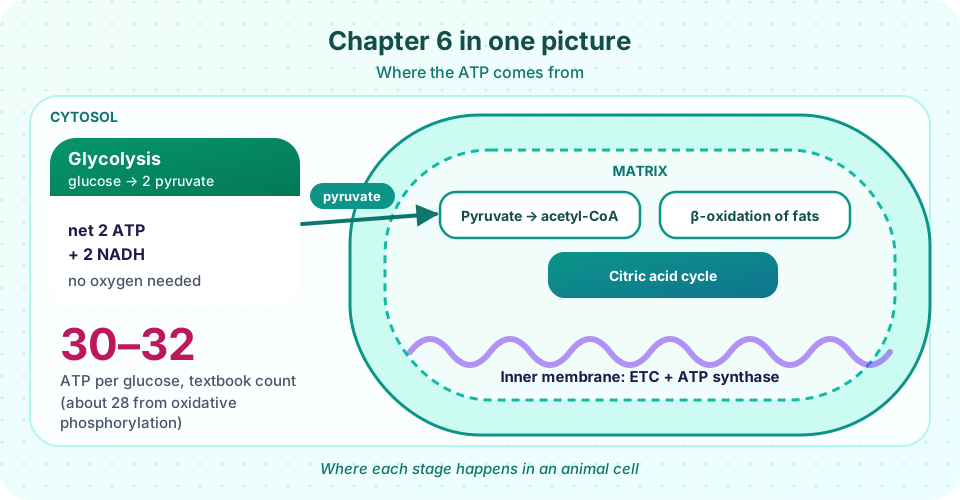
Recap table
| Topic | Key facts | Lesson |
|---|---|---|
| ATP | ΔG°′ ≈ −30.5 kJ/mol; mid-ladder phosphate donor; PEP and 1,3-BPG can make it | ATP and redox carriers |
| Carriers | NADH and FADH₂ for catabolism; NADPH for biosynthesis; CoA for acyl groups | ATP and redox carriers |
| Free energy of redox | ΔG°′ = −nFΔE°′; NADH to O₂ about −220 kJ/mol |
ATP and redox carriers |
| Glycolysis | 10 steps, net 2 ATP and 2 NADH, control at hexokinase, PFK-1, pyruvate kinase | Glycolysis |
| Citric acid cycle | Per turn: 3 NADH, 1 FADH₂, 1 GTP, 2 CO₂ | Citric acid cycle |
| Respiratory chain | Complexes I, III, IV pump H⁺; ATP synthase makes ATP | Citric acid cycle |
| Yield | About 30 to 32 ATP per glucose | Citric acid cycle |
Connecting the pathways
Flow of carbon and electrons. Carbon leaves glucose as CO₂ in two places: the pyruvate dehydrogenase step and the citric acid cycle. The electrons go to NAD⁺ and FAD, then to O₂ at complex IV. Oxygen's job is to take electrons away so the carriers can be reused.
Regulation by energy state. High ATP, NADH and citrate switch glycolysis and the cycle off; high ADP and AMP switch them on. The same ratios coordinate pathways in different compartments.
No oxygen, no problem for a while. Without oxygen, the chain stops and NADH accumulates. Fermentation regenerates NAD⁺ so that glycolysis can still make 2 ATP per glucose, which is enough for a short sprint but not for hours.
Check your understanding
Quick check · 10 questions
of 10 answered You scored / 10 · perfect!
-
1. What is the net ATP gain of glycolysis per glucose?
Two ATP are used and four are made. -
2. Which compound is the final electron acceptor in aerobic respiration?
Oxygen accepts electrons at complex IV and is reduced to water. -
3. Which products are made per turn of the citric acid cycle?
Remember 3-1-1-2: NADH, FADH₂, GTP, CO₂. -
4. Where is the electron transport chain located in eukaryotes?
The complexes and ATP synthase are embedded in the folded inner membrane. -
5. Lactate fermentation is needed in anaerobic muscle because it
Without NAD⁺, GAPDH (step 6) cannot run and glycolysis stops. -
6. ΔE°′ between NADH (−0.32 V) and O₂ (+0.82 V) is 1.14 V. What is ΔG°′ for two electrons?
ΔG°′ = −2 × 96.485 × 1.14 ≈ −220 kJ/mol. -
7. Which step of glycolysis is the main committed, regulated step?
PFK-1 is controlled by ATP, citrate, AMP and fructose 2,6-bisphosphate. -
8. Why does an uncoupler produce heat?
Oxygen use continues but the gradient's energy is released as heat. -
9. Which molecule feeds both sugar and fat breakdown into the cycle?
Acetyl-CoA collects the two-carbon units from both pathways. -
10. Why does FADH₂ yield less ATP than NADH?
Complex II pumps no protons, so FADH₂ electrons pass fewer pumping sites.
Summary
- ATP, NADH, FADH₂ and NADPH are the main currencies of metabolism.
- Glycolysis nets 2 ATP and 2 NADH; the cycle and respiratory chain finish the job in the mitochondrion.
- Oxygen is the final electron acceptor; the proton gradient makes about 30 to 32 ATP per glucose.
- Energy-state signals regulate all of these pathways.
Track your progress
Create a free account to tick off lessons and pick up where you left off on any device.
of Biochemistry lessons completed