


















Lesson 25 of 43 · Carbohydrates and Lipids
Chapter 5 review: carbohydrates and lipids
Review monosaccharides, glycosidic bonds, starch, glycogen, cellulose, fatty acids, triacylglycerols and membranes with a one-page summary and a ten-question quiz.
You have now met the two families that supply most of the energy in food and build most of the structure around cells. This review collects the big ideas on one page and then tests how well they connect. If a question is hard, jump back to the lesson named in the explanation.
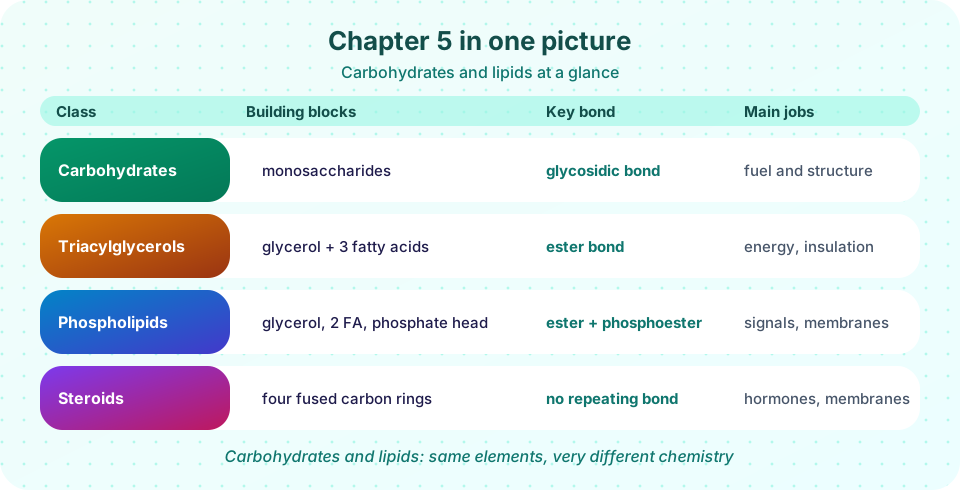
Recap table
| Topic | The key idea | Lesson |
|---|---|---|
| Sugar structure | (CH₂O)n; aldose or ketose; glucose has 16 stereoisomers (8 D) |
Monosaccharides |
| Anomers | α: C1 OH opposite CH₂OH; β: same side; 36 % α and 64 % β at equilibrium | Monosaccharides |
| Glycosidic bonds | Maltose α-1,4; lactose β-1,4; sucrose α-1,β-2 (non-reducing) | Monosaccharides |
| Starch and glycogen | α-1,4 chains; branches by α-1,6 (every 24–30 or 8–12 residues) | Polysaccharides |
| Cellulose | β-1,4; straight chains; hydrogen-bonded microfibrils; not digestible by humans | Polysaccharides |
| Fatty acids | Cis double bonds kink chains and lower melting points | Lipids |
| Triacylglycerols | Glycerol plus three fatty acids; stored dry; about 9 kcal per gram | Lipids |
| Membranes | Amphipathic lipids form bilayers because of the hydrophobic effect | Lipids |
Connecting the lessons
Three links are worth making before the quiz.
Shape decides function. α versus β at one carbon turns a digestible fuel into an indigestible structural material. In the same way, a cis versus a saturated chain decides whether a lipid is liquid or solid.
Condensation builds, hydrolysis breaks. Glycosidic bonds, ester bonds and (later) peptide bonds and phosphodiester bonds are all made by removing water and broken by adding it, usually with an enzyme.
Energy comes from oxidation. Fat is more reduced than carbohydrate, which is why it yields about 9 kcal per gram against 4. Chapter 6 shows how glucose and fatty acids are actually oxidized.
Check your understanding
Quick check · 10 questions
of 10 answered You scored / 10 · perfect!
-
1. A solution of pure α-glucose slowly changes its optical rotation. This is called
Mutarotation is the interconversion of α and β anomers through the open-chain form. -
2. Which pair of sugars are C4 epimers?
Galactose differs from glucose only at C4. Mannose is the C2 epimer; fructose is a structural isomer. -
3. Lactose is joined by which bond?
Lactose is galactose β-1,4 glucose; the other two descriptions are maltose and sucrose. -
4. What makes glycogen suited to rapid mobilization?
Each branch adds an end for glycogen phosphorylase, so many enzymes act in parallel. -
5. Humans cannot digest cellulose because we lack
Human amylases cut α-1,4 bonds only; β-1,4 bonds in cellulose need cellulases from microbes. -
6. Oleic acid is 18:1(Δ9). How many carbons and double bonds does it have?
The first number is the carbon count and the second the number of double bonds; Δ9 is the position. -
7. A triacylglycerol is stored mostly without water. What is the consequence?
Dry storage plus reduced carbon gives fat a much higher energy content per unit of tissue mass than hydrated glycogen. -
8. Why do phospholipids form bilayers spontaneously?
The hydrophobic effect drives the tails together; heads face water on both sides. -
9. Which is not a function of cholesterol?
Energy storage in droplets is the job of triacylglycerols. Cholesterol modulates membranes and gives rise to hormones and bile acids. -
10. Sucrose does not react in Benedict's test because
With both anomeric carbons used in the bond, neither ring can open to give a free carbonyl.
Summary
- Carbohydrate chemistry is set by hydroxyl positions, ring closure and the anomeric carbon.
- α and β glycosidic bonds produce digestible fuel stores and indigestible structure from the same monomer.
- Lipids are defined by hydrophobicity; fatty acid unsaturation controls packing and melting point.
- Triacylglycerols store energy compactly; phospholipids and cholesterol build membranes.
Track your progress
Create a free account to tick off lessons and pick up where you left off on any device.
of Biochemistry lessons completed