


















Lesson 8 of 43 · Water, pH and Biomolecules
pH, pKa and buffers: keeping cells at the right acidity
Learn the pH scale, weak acids and pKa, the Henderson-Hasselbalch equation, titration curves, and how phosphate and bicarbonate buffers protect cells and blood.
Change the pH of a cell by one unit and most enzymes slow down or stop. Blood pH is held between about 7.35 and 7.45; a drift to 7.0 or 7.8 is life-threatening. Cells and bodies stay within these narrow limits because they contain buffers: mixtures of a weak acid and its conjugate base that soak up added acid or base. This lesson shows how pH is defined, how buffers work, and how to calculate with the Henderson–Hasselbalch equation.
What you will learn
- Define pH and calculate it from [H⁺], and the reverse.
- Define Ka and pKa and relate them to acid strength.
- Use the Henderson–Hasselbalch equation to find pH, ratios and buffer compositions.
- Explain how phosphate and bicarbonate buffers work in cells and blood.
Key terms
pH: −log₁₀[H⁺], with concentration in mol/L.
Weak acid (HA): an acid that dissociates only partly: HA ⇌ H⁺ + A⁻.
Ka and pKa: the acid dissociation constant Ka = [H⁺][A⁻]/[HA] and pKa = −log₁₀ Ka.
Conjugate base (A⁻): what remains after the acid donates its proton.
Buffer: a solution that resists changes in pH, typically a weak acid plus its conjugate base.
pH: a logarithmic scale
The concentration of H⁺ in cells spans many orders of magnitude, so chemists use a logarithm: pH = −log₁₀[H⁺]. A solution with [H⁺] = 1 × 10⁻⁷ M has pH 7. Because the scale is logarithmic, each pH unit is a factor of 10 in [H⁺]: pH 6 has ten times more H⁺ than pH 7 and a hundred times more than pH 8.
At 25 °C, Kw = [H⁺][OH⁻] = 10⁻¹⁴, so pH + pOH = 14. Some typical values (approximate): gastric juice 1.5 to 3.5, lysosomes about 4.5 to 5, cytosol about 7.2, blood 7.4, mitochondrial matrix about 7.8 to 8.
Worked example. What is the pH of 0.02 M HCl (a strong acid, fully dissociated)? [H⁺] = 0.02 = 2 × 10⁻² M, so pH = −log₁₀(0.02) = 1.70.
Weak acids, Ka and pKa
Most acids in biochemistry (carboxylic acids, phosphoric acid, protonated amines) are weak: they donate H⁺ only partially. Their strength is measured by Ka. Taking −log₁₀ of the Ka expression and rearranging gives the Henderson–Hasselbalch equation:
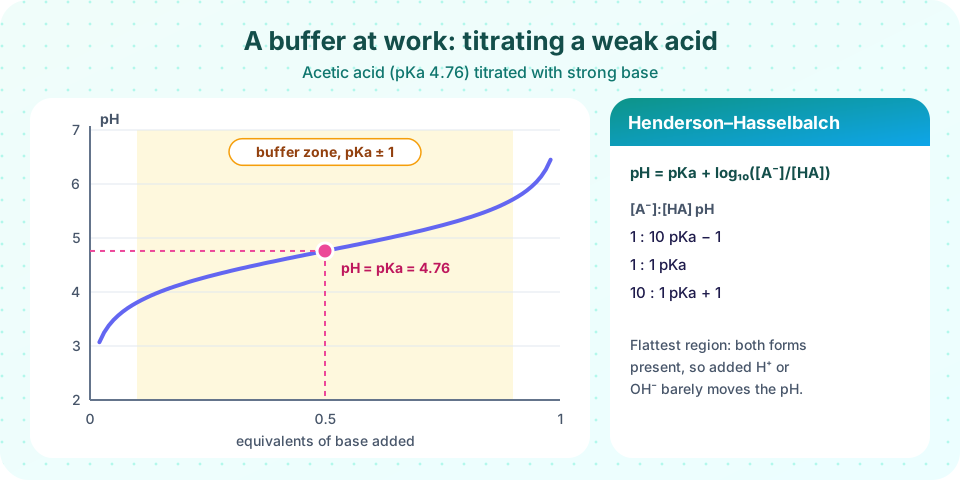
pH = pKa + log₁₀([A⁻] / [HA])
Read it like a dial. When [A⁻] = [HA] the log term is zero and pH = pKa. If the pH is one unit above the pKa, the base form is ten times the acid form; one unit below, the acid form is ten times the base. A group is therefore mostly protonated below its pKa and mostly deprotonated above it. This is how you decide the charge of an amino acid side chain at a given pH (chapter 3).
| Acid / conjugate base | pKa (25 °C, approximate) |
|---|---|
| Acetic acid / acetate | 4.76 |
| H₂PO₄⁻ / HPO₄²⁻ | 6.86 |
| CO₂ + H₂O / HCO₃⁻ (apparent, in blood) | 6.1 |
| NH₄⁺ / NH₃ | 9.25 |
How a buffer works
A buffer works because both components are present. If acid is added, the conjugate base A⁻ consumes it: A⁻ + H⁺ → HA. If base is added, HA donates protons: HA + OH⁻ → A⁻ + H₂O. The ratio [A⁻]/[HA] changes only a little, and because pH depends on the logarithm of the ratio, the pH barely moves.
Worked example. A buffer is made from 0.05 M acetic acid and 0.05 M sodium acetate (pH = 4.76). Add 0.01 mol of HCl to one litre:
- A⁻ falls to 0.04 M; HA rises to 0.06 M.
pH = 4.76 + log₁₀(0.04/0.06) = 4.76 − 0.18 = 4.58.
The pH moved by 0.18 units. The same 0.01 mol of HCl in a litre of unbuffered water would give [H⁺] = 0.01 M, pH 2.0, a change of 5 units.
A buffer is most effective within about one pH unit of its pKa, where both forms are present in substantial amounts; its capacity (how much acid or base it absorbs) grows with the total concentration.
Worked example: making a buffer. To prepare 1 L of 0.1 M phosphate buffer at pH 7.2 (using pKa 6.86): [HPO₄²⁻]/[H₂PO₄⁻] = 10^(7.2 − 6.86) = 10^0.34 = 2.19. Then [HPO₄²⁻] = 0.1 × 2.19/3.19 = 0.069 M and [H₂PO₄⁻] = 0.031 M.
Buffers in living systems
- Phosphate buffer (pKa 6.86) is important inside cells, where the pH is about 7.2. It is also the basis of many laboratory buffers.
- Bicarbonate buffer is the main buffer of blood plasma. CO₂ from respiration dissolves and forms carbonic acid, which dissociates to bicarbonate. Using the apparent pKa of 6.1, with
[HCO₃⁻] = 24 mMand[CO₂] = 0.03 × pCO₂ = 0.03 × 40 = 1.2 mM:pH = 6.1 + log₁₀(24/1.2) = 6.1 + 1.30 = 7.40. The system is unusually powerful because the lungs control CO₂ and the kidneys control bicarbonate. - Proteins buffer too: histidine side chains (pKa about 6) in hemoglobin absorb protons.
Common misconceptions
"Every cell compartment sits at pH 7." Lysosomes are acidic (about 4.5 to 5), the stomach is far more acidic, and the mitochondrial matrix is slightly basic. These differences are used by enzymes and transporters.
"A buffer stops pH from changing." It limits the change. Beyond its capacity, or far from its pKa, pH changes sharply.
"A drop of 1 pH unit means a little more acid." It means ten times more H⁺.
Try it
The first demonstration is a Henderson–Hasselbalch dial. Move the pKa and the pH sliders and watch the fractions of acid and base forms. It applies the equation and nothing else.
The second example compares what happens to a buffer and to water when strong acid is added. It uses exact equilibrium relations, so it also shows where the buffer finally fails.
Press Run (or Ctrl + Enter) to see the result here.
Program input · what you'd type while the program runs
Type the answers before you press Run, one per line. Each time the program reads a line (with input()), it gets the next line from this box.
Check your understanding
Quick check · 6 questions
of 6 answered You scored / 6 · perfect!
-
1. A solution has [H+] = 1 × 10^-3 M. Its pH is:
pH = -log10(10^-3) = 3. -
2. When pH equals pKa, the ratio [A-]/[HA] is:
From pH = pKa + log([A-]/[HA]), the log is zero when the ratio is 1. -
3. Solution A has pH 5 and solution B has pH 7. Compared with B, A has:
Two pH units is a factor of 10^2 = 100. -
4. Which buffer is best for holding a solution near pH 7.2?
A buffer works best within one unit of its pKa; 6.86 is the closest to 7.2. -
5. Blood has [HCO3-] = 24 mM and dissolved CO2 = 1.2 mM; apparent pKa 6.1. What is the pH?
pH = 6.1 + log(24/1.2) = 6.1 + log 20 = 6.1 + 1.30 = 7.40. -
6. A buffer's capacity increases when:
Higher concentrations of acid and base forms can absorb more added H+ or OH-.
Summary
pH = −log₁₀[H⁺]; each unit is a tenfold change in [H⁺].- Weak acids have a pKa;
pH = pKa + log([A⁻]/[HA]), and pH = pKa when the two forms are equal. - A buffer resists pH change within about one unit of its pKa; capacity grows with concentration.
- Phosphate and bicarbonate buffers keep cells near pH 7.2 and blood near 7.4.
Next: Chapter 2 review
Track your progress
Create a free account to tick off lessons and pick up where you left off on any device.
of Biochemistry lessons completed