


















Lesson 19 of 43 · Enzymes and Kinetics
Enzyme inhibition, regulation, pH, temperature and cofactors
Compare competitive, uncompetitive and noncompetitive inhibition, irreversible inhibitors, allosteric and feedback control, and the effects of pH, temperature and cofactors.
Cells need to turn enzymes up and down, and medicine often works by doing exactly that. Statins slow cholesterol synthesis, aspirin reduces inflammation and penicillin stops bacteria building cell walls, all by inhibiting enzymes. Cells use the same logic to regulate their own metabolism. This lesson covers the main kinds of inhibition, how to recognize them on kinetic plots, and the other levers that control enzyme activity.
What you will learn
- Distinguish competitive, uncompetitive, noncompetitive and mixed inhibition by mechanism and effect on Km and Vmax.
- Interpret Lineweaver–Burk plots with inhibitors.
- Explain irreversible inhibition, allosteric control and feedback inhibition.
- Describe how pH, temperature and cofactors affect enzymes.
Key terms
Ki: the dissociation constant of the enzyme-inhibitor complex; a small Ki means a potent inhibitor.
Apparent Km, Vmax: the values measured in the presence of an inhibitor.
Allosteric enzyme: an enzyme regulated by effectors binding at sites other than the active site, often with sigmoidal kinetics.
Feedback inhibition: an end product of a pathway inhibits an early enzyme of that pathway.
Cofactor / coenzyme: a nonprotein helper (metal ion or small organic molecule) needed for activity.
Reversible inhibitors
Reversible inhibitors bind noncovalently and can dissociate, so their effect is lessened by dilution. Define α = 1 + [I]/Ki and α' = 1 + [I]/Ki' (Ki' is for binding to the ES complex).
| Type | Binds to | Mechanism | Apparent Km | Apparent Vmax |
|---|---|---|---|---|
| Competitive | free enzyme E | competes with substrate for the active site | increases (α Km) | unchanged |
| Uncompetitive | ES complex only | binds only after substrate; locks ES | decreases (Km/α') | decreases (Vmax/α') |
| Noncompetitive (pure) | E and ES equally | binds elsewhere; enzyme cannot turn over | unchanged | decreases (Vmax/α) |
| Mixed | E and ES with different affinity | general case | changes (α Km/α') | decreases (Vmax/α') |
The rate equations follow from the Michaelis–Menten equation:
- Competitive:
v = Vmax[S] / (α Km + [S]) - Uncompetitive:
v = Vmax[S] / (Km + α'[S]) - Noncompetitive:
v = (Vmax/α)[S] / (Km + [S])
Competitive inhibition is overcome by adding more substrate, since at high [S] the substrate outcompetes the inhibitor: Vmax is unchanged. Classic examples are malonate versus succinate for succinate dehydrogenase, statins competing with HMG-CoA at HMG-CoA reductase, and methotrexate at dihydrofolate reductase. Many drugs are competitive inhibitors that resemble the substrate or the transition state.
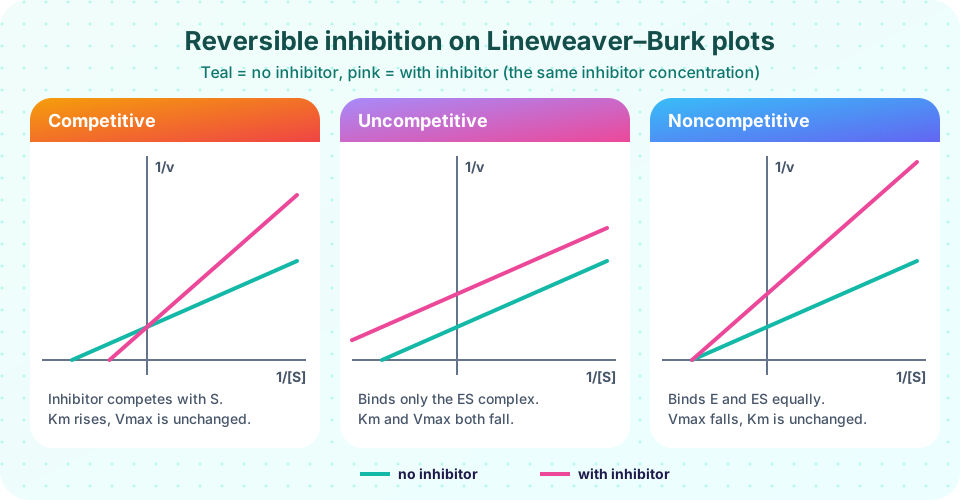
On a Lineweaver–Burk plot (see the picture above), competitive inhibition gives lines that meet on the y-axis (same Vmax); uncompetitive gives parallel lines; noncompetitive gives lines that meet on the x-axis (same Km).
Worked example. An enzyme has Km = 2 mM and Vmax = 100 µmol/min. A competitive inhibitor at [I] = Ki gives α = 2, so the apparent Km is 4 mM. At [S] = 2 mM the rate drops from 50 to 100 × 2/(4 + 2) = 33.3 µmol/min. At very high [S] the rate climbs back toward 100.
Irreversible inhibitors
Irreversible (or covalent) inhibitors form a stable covalent bond with the enzyme and permanently remove active enzyme: Vmax falls in proportion to the amount inactivated, and dilution does not restore activity. Aspirin acetylates a serine residue in cyclooxygenase, blocking prostaglandin synthesis. Penicillin acylates the active-site serine of the bacterial transpeptidase that cross-links cell walls. Many nerve agents and pesticides covalently modify the active-site serine of acetylcholinesterase. This information is educational and not medical advice.
Regulation inside the cell
Cells combine several mechanisms to tune enzyme activity:
- Allosteric regulation. Effectors bind away from the active site and shift the enzyme between low- and high-activity forms. Allosteric enzymes often show sigmoidal kinetics (like hemoglobin) with a half-saturation constant K₀.₅ instead of Km. Phosphofructokinase-1 in glycolysis, for instance, is inhibited by ATP and citrate and activated by AMP.
- Feedback inhibition. The end product of a pathway inhibits an early step, so the cell stops making what it has enough of. Aspartate transcarbamoylase, an early enzyme of pyrimidine synthesis, is inhibited by CTP, an end product.
- Covalent modification. Phosphorylation by kinases (and removal by phosphatases) switches enzymes on or off, as in glycogen phosphorylase.
- Zymogens. Some enzymes are made inactive and activated by cutting: chymotrypsinogen becomes chymotrypsin when trypsin cleaves it, which protects the pancreas from self-digestion.
- Enzyme amount. Gene expression and protein degradation change the quantity of enzyme, and hence Vmax.
pH, temperature and cofactors
pH. Each enzyme has a pH optimum because the ionization state of active-site residues and the protein's structure depend on pH. Pepsin in the stomach works best near pH 2; trypsin in the small intestine near pH 8; most intracellular enzymes near 7 to 8.
Temperature. Rates rise with temperature (roughly doubling per 10 °C for many reactions) until the protein starts to denature, then activity drops sharply, giving a bell-shaped curve with an optimum. Human enzymes typically have optima near 37 °C. Enzymes from heat-loving microbes, such as Taq polymerase used in PCR, work at 70 °C or higher.
Cofactors. Many enzymes need a nonprotein partner. Metal ions (Zn²⁺ in carbonic anhydrase, Mg²⁺ with ATP, Fe in heme enzymes) assist in binding or catalysis. Coenzymes are small organic molecules, often derived from vitamins, that carry chemical groups or electrons: NAD⁺ (from niacin), FAD (riboflavin, vitamin B₂), coenzyme A (pantothenic acid), thiamine pyrophosphate (thiamine, B₁), pyridoxal phosphate (B₆) and biotin. An enzyme without its cofactor is called an apoenzyme; with it, a holoenzyme.
Common misconceptions
"A noncompetitive inhibitor binds the active site." It binds elsewhere, and substrate can still bind. It lowers the catalytic capacity, so Vmax falls.
"More substrate overcomes any inhibitor." Only competitive inhibition is overcome by high substrate. Uncompetitive and noncompetitive inhibition still reduce Vmax.
"Higher temperature always makes enzymes work faster." Speed rises until denaturation, then collapses.
Try it
The first example computes rate curves for the three inhibitor types at [I]/Ki = 1 (so α = 2) and prints the apparent parameters.
Press Run (or Ctrl + Enter) to see the result here.
Program input · what you'd type while the program runs
Type the answers before you press Run, one per line. Each time the program reads a line (with input()), it gets the next line from this box.
The second example is an interactive explorer. Pick the type of inhibition and change [I]/Ki; the graph shows how the rate curve moves.
Check your understanding
Quick check · 6 questions
of 6 answered You scored / 6 · perfect!
-
1. A competitive inhibitor changes Km and Vmax how?
The inhibitor competes for the active site, so more substrate is needed (higher apparent Km), but high [S] restores Vmax. -
2. Parallel lines on a Lineweaver-Burk plot indicate:
Uncompetitive inhibition lowers Km and Vmax by the same factor, so the slope Km/Vmax is unchanged. -
3. Noncompetitive inhibition shows lines meeting at the:
Km is unchanged, so the x-intercept -1/Km is the same. -
4. How does aspirin inhibit cyclooxygenase?
Aspirin is an irreversible inhibitor that acetylates a serine residue in COX. -
5. Feedback inhibition usually targets:
End products inhibit an early (often committed) step, shutting down the whole pathway. -
6. Where does the pH optimum of pepsin lie?
Pepsin works in the acidic stomach with an optimum near pH 2.
Summary
- Reversible inhibitors: competitive (Km up), uncompetitive (both down), noncompetitive (Vmax down), mixed.
- Lineweaver–Burk fingerprints: lines meeting on the y-axis, parallel lines, lines meeting on the x-axis.
- Irreversible inhibitors modify the enzyme covalently; many drugs act this way or as transition-state analogs.
- Cells regulate enzymes by allostery, feedback, covalent modification, zymogens and enzyme amount; pH, temperature and cofactors also shape activity.
Next: Chapter 4 review
Track your progress
Create a free account to tick off lessons and pick up where you left off on any device.
of Biochemistry lessons completed