


















Lesson 2 of 43 · Getting Started
The chemistry of life: elements, molecules and cells
Meet the elements and functional groups of life, the four classes of biomolecules, and the cell compartments where biochemical reactions take place.
Take a living cell apart and you find nothing exotic: the same atoms as in rocks, air and water, arranged in unusual ways. What is special is the arrangement. A few elements, a handful of bond types and four families of molecules build everything from a bacterium to a blue whale. This lesson gives you the inventory and the logic behind it.
What you will learn
- Which elements dominate living matter and why carbon is the backbone.
- The common functional groups and how they change a molecule's behavior.
- The four classes of biomolecules and how monomers join into polymers.
- Where in the cell different biochemical processes happen.
Key terms
Functional group: a small group of atoms (such as -OH or -COOH) that gives a molecule characteristic reactions and properties.
Monomer: a small building block; polymer: a chain of many monomers.
Condensation (dehydration) reaction: joins two molecules and releases a water molecule.
Hydrolysis: splits a bond by adding water.
Organelle: a membrane-bound compartment inside a eukaryotic cell.
The elements of life
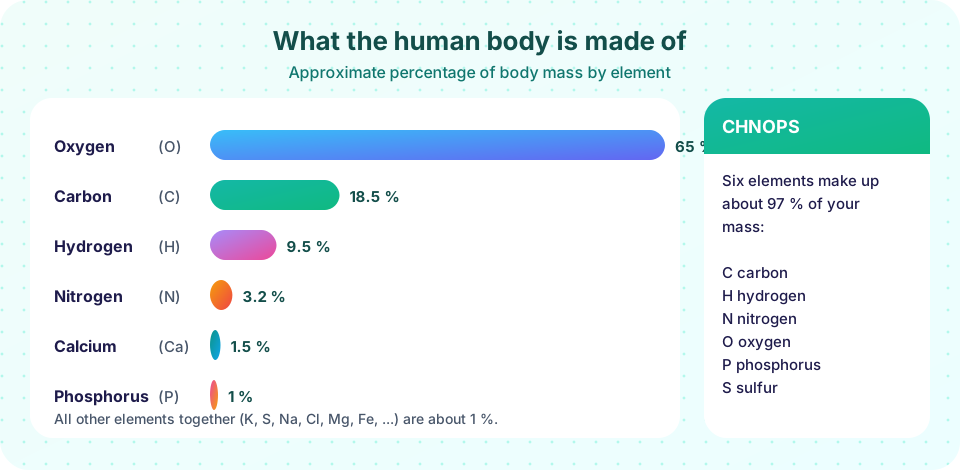
Oxygen is the most abundant element in the body by mass, mostly because the body is about 60 percent water by mass in adults (the figure varies with age and body composition). Counting atoms rather than mass, hydrogen leads. Six elements, abbreviated CHNOPS (carbon, hydrogen, nitrogen, oxygen, phosphorus, sulfur), make up roughly 97 percent of body mass.
- Carbon forms the skeleton of every organic molecule.
- Hydrogen and oxygen appear in water and in almost every functional group.
- Nitrogen occurs in amino acids, nucleotides and many cofactors.
- Phosphorus is in nucleic acids, ATP and membrane phospholipids.
- Sulfur appears in two amino acids (cysteine and methionine) and in coenzyme A.
Smaller amounts matter hugely: calcium for bones and signaling, sodium, potassium and chloride for electrical signaling, magnesium for ATP-using enzymes, iron in hemoglobin and zinc in many enzymes.
Why carbon?
A carbon atom has four valence electrons, so it forms four covalent bonds, in tetrahedral geometry when all four are single bonds. Carbon-carbon bonds are strong (about 346 kJ/mol for a single bond) yet can be broken by enzymes at body temperature. Carbon can also form chains, branches, rings and double bonds. No other element offers this mix of stability and variety under watery conditions. Silicon, its neighbor in the periodic table, forms weaker Si-Si bonds and unstable chains in water.
Functional groups
Most biomolecules are a carbon skeleton decorated with a few repeating groups. Learn these seven and you can read most structures.
| Group | Formula | Properties and examples |
|---|---|---|
| Hydroxyl | -OH |
Polar, forms hydrogen bonds; alcohols, sugars |
| Carbonyl | C=O |
Polar; aldehydes (end of chain) and ketones (inside chain) |
| Carboxyl | -COOH |
Acidic; loses H⁺ to give -COO⁻; amino acids, fatty acids |
| Amino | -NH₂ |
Basic; gains H⁺ to give -NH₃⁺; amino acids |
| Phosphate | -OPO₃²⁻ |
Negatively charged; ATP, DNA, phospholipids |
| Sulfhydryl | -SH |
Forms disulfide bonds (-S-S-); cysteine |
| Methyl | -CH₃ |
Nonpolar; marks DNA and proteins (methylation) |
Polarity matters because the rest of the course keeps returning to one rule: polar groups mix with water, nonpolar groups avoid it. A group that can gain or lose a proton changes its charge with pH (lesson 4 of chapter 2).
Four classes of biomolecules
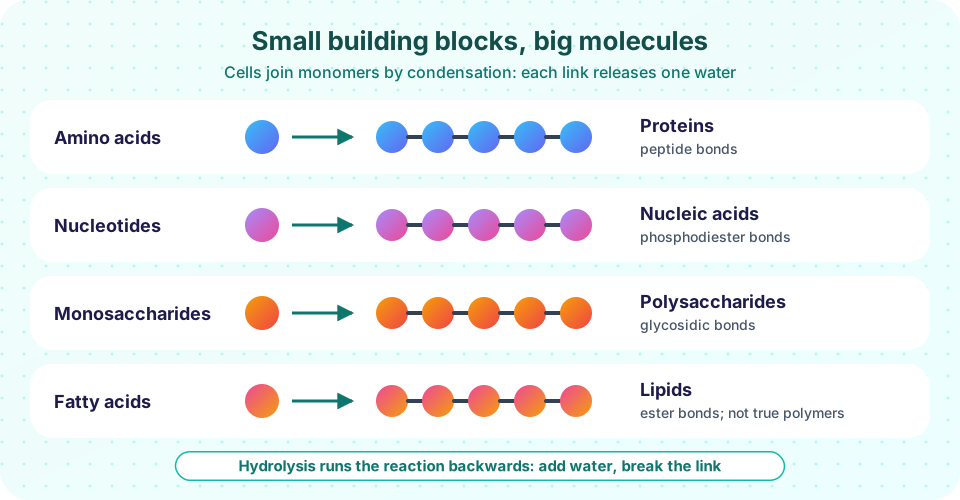
Cells build large molecules from a short list of small ones.
| Class | Monomer | Linkage | Main roles |
|---|---|---|---|
| Proteins | amino acids | peptide bond | catalysis, structure, transport, signaling |
| Nucleic acids | nucleotides | phosphodiester bond | information storage and transfer |
| Carbohydrates | monosaccharides | glycosidic bond | energy, structure, recognition |
| Lipids | fatty acids, glycerol and others | ester bond (in many) | membranes, energy storage, hormones |
The assembly reaction in each case is a condensation: a hydroxyl from one monomer and a hydrogen from another leave as H₂O. The reverse, hydrolysis, uses water to break the link. Digestion is largely hydrolysis, and building the same molecules in cells needs energy because condensation in water is uphill.
The cell as a chemical factory
Cells fall into two broad types. Prokaryotes (bacteria and archaea) lack a nucleus and are typically 1 to 10 µm long. Eukaryotes (animals, plants, fungi, protists) have a membrane-bound nucleus and organelles and are typically 10 to 100 µm. Location matters because each compartment keeps its own conditions and reactions.
| Compartment | Typical biochemical role |
|---|---|
| Cytosol | glycolysis, many biosynthetic reactions |
| Nucleus | DNA storage, replication, transcription |
| Ribosomes | translation (protein synthesis) |
| Rough ER and Golgi | protein folding, modification and sorting |
| Mitochondria | citric acid cycle, oxidative phosphorylation |
| Lysosomes | hydrolytic breakdown of macromolecules |
| Chloroplasts (plants, algae) | photosynthesis |
A rough composition of a bacterium such as E. coli: about 70 percent water, about 15 percent protein, about 6 percent RNA, with the remainder split among lipids, polysaccharides, DNA and small molecules. These are approximate, and they change with growth conditions.
Common misconceptions
"Condensation adds water." The opposite: condensation releases a water molecule as two monomers join. Hydrolysis adds water to split them.
"Carbon is special because it is abundant." Carbon is not the most common element in the Earth's crust. Its importance comes from its bonding: four stable bonds, long chains and rings.
"Only proteins matter." Proteins do most of the work, but nucleic acids carry the instructions, lipids form the membranes and carbohydrates supply fuel and structure. Life depends on all four classes.
Try it
The first example summarizes cell composition. The numbers are approximate textbook-style values for a growing bacterium, shown as a chart so you can see how dominant water is.
Press Run (or Ctrl + Enter) to see the result here.
Program input · what you'd type while the program runs
Type the answers before you press Run, one per line. Each time the program reads a line (with input()), it gets the next line from this box.
The second example is a molar mass calculator. It shows that a condensation reaction really does lose water: two glucose molecules form maltose and one H₂O.
Press Run (or Ctrl + Enter) to see the console output here.
No output.
Check your understanding
Quick check · 5 questions
of 5 answered You scored / 5 · perfect!
-
1. What do the letters in CHNOPS stand for?
CHNOPS is a mnemonic for carbon, hydrogen, nitrogen, oxygen, phosphorus and sulfur. -
2. Which functional group is acidic and loses a proton at physiological pH?
The carboxyl group, -COOH, donates H+ to become -COO-. The amino group is the basic one. -
3. What happens in a condensation reaction?
Condensation (dehydration) joins monomers and releases H2O. Adding water to split a bond is hydrolysis. -
4. Which bond links amino acids in a protein?
Amino acids are joined by peptide bonds, a covalent amide linkage. Hydrogen bonds are weak and shape folding, not the backbone. -
5. Why is carbon well suited as the backbone of biomolecules?
Carbon's four bonds and strong, yet breakable, C-C bonds give an enormous variety of stable structures.
Summary
- CHNOPS elements make up about 97 percent of body mass; carbon is the structural backbone.
- Hydroxyl, carbonyl, carboxyl, amino, phosphate, sulfhydryl and methyl groups explain most biochemical behavior.
- Four classes of biomolecules: proteins, nucleic acids, carbohydrates and lipids. Monomers join by condensation and polymers are split by hydrolysis.
- Eukaryotic cells divide labor among compartments: nucleus, mitochondria, ER, cytosol and others.
Next: Energy and free energy
Track your progress
Create a free account to tick off lessons and pick up where you left off on any device.
of Biochemistry lessons completed