


















Lesson 22 of 43 · Carbohydrates and Lipids
Monosaccharides and glycosidic bonds
Learn what a sugar is, how glucose forms alpha and beta rings, why mutarotation happens, and how glycosidic bonds join sugars into maltose, lactose and sucrose.
Glucose is the most important sugar in biology: your brain runs mostly on it, plants make it from carbon dioxide, and it is the building block of starch, glycogen and cellulose. This lesson shows you how to read a sugar's structure, why one molecule can exist in two ring forms, and how a single bond type links sugars together.
What you will learn
- Classify a sugar as an aldose or ketose and as a triose, pentose or hexose.
- Explain D and L, epimers and why an aldohexose has 16 stereoisomers.
- Draw how the ring closes and tell α from β anomers.
- Describe mutarotation and what makes a sugar "reducing".
- Name the bond in maltose, lactose and sucrose.
Key terms
Monosaccharide: a single sugar unit, general formula (CH₂O)n with n from 3 to 7 in nature.
Aldose / ketose: a sugar whose carbonyl group is an aldehyde (at C1) / a ketone (usually at C2).
Anomer: one of two ring forms that differ only in the configuration at the new stereocenter, the anomeric carbon.
Glycosidic bond: the covalent bond between the anomeric carbon of one sugar and an oxygen (or nitrogen) of another molecule.
Reducing sugar: a sugar with a free anomeric carbon that can open to the aldehyde form and reduce mild oxidants.
Sugars by carbon count and carbonyl position
The name tells you the structure. A sugar with an aldehyde is an aldose; one with a ketone is a ketose. Add the carbon count: triose (3), tetrose (4), pentose (5), hexose (6). Glucose is an aldohexose. Fructose, the sweet sugar of fruit and honey, is a ketohexose with the same formula, C₆H₁₂O₆, but a different arrangement of atoms (a structural isomer). Ribose, in RNA, is an aldopentose. Dihydroxyacetone phosphate and glyceraldehyde 3-phosphate, which you will meet in glycolysis, are a ketotriose and an aldotriose.
Stereochemistry: D, L and epimers
In an aldose with n carbons, the carbons from C2 to C(n−1) are stereocenters. Glucose has four (C2, C3, C4, C5), so there are 2⁴ = 16 aldohexose stereoisomers: eight D and eight L. The D or L label comes from the stereocenter farthest from the carbonyl (C5 in a hexose), compared with D- or L-glyceraldehyde. Nearly all sugars in your body are D-sugars.
Two sugars that differ at exactly one stereocenter are epimers. Galactose is the C4 epimer of glucose; mannose is the C2 epimer. One flipped hydroxyl is enough for enzymes to treat them differently: a deficiency of an enzyme that processes galactose causes the inherited disease galactosemia.
Ring closure and anomers
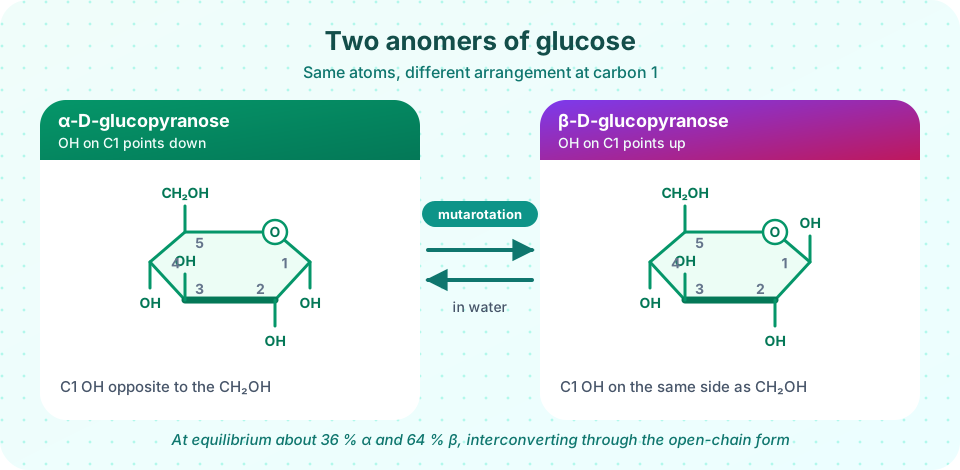
In water, glucose spends almost all its time as a ring. The hydroxyl on C5 attacks the aldehyde carbon (C1), forming a hemiacetal and a six-membered ring called a pyranose. Ring closure creates a new stereocenter at C1, the anomeric carbon, so two forms exist:
- α-D-glucopyranose: the C1 hydroxyl is on the opposite face from the CH₂OH group (drawn down in a Haworth projection).
- β-D-glucopyranose: the C1 hydroxyl is on the same face as the CH₂OH group (drawn up).
At equilibrium in water, about 36 % is α and 64 % is β, with only a tiny fraction in the open-chain form. β is favored because in the chair conformation all its bulky groups can sit in equatorial positions, which reduces crowding.
Fructose usually closes a five-membered furanose ring using its C2 ketone and C5 hydroxyl. Ribose and deoxyribose in nucleic acids are furanoses too.
Mutarotation and reducing sugars
Dissolve pure α-glucose crystals in water and the optical rotation of the solution slowly drifts to a steady value. That drift, called mutarotation, is the ring opening and re-closing until the α/β mixture reaches equilibrium. The open-chain form is the doorway between the two anomers.
The open chain also has a free aldehyde. A sugar that can open this way is a reducing sugar: it reduces Cu²⁺ to Cu⁺ in Benedict's test, the old way to detect glucose in urine. A sugar locked in a ring by a glycosidic bond at its anomeric carbon cannot open and does not react.
Glycosidic bonds: joining sugars
Two sugars are joined when the anomeric hydroxyl of one reacts with a hydroxyl of another, releasing water. The result is a glycosidic bond, named by the anomeric configuration and the carbons joined.
| Disaccharide | Units | Bond | Reducing? |
|---|---|---|---|
| Maltose | glucose + glucose | α-1,4 | yes |
| Lactose | galactose + glucose | β-1,4 | yes |
| Sucrose | glucose + fructose | α-1,β-2 | no |
Sucrose is not reducing because the bond ties up the anomeric carbons of both sugars. Lactase cleaves the β-1,4 bond of lactose; in most mammals the gene is switched down after weaning, which is why many adults are lactose intolerant.
Sugars are also modified: amino sugars such as N-acetylglucosamine (in chitin and bacterial cell walls), sugar acids such as glucuronic acid, and deoxy sugars such as deoxyribose (no hydroxyl at C2) are all derivatives of the basic scheme.
Common misconceptions
"Glucose is a six-carbon straight chain." In water it is almost entirely a ring. The open chain is the rare, reactive form.
"α and β are different molecules, like glucose and fructose." They are two forms of the same sugar that convert into each other in solution.
"All sugars are sweet and soluble." Many polysaccharides are tasteless and insoluble; sweetness is a property of small sugars binding a taste receptor.
Try it
A first look at stereoisomers and molar masses. This code counts stereocenters and adds atomic masses, so you can check a formula by hand.
Press Run (or Ctrl + Enter) to see the result here.
Program input · what you'd type while the program runs
Type the answers before you press Run, one per line. Each time the program reads a line (with input()), it gets the next line from this box.
The next plot shows mutarotation as an approach to equilibrium. The rate constant is arbitrary (the time axis is in arbitrary units), but the endpoint, 36 % α, is the real equilibrium composition.
Press Run (or Ctrl + Enter) to see the result here.
Program input · what you'd type while the program runs
Type the answers before you press Run, one per line. Each time the program reads a line (with input()), it gets the next line from this box.
Check your understanding
Quick check · 4 questions
of 4 answered You scored / 4 · perfect!
-
1. How many stereoisomers does an aldohexose such as glucose have?
An aldohexose has four stereocenters (C2 to C5), so 2^4 = 16 stereoisomers, eight D and eight L. -
2. Galactose is to glucose as
Galactose is the C4 epimer of glucose: the two sugars differ at exactly one stereocenter, C4. -
3. Why is sucrose a non-reducing sugar?
In sucrose both anomeric carbons are tied up in the α-1,β-2 bond, so neither ring can open to a free aldehyde or ketone. -
4. What does mutarotation describe?
Mutarotation is the slow ring opening and re-closing that brings α and β anomers to their equilibrium mixture.
Summary
- Sugars are classified by carbonyl type (aldose or ketose) and carbon count.
- Glucose has 16 aldohexose stereoisomers; epimers differ at one stereocenter.
- Ring closure creates the anomeric carbon and the α and β forms; at equilibrium about 36 % are α and 64 % are β.
- A sugar with a free anomeric carbon is reducing; a glycosidic bond at that carbon removes the property.
- Maltose (α-1,4), lactose (β-1,4) and sucrose (α-1,β-2) show how bond type and sugar identity make different disaccharides.
Track your progress
Create a free account to tick off lessons and pick up where you left off on any device.
of Biochemistry lessons completed