


















Lesson 29 of 43 · Metabolism and Bioenergetics
The citric acid cycle and oxidative phosphorylation
Follow acetyl-CoA through the citric acid cycle, see how NADH feeds the electron transport chain, and learn how the proton gradient drives ATP synthase and sets the ATP yield.
Glycolysis rescued only a small part of glucose's energy. Most of it is still sitting in the bonds of pyruvate. In the mitochondrion, pyruvate is oxidized completely to carbon dioxide, and the electrons it loses are handed to oxygen through a chain of protein complexes that pump protons. The resulting gradient drives ATP synthase, one of the most elegant machines in biology.
What you will learn
- Describe the pyruvate dehydrogenase step and each turn of the citric acid cycle.
- Account for the carbon atoms and the carriers produced per turn.
- Explain the electron transport chain, the proton gradient and ATP synthase.
- Calculate ATP yield per glucose and name classic inhibitors and uncouplers.
Key terms
Citric acid (Krebs, TCA) cycle: the eight-step matrix cycle that oxidizes acetyl-CoA to two CO₂.
Electron transport chain: protein complexes in the inner membrane that pass electrons from NADH and FADH₂ to O₂.
Proton-motive force: the energy stored in the H⁺ concentration difference and the voltage across the inner membrane.
Chemiosmotic coupling: Peter Mitchell's idea that a proton gradient links electron transport to ATP synthesis.
Uncoupler: a compound or protein that lets protons leak back so the energy is lost as heat.
From pyruvate to acetyl-CoA
Pyruvate crosses into the matrix and is converted by the pyruvate dehydrogenase complex to acetyl-CoA, CO₂ and NADH (one NADH per pyruvate, two per glucose). This step is irreversible, which is why animals cannot turn fat back into glucose. It is inhibited by its products, acetyl-CoA and NADH.
The citric acid cycle
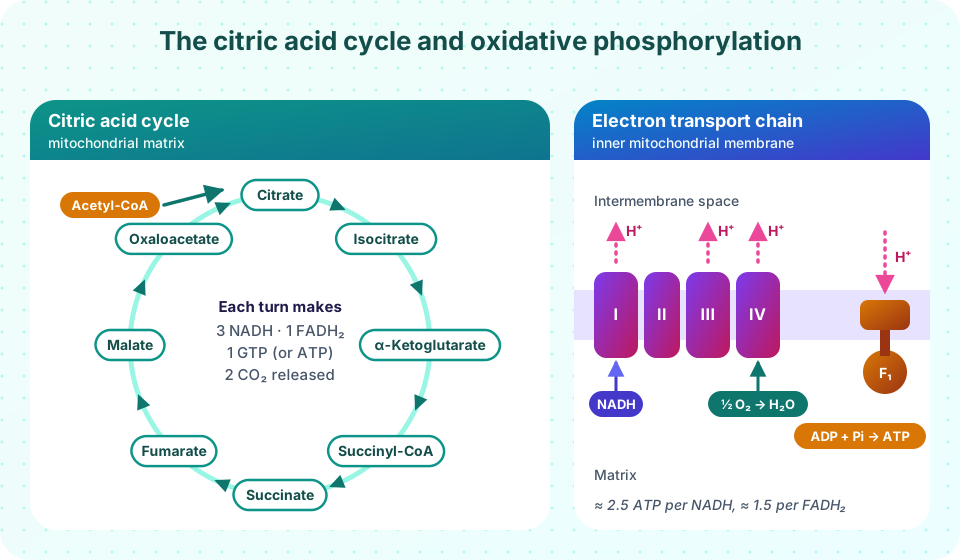
Acetyl-CoA (two carbons) combines with oxaloacetate (four carbons) to give citrate (six carbons). Over the next steps two carbons leave as CO₂ and oxaloacetate is regenerated, so the cycle can turn again. Each turn gives:
- 3 NADH (isocitrate dehydrogenase, α-ketoglutarate dehydrogenase and malate dehydrogenase),
- 1 FADH₂ (succinate dehydrogenase, which is also respiratory complex II),
- 1 GTP (succinyl-CoA synthetase; a substrate-level phosphorylation, interchangeable with ATP),
- 2 CO₂.
One glucose gives two acetyl-CoA, so two turns. The carbons leaving as CO₂ are not the two acetyl carbons of that turn but come from oxaloacetate; the acetyl carbons are lost in later turns. The cycle is controlled mostly by the energy state: ATP and NADH inhibit isocitrate dehydrogenase, while ADP and Ca²⁺ stimulate dehydrogenases, so the cycle speeds up when ATP is needed. Intermediates are also drained for biosynthesis (citrate for fatty acids, α-ketoglutarate for amino acids) and must be refilled, which is why the cycle is described as a hub, not just a furnace.
The electron transport chain
Four complexes sit in the inner membrane, together with two mobile carriers: ubiquinone (coenzyme Q) in the membrane and cytochrome c in the intermembrane space.
| Complex | Name | Protons pumped per 2 e⁻ |
|---|---|---|
| I | NADH dehydrogenase | 4 |
| II | Succinate dehydrogenase | 0 |
| III | Cytochrome bc₁ | 4 |
| IV | Cytochrome c oxidase | 2 |
NADH gives its electrons to complex I; FADH₂ feeds in at complex II. Both pass them to ubiquinone, then complex III, cytochrome c and complex IV, where oxygen is reduced to water. Electrons move to carriers with steadily higher reduction potential, and the released energy is used to pump H⁺ from the matrix to the intermembrane space. NADH electrons thus pass three pumping sites and FADH₂ electrons only two, which is why NADH yields more ATP.
ATP synthase
The inner membrane is nearly impermeable to H⁺, so the gradient, both a pH difference and a voltage, stores the proton-motive force. ATP synthase has a membrane-embedded F₀ part, a ring of c subunits through which protons flow, and a catalytic F₁ part in the matrix. Proton flow rotates the ring and a central stalk, and the rotation forces the three catalytic sites of F₁ to cycle through binding ADP and Pi, forming ATP, and releasing it. Paul Boyer and John Walker shared part of the 1997 Nobel Prize in Chemistry for this mechanism; Peter Mitchell received the 1978 prize for chemiosmotic theory.
The mitochondrion also exchanges ATP for ADP across the inner membrane (the ATP/ADP translocase) and imports phosphate, which costs part of the gradient.
Counting ATP
With about 10 protons pumped per NADH, about 6 per FADH₂, and a cost of roughly 4 protons per ATP made and exported, the textbook P/O ratios are about 2.5 ATP per NADH and 1.5 per FADH₂. For one glucose:
| Stage | Direct ATP | NADH | FADH₂ |
|---|---|---|---|
| Glycolysis | 2 | 2 | 0 |
| Pyruvate dehydrogenase | 0 | 2 | 0 |
| Citric acid cycle (2 turns) | 2 | 6 | 2 |
| Total | 4 | 10 | 2 |
4 + 10 × 2.5 + 2 × 1.5 = 32 ATP, when cytosolic NADH is imported by the malate-aspartate shuttle. If the glycerol-phosphate shuttle is used instead (as in skeletal muscle and brain, depending on the tissue), the two cytosolic NADH count as FADH₂ and the total is about 30. These are estimates because proton leak and varying stoichiometry make an exact number impossible, so you will often see 30 to 32.
Poisons and uncouplers
Rotenone blocks complex I, antimycin A blocks complex III, and cyanide, azide and carbon monoxide block complex IV; oligomycin blocks the F₀ proton channel of ATP synthase. Each stops respiration. An uncoupler such as 2,4-dinitrophenol lets protons cross the membrane without making ATP, so energy is released as heat; it was once used as a diet drug and proved dangerously toxic. Brown fat uses a natural uncoupling protein (UCP1) to make heat on purpose, particularly in newborns.
Common misconceptions
"The citric acid cycle needs oxygen directly." It does not use O₂, but it depends on NAD⁺ and FAD being regenerated by the respiratory chain, so it stops without oxygen.
"The CO₂ we exhale comes from the acetyl group that just entered." The two carbons lost in a turn derive from oxaloacetate; the acetyl carbons are retained until a later turn.
"There are exactly 36 or 38 ATP per glucose." Older textbooks used whole-number ratios; modern estimates are about 30 to 32.
Try it
A yield calculator. Change the P/O ratios and the shuttle to see how an uncertain parameter moves the answer.
Press Run (or Ctrl + Enter) to see the result here.
Program input · what you'd type while the program runs
Type the answers before you press Run, one per line. Each time the program reads a line (with input()), it gets the next line from this box.
Tracking carbons through the cycle shows where the CO₂ comes from.
Press Run (or Ctrl + Enter) to see the result here.
Program input · what you'd type while the program runs
Type the answers before you press Run, one per line. Each time the program reads a line (with input()), it gets the next line from this box.
Check your understanding
Quick check · 5 questions
of 5 answered You scored / 5 · perfect!
-
1. How many NADH, FADH₂ and GTP does one turn of the citric acid cycle make?
Each turn yields 3 NADH, 1 FADH₂ and 1 GTP, and releases 2 CO₂. -
2. Which complex of the respiratory chain does not pump protons?
Succinate dehydrogenase (complex II) passes FADH₂ electrons to ubiquinone without pumping. -
3. What does ATP synthase use to make ATP?
Protons flowing through F₀ rotate the central stalk, driving ATP formation in F₁. -
4. An uncoupler such as 2,4-dinitrophenol causes
By letting protons leak across the membrane it dissipates the gradient as heat while oxygen use continues. -
5. Using P/O ratios of 2.5 and 1.5 and the malate-aspartate shuttle, the yield per glucose is about
4 direct ATP plus 10 NADH × 2.5 plus 2 FADH₂ × 1.5 gives 32.
Summary
- Pyruvate dehydrogenase converts pyruvate to acetyl-CoA, making NADH and releasing CO₂.
- Each turn of the citric acid cycle makes 3 NADH, 1 FADH₂, 1 GTP and 2 CO₂.
- Electron transport pumps protons through complexes I, III and IV; ATP synthase uses the gradient to make ATP.
- Textbook P/O ratios 2.5 and 1.5 give about 30 to 32 ATP per glucose.
- Poisons block specific complexes; uncouplers dissipate the gradient as heat.
Next: Chapter 6 review
Track your progress
Create a free account to tick off lessons and pick up where you left off on any device.
of Biochemistry lessons completed