


















Lesson 11 of 43 · Amino Acids and Proteins
Amino acids: the twenty building blocks of proteins
Learn the general structure of amino acids, the twenty standard side chains grouped by chemistry, how they ionize, and how to calculate the isoelectric point.
Every protein in every organism is built from the same twenty standard amino acids. That is remarkable: the vast diversity of enzymes, antibodies and structural fibers comes from rearranging a small alphabet. Learning that alphabet, especially the chemistry of each side chain, is the key to predicting how a protein folds and what it can do.
What you will learn
- Draw the general structure of an amino acid and explain chirality.
- Group the twenty standard amino acids by side-chain chemistry.
- Predict the charge of an amino acid at a given pH.
- Calculate the isoelectric point (pI).
Key terms
α-carbon (Cα): the central carbon bonded to the amino group, carboxyl group, hydrogen and side chain.
Side chain (R group): the variable part that makes each amino acid different.
Zwitterion: a molecule with both a positive and a negative charge and no net charge overall.
Isoelectric point (pI): the pH at which a molecule has zero net charge.
Residue: an amino acid once it is part of a protein chain.
General structure
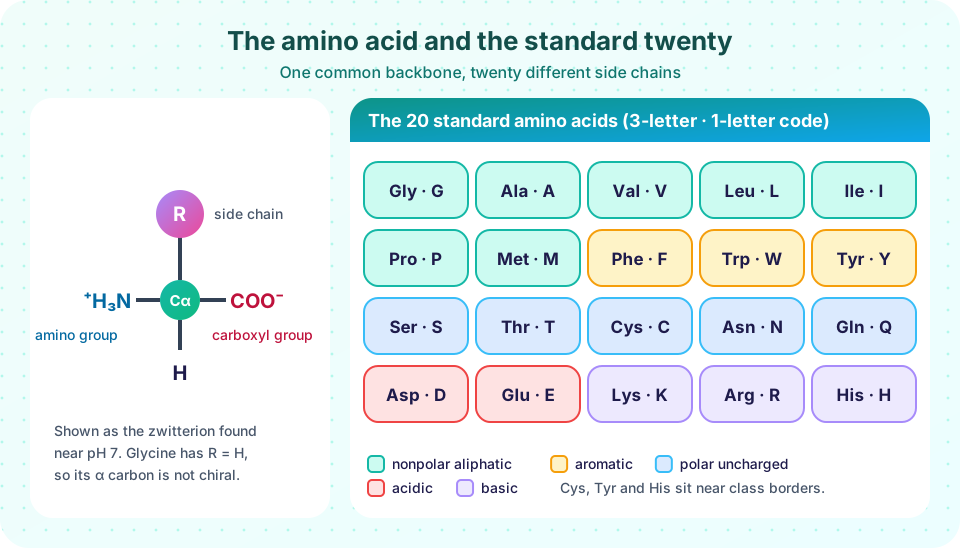
An amino acid has a central α-carbon attached to four groups: an amino group (-NH₂), a carboxyl group (-COOH), a hydrogen atom and a side chain R. At pH 7 an isolated amino acid exists as a zwitterion: the amino group is protonated (-NH₃⁺) and the carboxyl group is deprotonated (-COO⁻).
Except for glycine (R = H), the α-carbon has four different substituents, so it is chiral: two mirror-image forms exist, called D and L. Proteins in all organisms are built from L-amino acids (L-alanine, and so on). Most L-amino acids have the S configuration at the α-carbon; cysteine is R because of the way the sulfur changes the substituent priorities. D-amino acids occur in some bacterial cell walls and peptide antibiotics, but they are not used in ribosomal protein synthesis.
The twenty standard side chains
Group them by what the side chain does in water. This is far more useful than memorizing them one by one.
| Class | Amino acids (3-letter / 1-letter) | Key features |
|---|---|---|
| Nonpolar aliphatic | Gly (G), Ala (A), Val (V), Leu (L), Ile (I), Pro (P), Met (M) | Hydrophobic; Gly is smallest and flexible; Pro's ring links back to the backbone nitrogen and puts kinks in chains; Val, Leu, Ile are branched |
| Aromatic | Phe (F), Trp (W), Tyr (Y) | Large rings; absorb UV near 280 nm (mainly Trp and Tyr); Tyr has an -OH |
| Polar, uncharged | Ser (S), Thr (T), Cys (C), Asn (N), Gln (Q) | Hydroxyl, thiol or amide groups that hydrogen-bond; Cys can form disulfide bonds |
| Acidic (negative at pH 7) | Asp (D), Glu (E) | Side-chain carboxylate, pKa about 3.7 to 4.3 |
| Basic (positive at pH 7) | Lys (K), Arg (R), His (H) | Amino, guanidinium or imidazole groups; His has pKa about 6 so it is often a proton shuttle in enzymes |
Glycine, proline, cysteine and tyrosine have special roles (flexibility, kinks, disulfide bonds, phosphorylation sites), so their class placement is a convention, not a hard boundary.
Ionization and pI
Each ionizable group has its own pKa, so the charge of an amino acid changes with pH. For a simple amino acid with a nonionizable side chain such as glycine:
- pKa₁ (α-COOH) about 2.3
- pKa₂ (α-NH₃⁺) about 9.6
Below pH 2.3 it carries a net charge of +1; between about 2.3 and 9.6 it is a zwitterion with net charge 0; above 9.6 it is −1. The isoelectric point is midway between the two pKa values that surround the neutral form:
pI = (pKa₁ + pKa₂)/2
For glycine: pI = (2.34 + 9.60)/2 = 5.97.
For amino acids with an ionizable side chain, average the two pKa values around the neutral species. For aspartate (pK₁ 1.88, pK_R 3.65, pK₂ 9.60), the neutral form lies between the first two: pI = (1.88 + 3.65)/2 = 2.77. For lysine (pK₁ 2.18, pK₂ 8.95, pK_R 10.53) it lies between the last two: pI = (8.95 + 10.53)/2 = 9.74.
Values like these are called "typical": in a real protein the local environment shifts pKa values by one unit or more. A buried aspartate may have a pKa above 7, and a buried lysine may be neutral at pH 7.
Why care about pI? Proteins are least soluble at their pI, which is the basis of isoelectric precipitation, and isoelectric focusing separates proteins by charge in a pH gradient.
Hydrophobic and hydrophilic patterns
Nonpolar side chains (Val, Leu, Ile, Phe, Met, Ala) generally end up buried in the protein core, while charged and polar ones (Asp, Glu, Lys, Arg, Ser, Asn, Gln) occupy the surface where they meet water. A rough "hydropathy" scale, such as the Kyte–Doolittle scale, scores each amino acid and lets you find membrane-spanning helices as long stretches of hydrophobic residues.
Common misconceptions
"Zwitterions have no charges." They have two, one positive and one negative, that cancel to give zero net charge.
"The pI is where all groups are uncharged." At the pI the net charge is zero, but the ionizable groups are charged. Glycine at its pI has both an NH₃⁺ and a COO⁻.
"Cysteine and methionine are both just hydrophobic." Methionine is hydrophobic, but cysteine's thiol can form disulfide bonds and bind metals, giving it unique roles.
Try it
The first example computes the net charge of an amino acid at every pH from its pKa values and finds the pI numerically. This is a model using textbook pKa values.
Press Run (or Ctrl + Enter) to see the result here.
Program input · what you'd type while the program runs
Type the answers before you press Run, one per line. Each time the program reads a line (with input()), it gets the next line from this box.
The second example turns a one-letter sequence into a molecular mass and a simple charge estimate at pH 7. It uses standard average residue masses (the mass of each amino acid minus one water) and treats K and R as +1, D and E as −1.
Press Run (or Ctrl + Enter) to see the console output here.
No output.
Check your understanding
Quick check · 6 questions
of 6 answered You scored / 6 · perfect!
-
1. Which amino acid has no chiral center?
Glycine's side chain is H, so its alpha carbon has two identical substituents and is not chiral. -
2. At pH 7, the alpha amino and alpha carboxyl groups of a free amino acid are mostly:
pKa values around 9.6 and 2.3 mean the amine is protonated and the carboxyl deprotonated at pH 7. -
3. What is the pI of glycine (pKa 2.34 and 9.60)?
pI = (2.34 + 9.60)/2 = 5.97. -
4. Which amino acid can form disulfide bonds?
Two cysteine thiol groups can oxidize to a disulfide bond. -
5. Which class would you expect mostly in the interior of a soluble protein?
Hydrophobic residues bury themselves away from water in the protein core. -
6. Lysine has pK1 2.18, pK2 8.95 and pKR 10.53. Its pI is:
The neutral form lies between pK2 and pKR, so pI = (8.95 + 10.53)/2 = 9.74.
Summary
- An amino acid has an α-carbon with NH₃⁺, COO⁻, H and a variable R group; proteins use L-amino acids.
- The twenty standard side chains fall into nonpolar aliphatic, aromatic, polar uncharged, acidic and basic classes.
- Charge depends on pH through each group's pKa; pI is the average of the two pKa values around the neutral form.
- Side-chain chemistry decides where a residue sits in a folded protein.
Track your progress
Create a free account to tick off lessons and pick up where you left off on any device.
of Biochemistry lessons completed