


















Lesson 38 of 43 · Signaling and Regulation
Chapter 8 review: signaling and regulation
Review receptors, G proteins, cAMP, kinases, allostery, hemoglobin cooperativity and feedback inhibition with a two-pathway summary and a ten-question quiz.
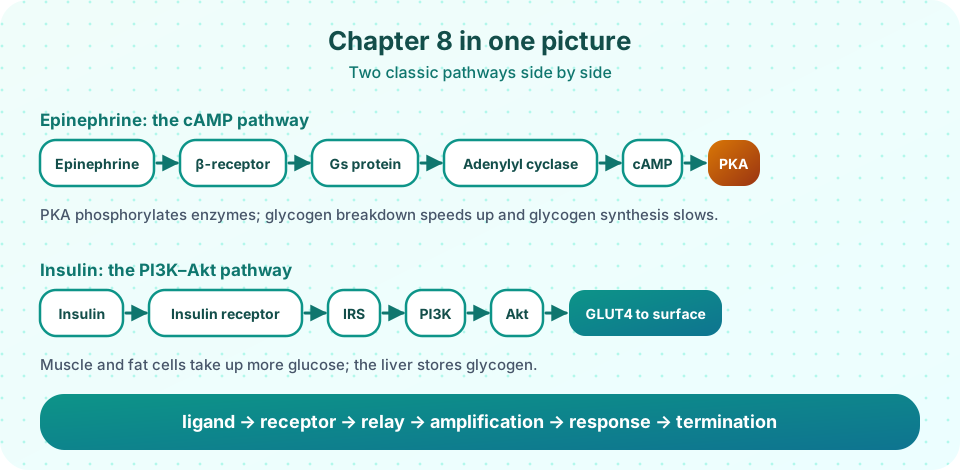
Signaling and regulation connect everything in this course. Hormones tell metabolic pathways when to run, and enzymes are tuned by effectors, phosphates and feedback so that the cell makes what it needs and no more. The summary below sets two classic pathways next to each other; spotting what they share is the best way to see the general pattern.
Recap table
| Topic | Key facts | Lesson |
|---|---|---|
| Receptor families | GPCR, RTK, ligand-gated channel, nuclear receptor | Receptors and messengers |
| GPCR pathway | Receptor, G protein (GTP), adenylyl cyclase, cAMP, PKA | Receptors and messengers |
| Off-signals | G protein GTPase, phosphodiesterase, phosphatases | Receptors and messengers |
| Cooperativity | Hemoglobin: sigmoidal, P₅₀ about 26 mmHg, n about 2.8; myoglobin: hyperbolic, P₅₀ about 2.8 mmHg | Allostery |
| Effectors | 2,3-BPG, H⁺ and CO₂ shift the curve right (Bohr effect) | Allostery |
| Feedback and covalent control | End-product inhibition; phosphorylation; zymogen cleavage | Allostery |
What the two pathways share
Both begin with a ligand binding a surface receptor, both pass the signal through a relay, both amplify it, and both end in an enzyme or transporter being switched on. They differ in their relays: epinephrine uses a G protein and a second messenger, insulin uses phosphorylated adaptor proteins and a lipid second messenger, and so their effects also differ (breakdown of stored fuel versus uptake and storage). In both, the response is stopped by phosphatases and by hydrolysis of the signaling molecules.
Check your understanding
Quick check · 10 questions
of 10 answered You scored / 10 · perfect!
-
1. Which of these is a ligand-gated ion channel?
The nicotinic receptor opens an ion pore when acetylcholine binds. -
2. Which enzyme converts ATP to cAMP?
Adenylyl cyclase makes cAMP; phosphodiesterase breaks it down. -
3. What switches off a G protein?
The intrinsic GTPase activity of Gα returns it to the GDP-bound inactive state. -
4. A sigmoidal binding curve indicates
Each bound ligand makes the next bind more easily. -
5. 2,3-BPG binding to hemoglobin
It shifts the curve to the right so more oxygen is delivered. -
6. Which is an example of feedback inhibition?
The end product (CTP) inhibits the first enzyme of its own pathway. -
7. Which receptor family acts by changing gene expression?
Steroid and thyroid hormone receptors bind DNA response elements. -
8. Why do cascades amplify signals?
Each stage multiplies the number of active molecules. -
9. Cholera toxin causes diarrhea because it
Locked-on Gαs keeps adenylyl cyclase active and drives chloride and water secretion. -
10. Which regulation is irreversible?
Proteolytic cleavage is a one-way activation.
Summary
- Signaling follows a common design: ligand, receptor, relay, amplification, response and termination.
- G proteins, cAMP, kinases and phosphatases are the main switches.
- Allostery, cooperativity, feedback inhibition and covalent modification regulate enzymes on different time scales.
- Hemoglobin illustrates how cooperativity serves physiology.
Track your progress
Create a free account to tick off lessons and pick up where you left off on any device.
of Biochemistry lessons completed