


















Lesson 15 of 43 · Amino Acids and Proteins
Chapter 3 review: Amino Acids and Proteins
Review chapter 3: amino acid chemistry and pI, the peptide bond, helices and sheets, folding and denaturation, and binding curves, with a ten-question quiz.
Chapter 3 went from the smallest unit of a protein, one amino acid, to a working molecular machine. This review collects the ideas and numbers you should be able to recall, then tests how well they connect.
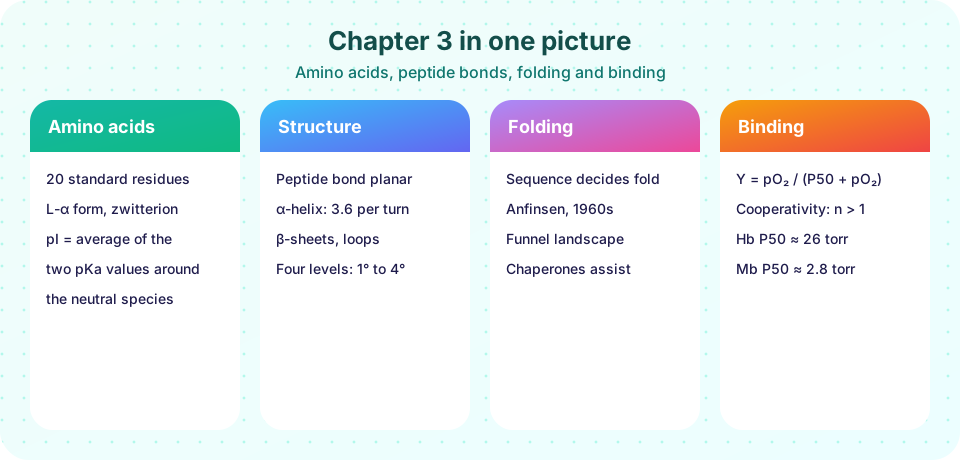
What you will learn
- Recall the main facts and formulas of chapter 3.
- Practice calculating charge, pI, helix geometry and saturation.
- Spot weak areas before starting enzymes.
Recap table
| Topic | What to remember |
|---|---|
| Amino acid | Cα with NH₃⁺, COO⁻, H, R; L-form; Gly is achiral |
| Classes | nonpolar aliphatic, aromatic, polar uncharged, acidic (Asp, Glu), basic (Lys, Arg, His) |
| Ionization | charge depends on pH and each pKa; pI = (pKa₁ + pKa₂)/2 around the neutral form |
| Peptide bond | planar, mostly trans; partial double bond; 0.133 nm C–N |
| α-helix | 3.6 residues/turn; 5.4 Å pitch; 1.5 Å rise; i → i+4 H-bonds |
| β-sheet | extended strands, interstrand H-bonds, parallel or antiparallel |
| Structure levels | primary, secondary, tertiary, quaternary |
| Folding | Anfinsen; Levinthal paradox; funnel; marginal stability 20–65 kJ/mol |
| Binding | θ = [L]/(Kd + [L]); Hill Y = pⁿ/(P50ⁿ + pⁿ); Mb n = 1, Hb n ≈ 2.8 |
Key terms
Zwitterion: dipolar ion with no net charge.
pI: pH of zero net charge.
Domain: compact folding unit of a protein.
Chaperone: protein that assists folding.
Cooperativity: binding at one site changes affinity at others.
Common misconceptions
"Sequence only matters at the active site." A residue far from the active site can change folding or stability; in sickle cell disease, a surface change affects the whole assembly.
"Hemoglobin and myoglobin are interchangeable." Their different P50 values and cooperativity suit them to delivery and storage.
Try it
Compute the net charge and pI of a short peptide from typical pKa values. This is a model: pKa values shift in real proteins.
Press Run (or Ctrl + Enter) to see the result here.
Program input · what you'd type while the program runs
Type the answers before you press Run, one per line. Each time the program reads a line (with input()), it gets the next line from this box.
Test yourself with flashcards. Click to flip. This is a study aid.
Check your understanding
Quick check · 10 questions
of 10 answered You scored / 10 · perfect!
-
1. Which amino acid is achiral?
Glycine's side chain is H, so its alpha carbon has two identical groups. -
2. At its pI, an amino acid with no ionizable side chain:
At the pI the positive and negative charges cancel; the groups themselves are still charged. -
3. Two amino acids join with the loss of:
Peptide bond formation is a condensation reaction that releases water. -
4. Which pair describes an alpha helix?
3.6 residues per turn and a 1.5 Å rise per residue give the 5.4 Å pitch. -
5. Which interaction is the main driving force of folding?
Burial of nonpolar side chains, an entropy-driven effect, is generally considered the main driving force. -
6. In Anfinsen's experiment, what removed ribonuclease A's activity?
Urea unfolded the chain and the reducing agent broke the four disulfide bonds. -
7. Hemoglobin's sigmoidal curve indicates:
Cooperative binding gives the S-shape. -
8. What is Kd for a ligand when half of the binding sites are occupied at 5 µM free ligand?
At half-saturation [L] = Kd. -
9. What does 2,3-BPG do to hemoglobin?
BPG stabilizes the T state, lowering oxygen affinity and promoting unloading. -
10. The Levinthal paradox is resolved by the idea that:
Folding is a guided descent in which favorable contacts bias the search.
Summary
- Twenty amino acids with distinct side chains build proteins; charge depends on pH through each pKa.
- The planar peptide bond and the hydrogen-bonded α-helix and β-sheet are the basis of secondary structure.
- Folding follows an energy funnel guided by the hydrophobic effect; stability is modest and chaperones help.
- Binding is described by Kd, P50 and the Hill equation; cooperativity makes hemoglobin an efficient transporter.
Track your progress
Create a free account to tick off lessons and pick up where you left off on any device.
of Biochemistry lessons completed