


















Lesson 13 of 43 · Amino Acids and Proteins
Protein folding, stability and misfolding
How a polypeptide finds its native fold: Anfinsen's experiment, the Levinthal paradox, the folding funnel, denaturation, chaperones and diseases of misfolding.
A newly made polypeptide is a floppy chain. Within milliseconds to minutes, in a crowded cell, it becomes a precisely folded machine. No one tells it how; the information is in its own sequence. How can a chain find its one correct shape among astronomically many alternatives, and what happens when it fails? This lesson follows the classic experiments and ideas.
What you will learn
- Explain Anfinsen's experiment and the thermodynamic hypothesis.
- Describe the Levinthal paradox and how the folding funnel resolves it.
- Explain what denaturation is and what agents cause it.
- Describe the role of chaperones and the consequences of misfolding.
Key terms
Native state: the folded, functional conformation of a protein.
Denaturation: loss of native structure (and usually function) without breaking peptide bonds.
Chaperone: a protein that helps other proteins fold or avoid aggregation.
Chaotrope: a solute such as urea or guanidinium chloride that disrupts noncovalent interactions and denatures proteins.
Amyloid: insoluble fibrils of misfolded protein rich in β-sheets.
Anfinsen's experiment
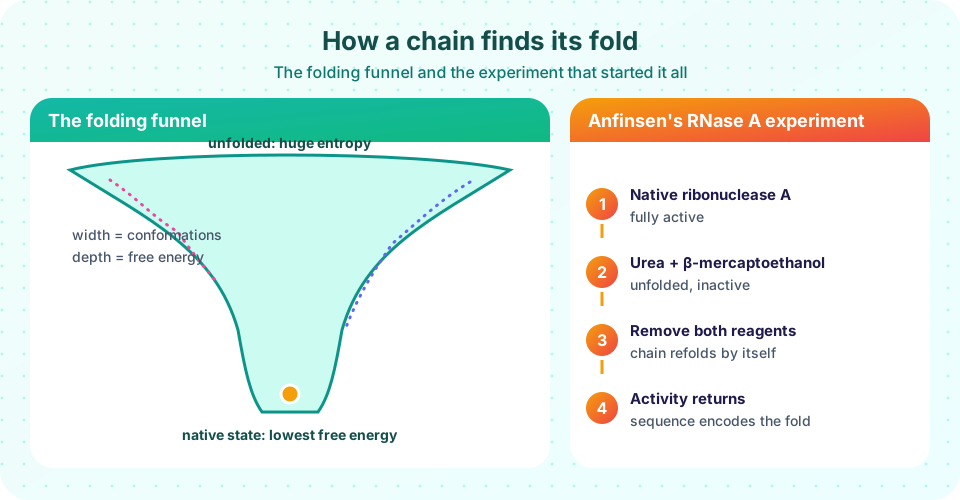
In the early 1960s Christian Anfinsen studied ribonuclease A, a small enzyme of 124 amino acids stabilized by four disulfide bonds. He treated the enzyme with 8 M urea and a reducing agent (β-mercaptoethanol). The urea unfolded the chain and the reducing agent broke the disulfide bonds; the enzyme lost its activity. Then he removed both reagents slowly by dialysis. The chain refolded, the disulfide bonds re-formed in the correct pairings, and enzymatic activity returned.
The experiment led to the thermodynamic hypothesis: the native structure is the state of lowest free energy under physiological conditions and is determined by the amino acid sequence alone. Anfinsen shared the 1972 Nobel Prize in Chemistry (with Stanford Moore and William Stein) for this work and related studies on ribonuclease.
The hypothesis has exceptions: some proteins need help from chaperones, some depend on cofactors or cleavage to reach their final form, and some are intrinsically disordered. But as a first principle it explains why protein structure can, at least in principle, be predicted from sequence, a goal that deep-learning systems such as AlphaFold (2020 to 2021) have now largely achieved for many proteins.
The Levinthal paradox
In 1968 Cyrus Levinthal pointed out an apparent paradox. Suppose each of the 100 residues in a protein has just three possible backbone conformations. That gives 3¹⁰⁰ ≈ 5 × 10⁴⁷ conformations. If the chain sampled a new conformation every 10⁻¹³ s (about the time of a bond vibration), a random search would take about 5 × 10³⁴ s, or 1.6 × 10²⁷ years, far longer than the age of the universe (1.4 × 10¹⁰ years). Yet real proteins fold in milliseconds to seconds.
The resolution is that folding is not a random search. Local interactions form early (helices and turns nucleate within microseconds), the hydrophobic effect collapses the chain, and every favorable contact lowers the free energy and biases the chain toward the native state.
The folding funnel
Modern theory pictures the energy landscape as a funnel. At the top is a very wide rim: enormous numbers of unfolded conformations with high free energy and high entropy. As the chain forms native-like contacts, it descends into the narrowing funnel, losing conformational entropy but gaining stabilizing interactions. Many routes lead to the bottom. The landscape is rugged, with small pockets (kinetic traps) where partially folded chains can linger or aggregate, which is where chaperones help.
How stable is a folded protein?
Surprisingly little. The free energy difference between folded and unfolded states of a typical small protein is only about 20 to 65 kJ/mol, equal to a few hydrogen bonds' worth. The reason is the balance of large opposing terms: folding gains many favorable contacts and the hydrophobic effect but pays a large penalty in lost backbone and side-chain entropy. This marginal stability helps proteins stay flexible, be degraded when damaged, and change shape for function.
Denaturation
Because stability is modest, many conditions unfold proteins:
- Heat: more thermal motion disrupts noncovalent interactions (egg white turning opaque).
- Extreme pH: changes charges on side chains, breaking salt bridges and hydrogen bonds.
- Chaotropes: 6 to 8 M urea or guanidinium chloride weaken the hydrophobic effect and hydrogen bonding.
- Detergents such as SDS bind and coat hydrophobic regions.
- Reducing agents: break disulfide bonds.
Denaturation is often reversible for small proteins (as in Anfinsen's experiment), but for many larger proteins unfolded chains aggregate and cannot refold.
In a two-state model, the unfolding free energy falls roughly linearly with denaturant concentration: ΔG_unfold = ΔG_H₂O − m[D]. The midpoint concentration is Cm = ΔG_H₂O / m.
Chaperones and helpers
In the crowded cell, partially folded chains can stick together. Chaperones prevent this. Hsp70 proteins bind exposed hydrophobic stretches of new chains and release them as they fold; chaperonins such as GroEL/GroES provide an enclosed chamber in which one chain can fold in isolation. Enzymes also help: protein disulfide isomerase shuffles disulfide bonds in the endoplasmic reticulum, and peptidyl-prolyl isomerase speeds up cis-trans switching around proline.
When folding fails
Misfolded proteins can lose function or form toxic aggregates.
- Cystic fibrosis: the most common mutation (ΔF508, loss of one phenylalanine) in the CFTR protein causes misfolding; the cell degrades the protein before it reaches the membrane.
- Alzheimer's disease: aggregates of amyloid-β peptide and tau protein accumulate (the details of their causal roles are still studied).
- Prion diseases: a misfolded form of the prion protein PrP converts normal PrP into the abnormal form.
This information is educational background and not a basis for diagnosis or treatment.
Common misconceptions
"Denaturation breaks the peptide bonds." It disrupts the folded shape; the sequence of amino acids stays intact.
"A protein tries every conformation until it finds the right one." If it did, folding would take longer than the age of the universe. Folding is guided downhill.
"Stable proteins are rigid and very strongly bound." Typical proteins are only marginally stable (tens of kJ/mol), which is part of how they function.
Try it
The first example makes the Levinthal paradox concrete. It computes the time for a random search for chains of different lengths, using the same assumptions as above (three states per residue, 10¹³ conformations per second).
Press Run (or Ctrl + Enter) to see the result here.
Program input · what you'd type while the program runs
Type the answers before you press Run, one per line. Each time the program reads a line (with input()), it gets the next line from this box.
The second example is a simple two-state denaturation model. It uses ΔG_unfold = ΔG_H₂O − m[D] with made-up but typical magnitudes, and plots the fraction folded.
Press Run (or Ctrl + Enter) to see the result here.
Program input · what you'd type while the program runs
Type the answers before you press Run, one per line. Each time the program reads a line (with input()), it gets the next line from this box.
Check your understanding
Quick check · 6 questions
of 6 answered You scored / 6 · perfect!
-
1. What did Anfinsen's ribonuclease A experiment show?
Denatured, reduced ribonuclease A refolded to an active enzyme in vitro, so the sequence determines the fold. -
2. The Levinthal paradox states that:
The number of possible conformations is so large that random search is impossible on biological timescales. -
3. Typical folding free energy of a small protein is about:
Proteins are marginally stable: tens of kJ/mol, equivalent to a few hydrogen bonds. -
4. Which does NOT denature a protein?
Neutral buffer at moderate temperature is the condition in which most proteins are stable. -
5. What do chaperones do?
Chaperones such as Hsp70 and GroEL/GroES prevent misfolding and aggregation. -
6. In a two-state model with dG(H2O) = 30 kJ/mol and m = 10 kJ/mol per M, the midpoint is at:
Cm = dG(H2O)/m = 30/10 = 3 M.
Summary
- Anfinsen showed that a protein's sequence specifies its native structure (the thermodynamic hypothesis).
- The Levinthal paradox rules out random search; folding follows a funnel-shaped energy landscape.
- Folded proteins are only marginally stable (about 20 to 65 kJ/mol) and are denatured by heat, pH, chaotropes, detergents and reducing agents.
- Chaperones prevent aggregation; misfolding underlies diseases such as cystic fibrosis and prion disease.
Track your progress
Create a free account to tick off lessons and pick up where you left off on any device.
of Biochemistry lessons completed