


















Lesson 39 of 43 · Projects and Practice
Practice: a biochemistry problem set
Work eight numerical biochemistry problems on free energy, equilibrium, glycogen branching, ATP yield, replication time, translation cost, hemoglobin and redox, with a checker.
Reading about biochemistry gets you part of the way. Solving numbers makes it stick. This set has eight problems drawn from chapters 5 to 8. Try each on paper first, using the hints. Then run the solver and the checker below to compare. Every answer here uses values from the lessons, so go back to the lesson named in the hint if you are stuck.
What you will learn
- Use
ΔG = ΔG°′ + RT ln QandΔG°′ = −RT ln K′in worked calculations. - Count ATP from the stages of respiration and from the P/O ratios.
- Combine rates, genome sizes and codon counts into estimates.
- Apply the Hill equation and
ΔG°′ = −nFΔE°′.
Key formulas
Free energy: ΔG = ΔG°′ + RT ln Q, with R = 8.314 J mol⁻¹ K⁻¹; at 37 °C, RT = 2.579 kJ/mol.
Equilibrium: K′ = exp(−ΔG°′ / RT); at 25 °C, RT = 2.479 kJ/mol.
Redox: ΔG°′ = −n F ΔE°′, F = 96.485 kJ V⁻¹ mol⁻¹.
Hill equation: Y = pⁿ / (pⁿ + P₅₀ⁿ).
The problems
Problem 1 (chapter 6). A reaction has ΔG°′ = +1.7 kJ/mol. In a cell at 37 °C the ratio of product to reactant is Q = 0.1. What is ΔG, and which way does the reaction go? Hint: use ΔG = ΔG°′ + RT ln Q.
Problem 2 (chapter 6). Glucose phosphorylation coupled to ATP hydrolysis has ΔG°′ = −16.7 kJ/mol. What is the equilibrium constant at 25 °C? Hint: K′ = exp(−ΔG°′ / RT).
Problem 3 (chapter 5). A glycogen particle contains 20,000 glucose residues with a branch point every 12 residues. How many non-reducing ends does it have? Hint: ends = branches + 1.
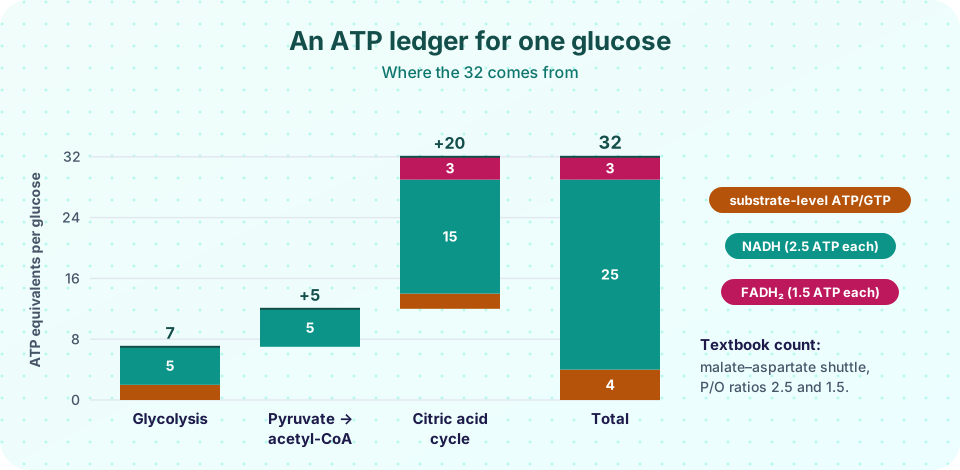
Problem 4 (chapter 6). How much ATP is made if two pyruvate molecules (not glucose) are oxidized completely, using P/O ratios 2.5 and 1.5? Hint: skip glycolysis; use pyruvate dehydrogenase and the citric acid cycle for two turns.
Problem 5 (chapter 7). E. coli has a 4.64 million base-pair chromosome. Two forks leave one origin, each moving at 800 base pairs per second. How many minutes does replication take?
Problem 6 (chapter 7). A protein has 300 amino acids. How many nucleotides are in the coding sequence including the stop codon, how many peptide bonds are made, and about how many high-energy phosphate bonds does synthesis use at roughly four per bond?
Problem 7 (chapter 8). Use the Hill equation with P₅₀ = 26 mmHg and n = 2.8 to find the fractional saturation of hemoglobin in a working muscle at pO₂ = 20 mmHg.
Problem 8 (chapter 6). Electrons pass from succinate (fumarate/succinate E°′ = +0.03 V) to oxygen (+0.82 V). What is ΔG°′ for two electrons?
Common mistakes
Mixing units. R is 8.314 J/(mol·K); free energies in the lessons are in kJ/mol. Convert one of them.
Forgetting that the cycle runs twice per glucose (two acetyl-CoA), or that pathway steps after aldolase run twice.
Using ΔG°′ where ΔG is needed. The standard value tells you the direction at standard conditions; the real direction depends on Q.
Try it
First the solver, which prints every answer. Cover the output and compute by hand before you run it.
Press Run (or Ctrl + Enter) to see the result here.
Program input · what you'd type while the program runs
Type the answers before you press Run, one per line. Each time the program reads a line (with input()), it gets the next line from this box.
Now check your own answers. Type your numbers (rounded as indicated) and the checker accepts a small tolerance.
Check your understanding
Quick check · 4 questions
of 4 answered You scored / 4 · perfect!
-
1. A reaction has ΔG°′ = −11.4 kJ/mol at 25 °C. Its K′ is about
Every 5.7 kJ/mol changes K′ by a factor of 10, so −11.4 kJ/mol gives K′ of about 100. -
2. If the cycle makes 3 NADH, 1 FADH₂ and 1 GTP per turn, how much ATP per turn with P/O 2.5 and 1.5?
3 × 2.5 + 1 × 1.5 + 1 = 10 ATP equivalents per turn. -
3. A gene encodes a 100-amino-acid protein. How many nucleotides does the coding sequence contain, including the stop codon?
100 codons × 3 = 300, plus 3 for the stop codon = 303. -
4. In the Hill equation, what is P₅₀?
P₅₀ is the partial pressure at which half the sites are occupied.
Summary
- Always check units before you use R, T, F and energies together.
- Count ATP by stage, and remember that two turns of the cycle follow one glucose.
- Estimating rates, lengths and costs ties the lessons to numbers.
- Check your answers against the lessons, not just the solver.
Track your progress
Create a free account to tick off lessons and pick up where you left off on any device.
of Biochemistry lessons completed