


















Lesson 35 of 43 · Signaling and Regulation
Cell signaling and regulation: the big picture
Map how cells receive signals, relay them through second messengers and kinases and regulate enzymes, with an overview of the three lessons in this chapter.
A cell is not a bag of enzymes running at fixed speed. It senses its surroundings, listens to hormones and neighbors, and adjusts which pathways run and how fast. After a meal, insulin tells muscle and fat to take up glucose. During a sprint, epinephrine tells the liver to release it. These instructions work through a small set of chemical devices that you can learn as a toolkit: receptors, relays, amplifiers, switches and off-signals.
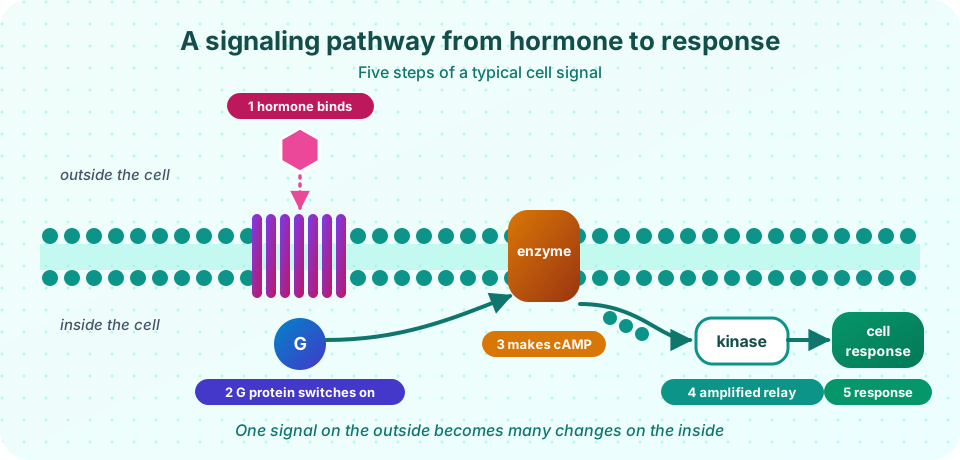
The chapter at a glance
The signaling toolkit
Why cascades?
Regulating enzymes
Takeaway
What each lesson covers
| Lesson | What you will learn |
|---|---|
| Receptors and second messengers | Four receptor families, G proteins, cAMP, kinase cascades and how signals end |
| Allostery and regulation of enzymes | Cooperativity, the hemoglobin curve, feedback inhibition and covalent control |
| Chapter review | Two classic pathways side by side |
Why this matters
Almost every drug you can name acts somewhere in a signaling pathway: beta-blockers block a receptor, caffeine blocks adenosine receptors and many cancer drugs block overactive kinases. Diseases such as diabetes involve defective hormone signaling. The same logic also shows up in metabolism: the regulated steps of glycolysis respond to energy signals through the mechanisms in this chapter.
Key terms
Ligand: a molecule that binds specifically to a receptor or protein.
Signal transduction: converting an extracellular signal into an intracellular response.
Second messenger: a small intracellular molecule or ion (cAMP, Ca²⁺, IP₃) that spreads a signal.
Kinase / phosphatase: an enzyme that adds / removes phosphate groups on proteins.
Check your understanding
Quick check · 3 questions
of 3 answered You scored / 3 · perfect!
-
1. Why do cells use signaling cascades?
Each step can activate many molecules of the next, amplifying the signal, and each step can be regulated. -
2. Which is a second messenger?
cAMP is made inside the cell in response to a hormone and spreads the signal. -
3. What does a phosphatase do?
Phosphatases reverse the action of kinases.
Summary
- Cells sense, relay, amplify and respond to signals with a toolkit of receptors, messengers and switches.
- Cascades amplify and add control points; phosphatases and GTP hydrolysis switch signals off.
- Enzyme activity is also tuned by allostery, covalent modification and feedback.
Track your progress
Create a free account to tick off lessons and pick up where you left off on any device.
of Biochemistry lessons completed