


















Lesson 5 of 43 · Water, pH and Biomolecules
Chapter 2 overview: water, pH and the forces between molecules
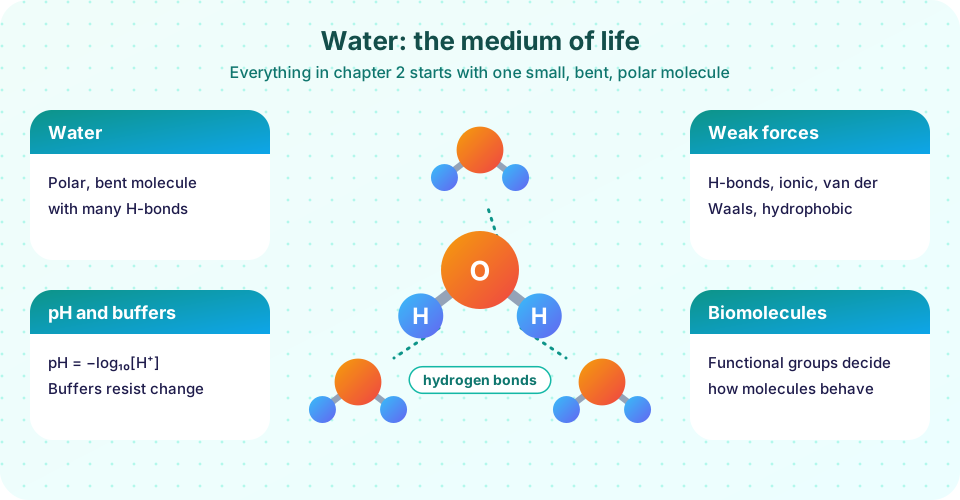
Overview of chapter 2: why water suits life, which weak forces hold biomolecules together, and how pH and buffers keep cells working.
Every reaction in this course happens in water. Cells are roughly 70 percent water by mass, and the properties of water shape the folding of proteins, the structure of membranes and the speed of enzymes. This chapter explains why, and then introduces pH, the measure of acidity that biochemists must keep under control.
What you will learn
- See how the four lessons of this chapter fit together.
- Predict what water does to polar, ionic and nonpolar substances.
- Preview the quantities you will calculate: bond energies, pH and buffer ratios.
The chapter at a glance
Water is polar
Polarity is the key to water's behavior.
Water as solvent
Like dissolves like.
Weak forces
Weak alone, strong together.
pH and buffers
Enzymes work in a narrow pH range.
Where each lesson fits
- Why water is special: molecular structure, hydrogen bonding, high heat capacity, solvent power and the hydrophobic effect.
- Weak forces that shape biomolecules: a tour of hydrogen bonds, ionic interactions, van der Waals forces and the hydrophobic effect, with their energies compared to thermal energy.
- pH, pKa and buffers: the pH scale, the Henderson–Hasselbalch equation, titration curves and how buffers protect cells and blood.
- Chapter 2 review: a one-page summary and a ten-question quiz.
Why start with water?
Think of water as the stage and biomolecules as the actors. If you move the actors to a different stage, such as oil or air, their behavior changes completely. A protein folded in water will not stay folded in a nonpolar solvent; a membrane forms only because lipids avoid water; DNA's double helix is stable partly because its bases are buried away from water. Almost every structural fact in the next chapters is, at heart, a fact about water.
Common misconceptions
"Water is just an inert background." Water takes part in reactions (hydrolysis, condensation) and sets the energetics of folding and binding through the hydrophobic effect.
"Hydrogen bonds are rare, special bonds." They are everywhere, but individually weak and short-lived: a given hydrogen bond in liquid water lasts only picoseconds before it reforms with another partner.
Try it
Water has an unusual density curve: unlike most liquids, it is densest at about 4 °C, and ice floats. The tabulated values below are standard handbook-style numbers at atmospheric pressure. Run the plot and look for the maximum.
Press Run (or Ctrl + Enter) to see the result here.
Program input · what you'd type while the program runs
Type the answers before you press Run, one per line. Each time the program reads a line (with input()), it gets the next line from this box.
A small preview of chapter 2's pH calculations: convert pH to hydrogen ion concentration and see how quickly it changes.
Press Run (or Ctrl + Enter) to see the console output here.
No output.
Check your understanding
Quick check · 4 questions
of 4 answered You scored / 4 · perfect!
-
1. Why is water a good solvent for salts?
The partial charges on O and H form hydration shells around ions, offsetting the energy cost of separating them. -
2. Which lesson of this chapter introduces the Henderson-Hasselbalch equation?
pH, pKa and buffers covers pH, titration curves and the Henderson-Hasselbalch equation. -
3. Liquid water is densest at about:
Water reaches maximum density near 4 °C. Ice is less dense than liquid water, so it floats. -
4. Which statement about hydrogen bonds in liquid water is correct?
Hydrogen bonds in liquid water have lifetimes of picoseconds, yet in large numbers they have large effects.
Summary
- Water's polarity and hydrogen bonding explain its solvent power and its effects on biomolecules.
- Weak forces (hydrogen bonds, ionic interactions, van der Waals contacts and the hydrophobic effect) work together to shape proteins, membranes and nucleic acids.
- pH and buffers keep conditions steady for enzymes.
- The next lesson looks closely at the water molecule.
Next: Why water is special
Track your progress
Create a free account to tick off lessons and pick up where you left off on any device.
of Biochemistry lessons completed