


















Lesson 3 of 43 · Getting Started
Energy and free energy: why reactions go
Learn enthalpy, entropy and Gibbs free energy, how ΔG°' relates to equilibrium, and how cells use ATP to power reactions that would not run alone.
Life builds order from disorder. Proteins fold, membranes form, DNA is copied with few errors. How does that square with a universe that tends toward disorder? The answer is not that cells break thermodynamics; it is that cells are open systems that take in energy and release heat and waste. This lesson gives you the single quantity that decides whether a reaction can proceed: the Gibbs free energy change, ΔG.
What you will learn
- Define enthalpy, entropy and free energy and read the sign of ΔG.
- Use
ΔG = ΔG°' + RT ln QandΔG°' = −RT ln K'eq. - Explain why "high-energy" phosphate bonds are better described as large negative ΔG of hydrolysis.
- Show how energy coupling lets cells drive unfavorable reactions.
Key terms
Enthalpy (H): heat content; ΔH is the heat exchanged at constant pressure.
Entropy (S): a measure of how many ways energy and matter can be arranged; more dispersal means higher entropy.
Gibbs free energy (G): the energy available to do work at constant temperature and pressure; ΔG = ΔH − TΔS.
Exergonic / endergonic: ΔG negative (can proceed) / ΔG positive (needs input of energy).
Standard state (biochemical): 1 M of solutes except H⁺ held at pH 7, written ΔG°'.
ΔG decides the direction
The second law of thermodynamics says the entropy of the universe increases in any spontaneous process. For a system at constant temperature and pressure, the Gibbs equation packages that requirement:
ΔG = ΔH − T·ΔS
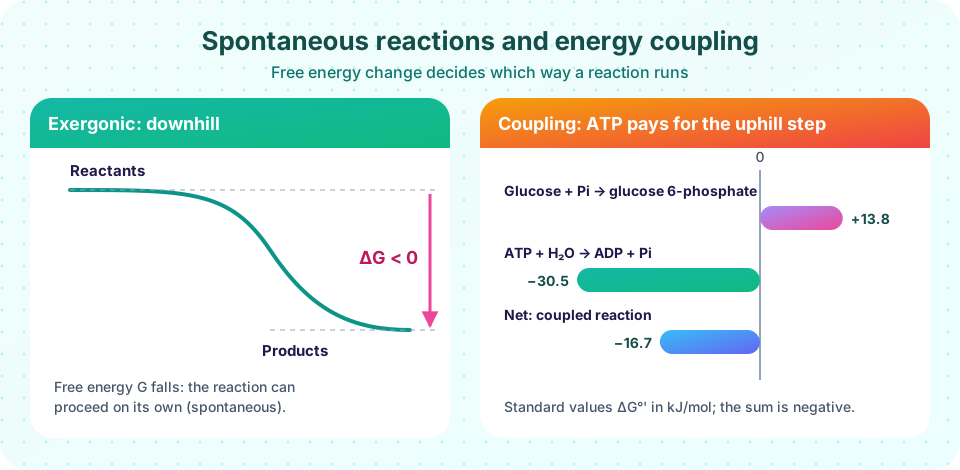
with temperature T in kelvin. If ΔG is negative the reaction is exergonic: it can proceed spontaneously in the forward direction. If ΔG is positive it is endergonic: the reverse reaction is favored. At ΔG = 0 the system is at equilibrium.
Two effects compete in ΔG. A reaction that releases heat (negative ΔH) tends to be favorable, and so does one that increases disorder (positive ΔS). The hydrophobic effect (chapter 2) is an entropy story: bury nonpolar groups and water molecules are freed, raising the entropy of the water.
Spontaneous does not mean fast. The oxidation of glucose has a large negative ΔG, yet a bag of sugar sits on the shelf for years. How fast a reaction runs depends on its activation barrier, which enzymes lower (chapter 4). ΔG says whether, not how quickly.
ΔG°' and the equilibrium constant
The standard free energy change is tied to the equilibrium constant. In the biochemical standard state:
ΔG°' = −RT ln K'eq
with R = 8.314 J mol⁻¹ K⁻¹. At 25 °C (298.15 K), RT = 2.479 kJ/mol, and because RT ln 10 = 5.708 kJ/mol, every 5.7 kJ/mol of ΔG°' changes K'eq by a factor of 10. A reaction with K'eq = 100 therefore has ΔG°' ≈ −11.4 kJ/mol.
But a cell is not at standard state. The real ΔG depends on actual concentrations through the reaction quotient Q (products over reactants):
ΔG = ΔG°' + RT ln Q
Worked example. The conversion glucose 6-phosphate → fructose 6-phosphate has ΔG°' = +1.7 kJ/mol, so K'eq = e^(−1.7/2.479) ≈ 0.50: at equilibrium there is about twice as much glucose 6-phosphate as fructose 6-phosphate. Yet in a cell where Q = [F6P]/[G6P] = 0.1:
ΔG = 1.7 + 2.479 × ln 0.1 = 1.7 − 5.7 ≈ −4.0 kJ/mol
The "uphill" standard reaction runs forward, because the cell keeps the product concentration low by consuming it in the next step. This is a central idea of metabolism: pathways are pulled forward by their downstream steps.
ATP and energy coupling
Cells transfer energy mostly through ATP (adenosine triphosphate). The hydrolysis ATP + H₂O → ADP + Pi has ΔG°' ≈ −30.5 kJ/mol. Inside cells, because ATP is kept far above its equilibrium ratio to ADP and Pi, the actual ΔG is more negative, commonly quoted as about −50 to −65 kJ/mol depending on the cell and conditions.
Textbooks sometimes call the phosphoanhydride bonds of ATP "high-energy bonds", which misleads: breaking any bond costs energy. The large negative ΔG comes from the products being more stable than ATP: less charge repulsion between the crowded negative phosphates, better solvation of ADP and Pi, and resonance stabilization of Pi.
Coupling lets an endergonic step ride on ATP hydrolysis. Because free energy changes add:
| Reaction | ΔG°' (kJ/mol) |
|---|---|
| Glucose + Pi → glucose 6-phosphate + H₂O | +13.8 |
| ATP + H₂O → ADP + Pi | −30.5 |
| Sum: Glucose + ATP → glucose 6-phosphate + ADP | −16.7 |
In reality the two halves are not separate: an enzyme (hexokinase) transfers the phosphate directly from ATP to glucose through a shared intermediate, so the favorable and unfavorable reactions are physically linked.
Common misconceptions
"A negative ΔG means the reaction is fast." ΔG tells you the direction, not the speed. Speed comes from kinetics.
"ATP stores energy in its bonds, like a battery." Energy is released by the overall hydrolysis because the products are more stable. Bond breaking itself requires energy.
"ΔG°' tells you the ΔG inside the cell." ΔG°' is for standard concentrations. Real ΔG depends on actual concentrations through RT ln Q, so it can differ in sign.
Try it
First, a calculator. Adjust ΔH, ΔS and temperature and see when the free energy changes sign. This is a model of the Gibbs equation, not a measurement.
Second, plot how real ΔG depends on the reaction quotient Q for an unfavorable reaction with ΔG°' = +7.5 kJ/mol. The curve crosses zero exactly at Q = K'eq.
Press Run (or Ctrl + Enter) to see the result here.
Program input · what you'd type while the program runs
Type the answers before you press Run, one per line. Each time the program reads a line (with input()), it gets the next line from this box.
Check your understanding
Quick check · 5 questions
of 5 answered You scored / 5 · perfect!
-
1. A reaction has ΔG = −20 kJ/mol. What can you conclude?
A negative ΔG means the forward direction is thermodynamically favorable. It says nothing about speed or about heat alone. -
2. At 25 °C, a change of 5.7 kJ/mol in ΔG°' changes K'eq by about:
RT ln 10 is about 5.7 kJ/mol at 298 K, so each 5.7 kJ/mol multiplies or divides K'eq by 10. -
3. Why can a reaction with positive ΔG°' still run forward in a cell?
ΔG = ΔG°' + RT ln Q. If products are removed quickly, Q is small and ΔG can be negative. Enzymes do not change ΔG°'. -
4. What is the best description of a 'high-energy' bond in ATP?
Hydrolysis is strongly favorable because of charge relief, solvation and resonance in the products, not because breaking the bond releases energy. -
5. Glucose + Pi has ΔG°' of +13.8 and ATP hydrolysis has −30.5 kJ/mol. What is the coupled ΔG°'?
Free energy changes add: 13.8 + (−30.5) = −16.7 kJ/mol.
Summary
ΔG = ΔH − TΔS; negative ΔG means exergonic, positive means endergonic, zero means equilibrium.ΔG°' = −RT ln K'eq; at 25 °C, 5.7 kJ/mol corresponds to a factor of 10 in K'eq.- Real ΔG = ΔG°' + RT ln Q, so concentrations can reverse the sign.
- ATP hydrolysis has ΔG°' ≈ −30.5 kJ/mol; coupling adds free energies so that unfavorable steps can proceed.
- ΔG gives direction only; enzymes control speed.
Next: Chapter 1 review
Track your progress
Create a free account to tick off lessons and pick up where you left off on any device.
of Biochemistry lessons completed