


















Lesson 23 of 43 · Carbohydrates and Lipids
Polysaccharides: starch, glycogen and cellulose
Discover how alpha-1,4, alpha-1,6 and beta-1,4 glycosidic bonds turn glucose into starch, glycogen and cellulose, and why shape decides digestibility and function.
Starch, glycogen and cellulose are all built from nothing but glucose. Yet one is a pantry staple, one is the reserve fuel in your liver and muscles, and one is the wood and cotton of the plant world that you cannot digest. The difference lies in how the glucose units are linked and branched. This lesson explains that difference, and why it matters for biology, nutrition and even paper-making.
What you will learn
- Compare amylose, amylopectin and glycogen in linkage and branching.
- Explain why glycogen's many branches matter for fast energy release.
- Explain why β-1,4 links make cellulose rigid and indigestible to humans.
- Name other important polysaccharides and sugar-protein conjugates.
Key terms
Polysaccharide: a long polymer of monosaccharides joined by glycosidic bonds.
Homopolysaccharide: a polysaccharide made of one kind of sugar (starch, glycogen, cellulose).
Non-reducing end: the end of a chain whose anomeric carbon is not free; enzymes that mobilize glycogen start here.
Branch point: a glucose residue joined to three neighbors, with an extra α-1,6 bond.
Glycoconjugate: a protein or lipid carrying covalently attached sugar chains.
Starch: the plant's energy store
Plants store glucose as starch in granules inside chloroplasts and in seeds and tubers. Starch is a mixture of two polymers:
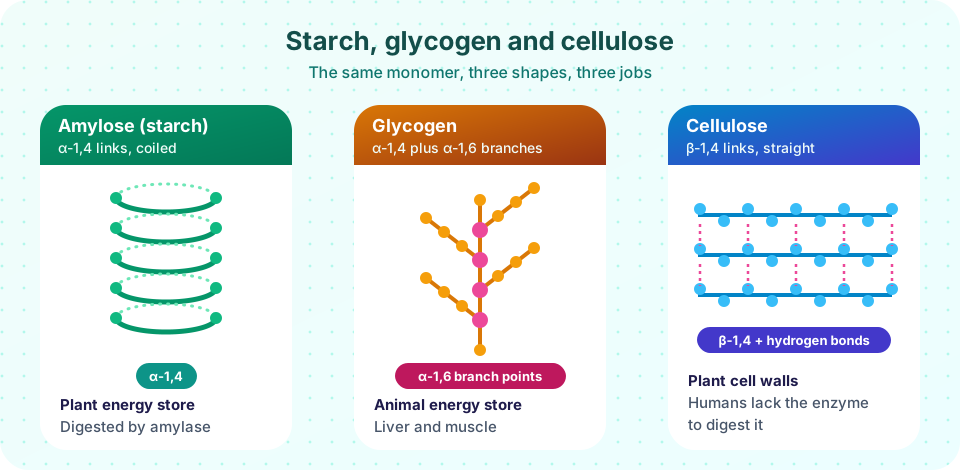
- Amylose: unbranched chains of glucose joined by α-1,4 bonds. The α geometry makes each bond bend, so the chain coils into a helix, six or so residues per turn.
- Amylopectin: also α-1,4 chains, but with an α-1,6 branch about every 24 to 30 residues.
Digestion begins with α-amylase in saliva and the pancreas, which cuts α-1,4 bonds in the interior of the chains. Brush-border enzymes finish the job and free glucose crosses into the blood. Cooking helps because heat and water swell the granules and make them far easier for amylase to attack.
Glycogen: the animal's quick-access reserve
Glycogen looks like amylopectin with branches every 8 to 12 residues. That dense, tree-like structure has an important consequence. Glycogen is broken down by glycogen phosphorylase, which removes one glucose at a time from the non-reducing ends of the chains, producing glucose 1-phosphate (this uses inorganic phosphate, not water). Every branch adds another end, so a highly branched particle has many ends and many enzymes can work on it at once. Branching also makes the molecule compact and more soluble than a single long chain.
Liver glycogen (a few percent of liver mass) is released to keep blood glucose steady between meals. Muscle glycogen (about 1 % of muscle mass) is kept for the muscle's own use. A debranching enzyme clears the α-1,6 points as phosphorylase approaches them. The control of these enzymes by hormones is a classic example of the signaling pathways in chapter 8.
Cellulose: the structural polymer
Cellulose has the same glucose units but with β-1,4 bonds. Each residue is flipped 180° relative to its neighbor, so the chain is straight and ribbon-like rather than coiled. Neighboring chains lie side by side and are held by many hydrogen bonds into microfibrils, strong enough to resist stretching: cotton is nearly pure cellulose, and wood combines it with lignin.
Humans have no enzyme that cleaves β-1,4 bonds in cellulose, so it passes through as dietary fiber (useful for gut health but not as fuel). Cows, termites and some other animals depend on gut microbes that make cellulases.
Other polysaccharides and glycoconjugates
- Chitin: β-1,4-linked N-acetylglucosamine; the strong polymer of insect and crustacean shells and fungal walls.
- Peptidoglycan: the mesh in bacterial cell walls, in which sugar chains are cross-linked by short peptides. Penicillin-type antibiotics block this cross-linking.
- Glycosaminoglycans such as hyaluronic acid: long, negatively charged chains that hold water in cartilage and joint fluid.
- Glycoproteins and glycolipids: short sugar chains attached to proteins and lipids on cell surfaces. They help cells recognize each other, and they define the ABO blood groups, which differ in the terminal sugar of a surface oligosaccharide.
Common misconceptions
"Starch and cellulose are different molecules." Both are glucose polymers. Only the bond geometry (α-1,4 versus β-1,4) differs.
"Glycogen is a long chain." It is a branched, roughly spherical particle with thousands of glucose units, not a single straight chain.
"Fiber has no function because we cannot digest it." Fermentable fiber feeds gut bacteria, and insoluble fiber adds bulk.
Try it
Branches are ends. In a branched polymer each new branch creates one more non-reducing end, so ends = branches + 1. This plot compares polymers of 10,000 residues with different branching intervals.
Press Run (or Ctrl + Enter) to see the result here.
Program input · what you'd type while the program runs
Type the answers before you press Run, one per line. Each time the program reads a line (with input()), it gets the next line from this box.
A toy model of release speed. Suppose each end loses one glucose per second (an arbitrary unit rate, not a measured one). How long does it take to free the first 1,000 residues?
Press Run (or Ctrl + Enter) to see the result here.
Program input · what you'd type while the program runs
Type the answers before you press Run, one per line. Each time the program reads a line (with input()), it gets the next line from this box.
Check your understanding
Quick check · 4 questions
of 4 answered You scored / 4 · perfect!
-
1. Which bond type makes cellulose chains straight and strong?
β-1,4 links flip each glucose 180° so the chain is straight, allowing extensive hydrogen bonding between chains. -
2. Why is glycogen mobilized faster than amylose would be?
Each branch adds a non-reducing end where glycogen phosphorylase can act, so many enzymes work at once. -
3. Which enzyme releases glucose 1-phosphate from the ends of glycogen?
Phosphorylase uses inorganic phosphate to cleave one residue at a time from a non-reducing end, giving glucose 1-phosphate. -
4. Which polysaccharide forms the shells of insects and crustaceans?
Chitin is a polymer of β-1,4-linked N-acetylglucosamine.
Summary
- Starch is amylose (α-1,4, helical) plus amylopectin (α-1,4 with α-1,6 branches every 24–30 residues).
- Glycogen is more densely branched (about every 8–12 residues) and is the animal reserve in liver and muscle.
- Branching gives many non-reducing ends, which speeds mobilization by glycogen phosphorylase.
- Cellulose has β-1,4 bonds, forms hydrogen-bonded microfibrils and is not digestible by human enzymes.
- Chitin, peptidoglycan, glycosaminoglycans and glycoconjugates extend the same chemistry to structure and recognition.
Track your progress
Create a free account to tick off lessons and pick up where you left off on any device.
of Biochemistry lessons completed