


















Lesson 1 of 43 · Getting Started
Course map: how this Biochemistry course works
Start here: who the Biochemistry course is for, what you need first, how the nine chapters fit together, and a plan for studying them.
Biochemistry asks a simple question with enormous answers: how do chemical reactions make a living thing? A bacterium dividing, a muscle contracting, a seed sprouting and a neuron firing are all chemistry, running inside water, at body temperature, with molecules that were assembled by the cell itself. This course teaches you how that chemistry works, from the properties of water to the way enzymes, metabolism and genes cooperate.
What you will learn
- Who this course is written for and what background helps.
- How the nine chapters build from small molecules to whole pathways.
- How each lesson is organized, so you can study efficiently.
- How to use the runnable examples and quizzes as part of your learning.
Key terms
Biochemistry: the study of the molecules, reactions and energy flows of living organisms.
Macromolecule: a very large molecule built by joining many small units: proteins, nucleic acids, polysaccharides.
Metabolism: the whole network of chemical reactions in a cell.
Enzyme: a biological catalyst, almost always a protein, that speeds up one reaction or a family of related reactions.
Homeostasis: keeping internal conditions (pH, ion levels, energy supply) steady despite change outside.
Who this course is for
The course follows an international curriculum: the common core of upper-secondary and first-year university biochemistry as taught in Cambridge A Level, IB Biology and Chemistry (including the biochemistry options), US AP Biology and introductory college courses. You do not need to be enrolled in any of them. If you are curious about how life works at the molecular level, you can follow it.
You will get the most out of it if you already know:
- Atoms and bonds. Protons, electrons, covalent and ionic bonds, and the idea of polarity.
- Moles and concentration. One mole is about 6.022 × 10²³ particles; a 1 M solution has one mole per litre.
- Basic algebra and logarithms. You will rearrange equations and use
log₁₀. If logarithms feel rusty, the pH lesson in chapter 2 revisits them. - Cells. A rough idea of what a nucleus, mitochondrion and membrane are. Lesson 2 gives a refresher.
No programming experience is needed. The runnable examples are short Python scripts you can change and rerun; they turn equations into pictures.
The nine chapters
Part 1: the stage
Water and weak forces shape every molecule.
Part 2: the machines
Structure decides function.
Part 3: fuel and parts
Cells burn fuel to build and move.
Part 4: information and control
Cells store, read and regulate information.
Part 5: apply it
Use every tool on real problems.
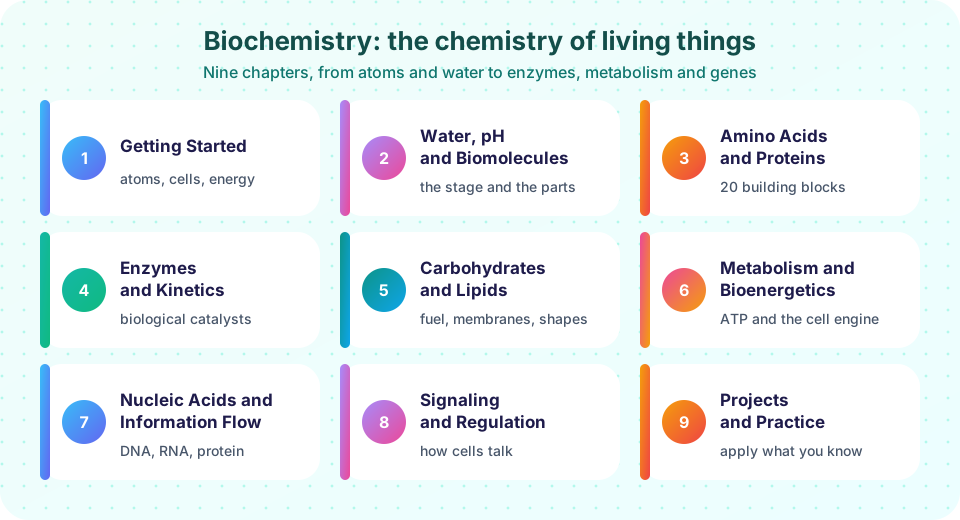
Chapters 1 to 4 (this part of the course) lay the foundations: the molecular setting, water and acid-base chemistry, proteins and enzymes. Chapters 5 to 9 then add the other major biomolecules, metabolism, information flow and regulation, and finish with projects and practice.
How each lesson is built
Every content lesson uses the same shape, so you always know where to look:
- What you will learn: the outcomes, as a checklist.
- Key terms: short definitions in a highlighted box.
- The body: explanations with worked examples and a picture near the top.
- Common misconceptions: wrong ideas that learners often hold, and the correction.
- Try it: interactive examples. Change a number and rerun.
- Check your understanding: a short quiz with explanations.
- Summary and a link to the next lesson.
Each chapter opens with an overview and ends with a review lesson that has a one-page picture and a longer quiz. Treat the review as a dress rehearsal: try it before you look back at the lessons.
How to study biochemistry
Biochemistry has a reputation for demanding memory, but the memory is much lighter if you learn the logic.
- Ask why before what. Why does water dissolve salt but not oil? Why can an enzyme speed up a reaction without changing its equilibrium? Reasons are easier to keep than lists.
- Draw it. Sketch molecules, curves and pathways from memory. If you cannot draw it, you do not know it yet.
- Use numbers. Constants such as RT ≈ 2.5 kJ/mol at 25 °C turn vague statements into estimates.
- Mix practice. Return to earlier quizzes. Spaced retrieval beats re-reading.
- Link scales. Always ask how an atom-level event (a hydrogen bond) shows up in a cell-level behavior (a protein that folds).
Common misconceptions
"Biochemistry is just memorizing pathways." Pathways matter, but they follow from a few principles: thermodynamics, kinetics and molecular recognition. Learn those and pathways become a pattern, not a list.
"Living systems break the laws of chemistry." They do not. Cells use the same energy and equilibrium rules as a test tube; they are simply very good at coupling reactions to each other.
Try it
The first example is a study planner. It is a simple demonstration, not a prescription: it divides an estimated workload by the time you have.
The second example puts molecular sizes on one logarithmic axis. Chapter by chapter, you will move along this axis from atoms to cells.
Press Run (or Ctrl + Enter) to see the result here.
Program input · what you'd type while the program runs
Type the answers before you press Run, one per line. Each time the program reads a line (with input()), it gets the next line from this box.
Check your understanding
Quick check · 4 questions
of 4 answered You scored / 4 · perfect!
-
1. Which description best fits biochemistry?
Biochemistry applies chemical principles to living systems: their molecules, reactions and energy flows. -
2. Why do the lessons recommend asking 'why' before 'what'?
Linking facts to principles such as thermodynamics and molecular recognition makes them easier to remember and to apply. -
3. Which chapter introduces enzymes and kinetics?
Chapter 4 covers enzymes, Michaelis-Menten kinetics and inhibition. Chapter 3 is proteins; chapter 7 is nucleic acids. -
4. A cell obeys the same energy rules as a test tube.
Cells do not break chemistry. They couple energy-releasing reactions to energy-requiring ones.
Summary
- Biochemistry explains life using the laws of chemistry and physics.
- The course moves from the setting (water, energy) to the parts (proteins, enzymes) and onward to fuels, metabolism, information and control.
- Each lesson has outcomes, key terms, worked examples, runnable demos and a quiz.
- Learn principles first; the details of pathways then follow patterns.
Next: The chemistry of life
Track your progress
Create a free account to tick off lessons and pick up where you left off on any device.
of Biochemistry lessons completed