


















Lesson 43 of 43 · Projects and Practice
Where to go next in biochemistry
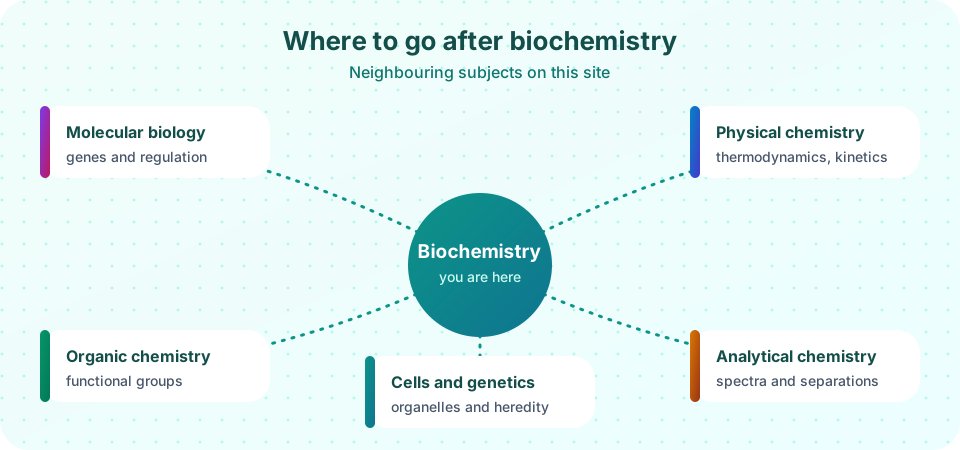
Plan your next steps after biochemistry: how it connects to molecular biology, physical chemistry, organic chemistry, analytical chemistry and cell biology, plus a study plan tool.
You have covered a lot: sugars and fats, the metabolic pathways that turn food into ATP, the flow of information from DNA to protein, and the signals and switches that tune it all. This final lesson shows how biochemistry connects to the neighboring subjects on this site, how to choose what to study next, and how to keep what you learned.
What you will learn
- See how each neighboring subject extends part of biochemistry.
- Choose a next subject based on your interests and goals.
- Build a weekly study plan and a revision routine.
The neighbors
| If you liked... | Study next | Why |
|---|---|---|
| DNA, RNA and the genetic code | Molecular biology | Gene regulation, cloning, PCR and the tools used to read and edit genes |
| Free energy, ATP and equilibrium | Physical chemistry | The thermodynamics and kinetics behind every biochemical calculation |
| Sugar rings, bonds and reactions | Organic chemistry basics | The functional groups and mechanisms of the molecules you met |
| Measurement and evidence | Analytical chemistry | Spectroscopy, chromatography and how concentrations are measured |
| Cells, organelles and heredity | Cells and genetics | The cellular setting where the pathways run |
How the subjects fit together
Think of biochemistry as the bridge between chemistry and biology. From chemistry it takes thermodynamics, kinetics and organic structure. To biology it gives the molecular explanation of how cells work. Moving toward chemistry deepens the why of each reaction (energies, rates and mechanisms), while moving toward biology deepens the where and when (which cells, which developmental stages, which diseases).
Key terms
Interdisciplinary: drawing on more than one field; biochemistry is a classic example.
Spaced repetition: reviewing material at increasing intervals to build long-term memory.
Retrieval practice: testing yourself instead of re-reading.
Study habits that work
- Redraw pathways from memory. Draw glycolysis and the citric acid cycle on a blank page, then check. Gaps show what to review.
- Practice calculations regularly. Free energy, equilibrium and ATP counting improve with repetition; reuse the problem set and the cheat sheet.
- Teach one idea a week to a friend or to yourself out loud. Explaining exposes weak spots.
- Connect, don't memorize. Link each pathway to what regulates it and to where it fits in the cell.
- Review in spaced rounds: one day, one week, one month after learning.
Common misconceptions
"Biochemistry is mostly memorizing pathways." The pathways follow a few chemical principles (oxidation, phosphorylation, condensation), and understanding those makes the details much easier.
"I have to finish everything before moving on." Interleaving subjects helps; revisit biochemistry after molecular biology or physical chemistry and it will make more sense.
Try it
Pick your interests and see a suggested next subject.
A study-plan generator: how many hours per week do you need to finish a goal by a date? The numbers are your own estimates.
Press Run (or Ctrl + Enter) to see the console output here.
No output.
Check your understanding
Quick check · 3 questions
of 3 answered You scored / 3 · perfect!
-
1. Which neighboring subject would best deepen your understanding of ΔG and rate constants?
Physical chemistry covers thermodynamics and kinetics in depth. -
2. What is retrieval practice?
Recalling information strengthens memory more than passive re-reading. -
3. Which subject extends the DNA, RNA and protein material of chapter 7?
Molecular biology studies gene regulation and the tools used to read and edit genes.
Summary
- Biochemistry is the bridge between chemistry and biology; each neighboring subject deepens one side.
- Molecular biology, physical chemistry, organic chemistry, analytical chemistry and cell biology are natural next steps.
- Redraw pathways from memory, practice calculations, teach ideas and review in spaced rounds.
Return to the course overview: Biochemistry
Track your progress
Create a free account to tick off lessons and pick up where you left off on any device.
of Biochemistry lessons completed