


















Lesson 33 of 43 · Nucleic Acids and Information Flow
Transcription, the genetic code and translation
See how RNA polymerase transcribes DNA into mRNA, how the 64-codon genetic code works, how tRNAs and ribosomes build proteins and how mutations change them.
A cell does not read its DNA directly to make proteins. It first makes a temporary RNA copy of a gene, then a ribosome reads that copy three bases at a time and assembles amino acids in the matching order. This two-step design lets a cell make many protein copies from one gene, and it lets the cell regulate how much of each protein it makes. This lesson walks through transcription, the genetic code and translation, with the energy bookkeeping at each stage.
What you will learn
- Describe initiation, elongation and termination of transcription and the extra steps in eukaryotes.
- Read the genetic code and explain its key properties.
- Explain how tRNAs are charged and how the ribosome extends a chain.
- Classify point mutations and predict their effect on a protein.
Key terms
RNA polymerase: the enzyme that builds RNA from a DNA template, 5′→3′, without needing a primer.
Codon: a triplet of mRNA bases that specifies one amino acid or a stop signal.
Anticodon: the three bases on a tRNA that pair with a codon.
Aminoacyl-tRNA synthetase: the enzyme that attaches the correct amino acid to its tRNA.
Reading frame: the way a sequence is divided into triplets, set by the start codon.
Transcription
RNA polymerase binds a promoter, opens a small bubble of DNA and reads one strand, the template strand, 3′→5′ while building RNA 5′→3′. The RNA therefore has the same sequence as the other (coding) strand, with U in place of T. Unlike DNA polymerase, RNA polymerase can begin a chain without a primer.
- Initiation: in bacteria a sigma factor guides the polymerase to promoter sequences. In eukaryotes RNA polymerase II needs general transcription factors that assemble at the TATA box and other elements, and regulatory proteins bind enhancers.
- Elongation: ribonucleoside triphosphates enter; each addition releases pyrophosphate. The polymerase moves along at tens of nucleotides per second.
- Termination: bacteria use signals such as a hairpin in the new RNA; eukaryotes cut the RNA at a signal and the polymerase later falls off.
Eukaryotic transcripts are processed. A 7-methylguanosine cap is added to the 5′ end, a poly-A tail to the 3′ end, and introns are removed by the spliceosome so that exons are joined. Alternative splicing lets one gene encode several proteins. Bacterial mRNA has no introns and is often translated while still being made.
Besides mRNA, cells make tRNA (adaptors), rRNA (the catalytic and structural core of ribosomes) and many regulatory RNAs.
The genetic code
There are 64 possible codons: 61 specify amino acids and 3 (UAA, UAG, UGA) signal stop. AUG codes for methionine and is also the usual start codon. The code is:
- Triplet and non-overlapping: read in one fixed frame.
- Degenerate: most amino acids have several codons, often differing at the third base. Crick's wobble hypothesis explains how fewer tRNAs than codons can still read them all.
- Nearly universal: the same in bacteria, plants and humans, with small variants such as in mitochondria.
tRNA and the ribosome
A tRNA is about 76 nucleotides folded into an L shape. One end carries the amino acid on its 3′ CCA; the other has the anticodon. An aminoacyl-tRNA synthetase attaches the correct amino acid, using ATP and releasing AMP and pyrophosphate, so charging costs two high-energy phosphate bonds. The synthetases are where the code is actually enforced: if they pick the wrong amino acid, the ribosome cannot tell.
The ribosome is made of rRNA and proteins: 70S in bacteria (30S and 50S subunits) and 80S in eukaryotes (40S and 60S). The small subunit holds the mRNA and checks codon–anticodon pairing; the large subunit catalyzes peptide bond formation. That catalytic site, the peptidyl transferase center, is made of RNA, so the ribosome is a ribozyme.
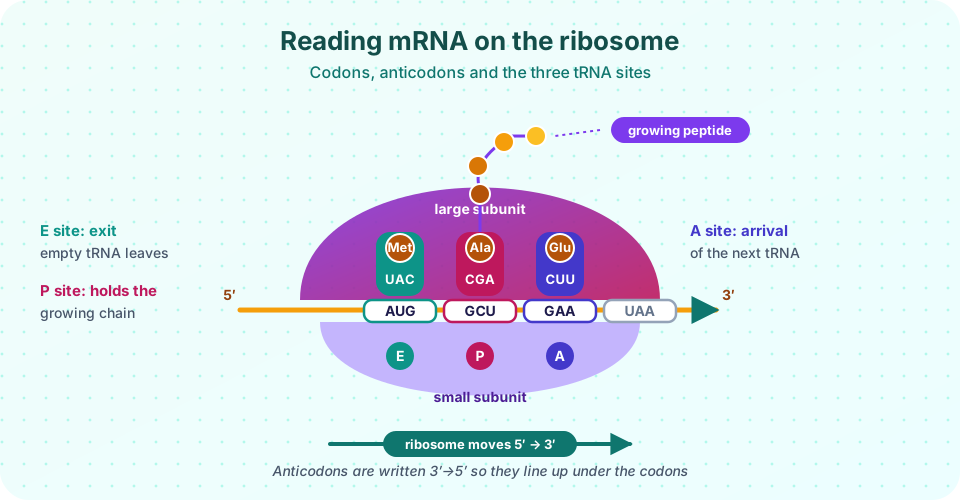
Three tRNA sites are shown in the picture: A (aminoacyl: the new tRNA arrives), P (peptidyl: holds the growing chain) and E (exit). The cycle:
- Initiation: the small subunit finds the start codon (in bacteria via a Shine–Dalgarno sequence), the initiator tRNA binds at P and the large subunit joins.
- Elongation: an elongation factor (EF-Tu in bacteria) delivers an aminoacyl-tRNA to the A site using GTP; the chain on the P-site tRNA is transferred onto the new amino acid (the peptide bond); EF-G and GTP move the ribosome one codon along (translocation).
- Termination: a stop codon in the A site is recognized by a release factor, and the finished chain is released.
Each peptide bond costs about four high-energy phosphate bonds (two to charge the tRNA, one GTP at delivery, one at translocation), which is why protein synthesis is a large part of a growing cell's energy budget.
Mutations
A change in one base can have different effects:
| Type | Example | Effect |
|---|---|---|
| Silent | GAA → GAG | Same amino acid (Glu) |
| Missense | GAG → GTG (mRNA GAG → GUG) | Different amino acid (Glu to Val), as in sickle cell hemoglobin |
| Nonsense | GAA → TAA | Stop codon; truncated protein |
| Frameshift | Insertion or deletion not a multiple of 3 | Everything downstream is changed |
Common misconceptions
"The coding strand is the template." The template strand is the one that is read; the coding strand has the same sequence as the RNA (with T for U).
"Every mutation harms." Many are silent or have little effect; a few help, which is how evolution happens.
"mRNA goes straight from the gene to the ribosome in all cells." In eukaryotes it is capped, spliced, tailed and exported from the nucleus first.
Try it
A transcription and translation machine. The codon table is built from the standard code written in the order U, C, A, G in each position.
Press Run (or Ctrl + Enter) to see the result here.
Program input · what you'd type while the program runs
Type the answers before you press Run, one per line. Each time the program reads a line (with input()), it gets the next line from this box.
Now apply point mutations to the same gene and see their effects.
Press Run (or Ctrl + Enter) to see the result here.
Program input · what you'd type while the program runs
Type the answers before you press Run, one per line. Each time the program reads a line (with input()), it gets the next line from this box.
Check your understanding
Quick check · 5 questions
of 5 answered You scored / 5 · perfect!
-
1. The template strand is 3′-TAC-5′. What is the mRNA codon (5′→3′)?
RNA is complementary and antiparallel to the template: 3′-TAC-5′ gives 5′-AUG-3′. -
2. How many codons code for amino acids in the standard genetic code?
Of 64 codons, 61 specify amino acids and 3 are stop codons. -
3. Which enzyme enforces the genetic code by attaching the right amino acid to a tRNA?
Each synthetase recognizes a specific tRNA and its amino acid; the ribosome only checks codon–anticodon pairing. -
4. A deletion of one base inside a gene causes
Removing one base shifts the reading frame of every downstream codon. -
5. Which part of the ribosome catalyzes peptide bond formation?
The peptidyl transferase center is formed by rRNA, making the ribosome a ribozyme.
Summary
- RNA polymerase builds RNA 5′→3′ from a template strand; eukaryotic RNA is capped, spliced and polyadenylated.
- The genetic code has 64 codons: 61 sense, 3 stop, AUG as start; it is degenerate and nearly universal.
- tRNAs are charged by synthetases; the ribosome decodes mRNA at the A, P and E sites with its rRNA catalyzing peptide bonds.
- Mutations are silent, missense, nonsense or frameshift, depending on their effect on the codons.
Next: Chapter 7 review
Track your progress
Create a free account to tick off lessons and pick up where you left off on any device.
of Biochemistry lessons completed