


















Lesson 17 of 43 · Enzymes and Kinetics
How enzymes work: activation energy, active sites and catalysis
See how enzymes lower activation energy, bind the transition state, and use proximity, acid-base, covalent and metal-ion catalysis, with chymotrypsin as a worked example.
Glucose burns in oxygen with an enormous release of energy, yet a spoonful of sugar can sit in the open air for years. The reaction is favorable but extremely slow, because molecules must pass through a high-energy intermediate state on the way from reactants to products. Enzymes make that passage easier. Understanding how they do it explains both their speed and their selectivity.
What you will learn
- Define activation energy and the transition state.
- Relate a decrease in ΔG‡ to a change in reaction rate.
- Describe the active site, induced fit and the main catalytic strategies.
- Walk through the mechanism of chymotrypsin.
Key terms
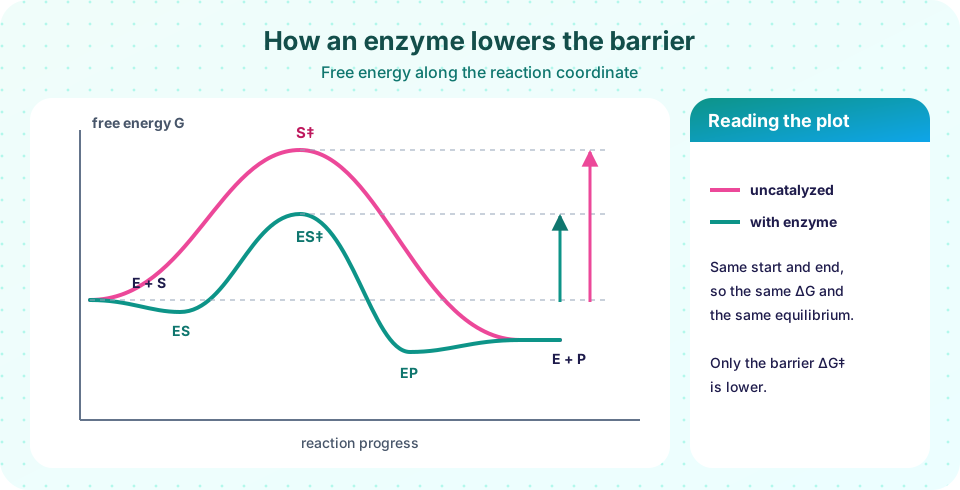
Activation energy (ΔG‡): the free energy needed to reach the transition state from the reactants.
Transition state (S‡): the highest-energy, fleeting arrangement of atoms along the reaction path.
Active site: the pocket of the enzyme where substrate binds and the reaction occurs.
Catalytic triad: three residues (Ser, His, Asp in serine proteases) that work together as a charge-relay system.
Transition-state analog: a stable molecule resembling the transition state, which binds the enzyme very tightly.
Activation energy and the rate
Two things decide how fast a reaction proceeds: how often molecules collide in the right orientation, and whether they have enough energy to climb the barrier. Transition state theory expresses the rate constant as
k = (k_B T / h) · e^(−ΔG‡ / RT)
where k_B T/h is about 6.2 × 10¹² s⁻¹ at 25 °C. The key point is the exponential: every 5.7 kJ/mol cut from the barrier multiplies the rate by about 10 at 25 °C (the same RT ln 10 = 5.7 kJ/mol rule you saw in chapter 1).
An enzyme that speeds up a reaction 10¹⁷-fold has lowered the barrier by 17 × 5.7 ≈ 97 kJ/mol. Even a barrier reduction of 40 kJ/mol gives a speed-up of about 10⁷.
What the enzyme does not do is change the free energy of the reactants and products. The overall ΔG, and therefore the equilibrium constant, is the same with or without the catalyst; the enzyme speeds the forward and reverse reactions equally.
Binding the transition state
Linus Pauling proposed in 1946 that enzymes work by binding the transition state more tightly than the substrate. The active site is therefore complementary not to the substrate in its resting form, but to the strained, partly bonded arrangement of the transition state. Binding energy from many weak contacts (hydrogen bonds, ionic interactions, van der Waals contacts) pays for the distortion and lowers ΔG‡. Evidence includes transition-state analogs, stable molecules shaped like the transition state, which bind enzymes millions of times more tightly than substrates and make powerful inhibitors and drugs.
The early lock-and-key model (Emil Fischer, 1894) pictured a rigid site matching the substrate. Daniel Koshland's induced-fit model (1958) says the site is flexible and reshapes itself on binding. Most enzymes show induced fit; binding the substrate can close a lid or bring catalytic groups into position.
Catalytic strategies
Enzymes combine several tricks, often in the same active site:
- Proximity and orientation. Binding brings reactants together, in the right orientation, at high effective concentration, removing the entropy cost of a bimolecular collision.
- Strain and distortion. The enzyme bends the substrate toward the transition state geometry.
- General acid-base catalysis. Side chains (His, Asp, Glu, Lys, Cys, Tyr) donate or accept protons at just the right moment.
- Covalent catalysis. A nucleophile in the active site forms a temporary covalent bond with the substrate, providing a lower-energy route.
- Metal-ion catalysis. Ions such as Zn²⁺, Mg²⁺ or Fe²⁺ stabilize negative charges, bind water in a more reactive form, or participate in redox steps.
- Microenvironment. A nonpolar pocket can make a charged group more reactive than it would be in water.
Worked example: chymotrypsin
Chymotrypsin is a digestive protease that cleaves peptide bonds on the carboxyl side of large hydrophobic residues (Phe, Tyr, Trp). It illustrates several strategies together:
- Specificity pocket. A deep, hydrophobic pocket accepts the aromatic side chain, positioning the peptide bond to be cleaved next to the catalytic residues.
- Catalytic triad. Ser195, His57 and Asp102 form a charge-relay network. Asp102 orients His57, which acts as a base and pulls a proton from Ser195's hydroxyl, turning it into a strong nucleophile.
- Acylation. The activated serine attacks the carbonyl carbon of the peptide bond, forming a tetrahedral intermediate with a negatively charged oxygen. The backbone N–H groups of the oxyanion hole stabilize this charge by hydrogen bonding. The bond then breaks and the first product (the new amino end of the cleaved chain) leaves, while the other part remains covalently attached to Ser195 as an acyl-enzyme.
- Deacylation. Water enters, activated by His57, and attacks the acyl-enzyme through a second tetrahedral intermediate. The second product (the new carboxyl end) is released and the enzyme is restored.
The covalent acyl-enzyme intermediate is a classic case of covalent catalysis; the oxyanion hole is transition-state stabilization in action.
Common misconceptions
"Enzymes supply energy to reactions." They provide no energy. They lower the barrier by stabilizing the transition state.
"A lower barrier pushes the equilibrium toward products." It speeds up both directions equally, so the equilibrium is unchanged.
"The active site fits the substrate perfectly." It is complementary to the transition state; a too-perfect fit to the substrate would trap it in a stable ES complex and slow the reaction.
Try it
The first example turns the barrier-rate relationship into numbers. It uses the Eyring-type expression above with a few lowered barriers, comparing them with the uncatalyzed rate.
Press Run (or Ctrl + Enter) to see the result here.
Program input · what you'd type while the program runs
Type the answers before you press Run, one per line. Each time the program reads a line (with input()), it gets the next line from this box.
The second example is a model of the reaction coordinate. Drag the slider to lower the barrier and read the speed-up; the flat reactant and product levels stay put.
Check your understanding
Quick check · 5 questions
of 5 answered You scored / 5 · perfect!
-
1. Lowering the activation free energy by 5.7 kJ/mol at 25 °C changes the rate by about:
RT ln 10 is about 5.7 kJ/mol, so each 5.7 kJ/mol multiplies the rate by 10. -
2. An enzyme alters which quantity?
Only the barrier changes; the thermodynamics of reactants and products is unaffected. -
3. Pauling's proposal was that enzymes bind most tightly to:
Stabilizing the transition state lowers the activation energy. -
4. In chymotrypsin, the role of Asp102 is to:
Asp102 orients and polarizes His57, which in turn activates Ser195. -
5. Which is an example of covalent catalysis?
The temporary covalent bond between Ser195 and the substrate provides a lower-energy pathway.
Summary
- Rate depends exponentially on the activation barrier:
k ∝ e^(−ΔG‡/RT); 5.7 kJ/mol buys a factor of 10 at 25 °C. - Enzymes bind and stabilize the transition state, using proximity, strain, acid-base, covalent and metal-ion catalysis.
- Overall ΔG and the equilibrium constant do not change.
- Chymotrypsin shows a catalytic triad, an oxyanion hole and a covalent acyl-enzyme intermediate.
Track your progress
Create a free account to tick off lessons and pick up where you left off on any device.
of Biochemistry lessons completed