


















Lesson 4 of 43 · Getting Started
Chapter 1 review: Getting Started
Review chapter 1 of the Biochemistry course: elements and functional groups, the four classes of biomolecules, cell compartments and free energy.
You now have the vocabulary and the energy rules that every later chapter uses. Before moving on, check that the main ideas hold together. Try the quiz from memory first and look back at the lessons only for questions you miss.
What you will learn
- Recall the key facts of chapter 1 in one place.
- Practice applying free-energy equations with numbers.
- Find the gaps to revisit before chapter 2.
Recap table
| Topic | Key facts |
|---|---|
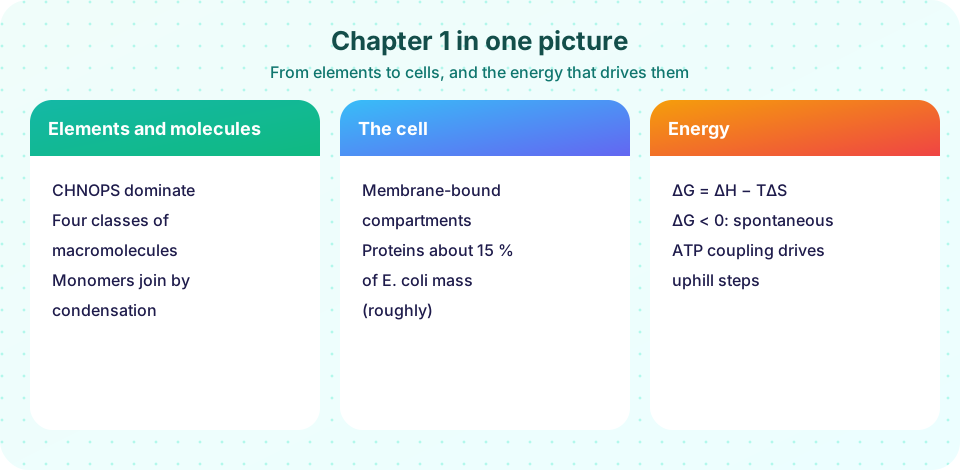
| Elements | CHNOPS make up about 97 % of body mass; carbon forms four stable bonds |
| Functional groups | hydroxyl, carbonyl, carboxyl, amino, phosphate, sulfhydryl, methyl |
| Macromolecules | proteins (amino acids), nucleic acids (nucleotides), carbohydrates (monosaccharides), lipids |
| Reactions | condensation releases water; hydrolysis adds it |
| Cell | prokaryotes lack a nucleus; eukaryotes have organelles with distinct jobs |
| Energy | ΔG = ΔH − TΔS; ΔG°' = −RT ln K'eq; ΔG = ΔG°' + RT ln Q |
| ATP | ΔG°' ≈ −30.5 kJ/mol; coupling adds free energies |
Key terms
CHNOPS: carbon, hydrogen, nitrogen, oxygen, phosphorus, sulfur.
Exergonic: ΔG < 0, can proceed on its own.
Reaction quotient Q: products over reactants at any moment; compare with K'eq to find the direction.
Coupling: linking an unfavorable reaction to a favorable one so the total ΔG is negative.
Common misconceptions
"If ΔG°' is positive the reaction cannot happen." Cells keep Q small by consuming products, which can make the real ΔG negative.
"Hydrolysis builds polymers." Hydrolysis breaks them; condensation builds them.
Try it
A quick tool to move between ΔG°' and the equilibrium constant. Fill in a few values and check them against the 5.7 kJ/mol rule.
Press Run (or Ctrl + Enter) to see the result here.
Program input · what you'd type while the program runs
Type the answers before you press Run, one per line. Each time the program reads a line (with input()), it gets the next line from this box.
And a self-test deck. Click a card to flip it. It is a study aid, not a diagnostic test.
Check your understanding
Quick check · 9 questions
of 9 answered You scored / 9 · perfect!
-
1. Which elements are in CHNOPS?
CHNOPS stands for carbon, hydrogen, nitrogen, oxygen, phosphorus and sulfur. -
2. Which group is basic and is protonated to -NH3+ at pH 7?
Amino groups accept protons. Carboxyl groups lose them. -
3. A condensation reaction between two monomers produces:
Condensation joins monomers and releases H2O. -
4. Which organelle runs oxidative phosphorylation in eukaryotes?
Mitochondria hold the citric acid cycle and the respiratory chain. -
5. ΔH = −40 kJ/mol, ΔS = −100 J/(mol K), T = 298 K. What is ΔG?
ΔG = −40 − 298 × (−0.100) = −40 + 29.8 = −10.2 kJ/mol. -
6. If K'eq = 100 at 25 °C, ΔG°' is closest to:
ΔG°' = −RT ln K = −2.479 × 4.605 ≈ −11.4 kJ/mol. -
7. Why can a reaction with positive ΔG°' proceed in a cell?
ΔG = ΔG°' + RT ln Q. A small Q can make ΔG negative even if ΔG°' is positive. -
8. Which statement about ATP is most accurate?
Hydrolysis releases free energy because of charge relief, solvation and resonance in ADP and Pi. -
9. A spontaneous reaction is always:
Spontaneous means ΔG < 0. The rate depends on the activation barrier.
Summary
- Life is built from CHNOPS, functional groups and four classes of macromolecules joined by condensation.
- Compartments keep different reactions apart in eukaryotic cells.
- ΔG determines the direction; concentrations (Q) and coupling decide what happens in a cell.
- Chapter 2 turns to the solvent that fills every cell: water.
Track your progress
Create a free account to tick off lessons and pick up where you left off on any device.
of Biochemistry lessons completed