


















Lesson 6 of 43 · Water, pH and Biomolecules
Why water is special: structure, hydrogen bonds and the hydrophobic effect
Understand the bent, polar water molecule, hydrogen bonding, high heat capacity, why water dissolves ions and sugars, and how the hydrophobic effect forms micelles.
Water is a small molecule with surprisingly large effects. Compare it with hydrogen sulfide, H₂S, which has the same shape and an element from the same column of the periodic table. H₂S boils at about −60 °C and is a gas at room temperature. Water boils at 100 °C and fills the oceans. The difference is hydrogen bonding, and it is one of the most important facts in biochemistry.
What you will learn
- Describe the geometry and polarity of the water molecule.
- Explain hydrogen bonding and how it raises boiling point and heat capacity.
- Predict what dissolves in water and why.
- Explain the hydrophobic effect and how micelles and membranes form.
Key terms
Polar molecule: a molecule with an uneven charge distribution, giving partial positive (δ+) and negative (δ−) regions.
Hydrogen bond: an attraction between a hydrogen covalently bound to a strongly electronegative atom (N, O) and a lone pair on another such atom.
Hydration shell: a layer of water molecules oriented around a dissolved ion or polar molecule.
Amphipathic: having both a polar (hydrophilic) and a nonpolar (hydrophobic) region.
Hydrophobic effect: the tendency of nonpolar groups to cluster in water, driven mainly by the entropy of the water.
The shape and charge of a water molecule
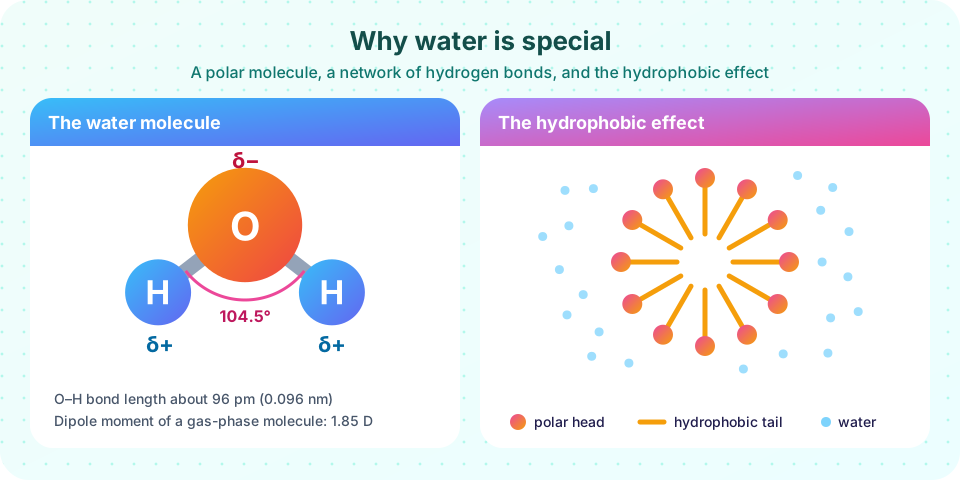
In H₂O, oxygen is much more electronegative than hydrogen (3.44 versus 2.20 on the Pauling scale), so the shared electrons spend more time near oxygen. Oxygen carries a partial negative charge (δ−) and each hydrogen a partial positive charge (δ+). Oxygen also has two lone pairs. The four electron groups around oxygen point roughly to the corners of a tetrahedron, and the two lone pairs push the O–H bonds together slightly, giving an H–O–H angle of 104.5°, a little less than the ideal tetrahedral 109.5°. The O–H bond length is about 96 pm (0.096 nm).
Because the molecule is bent and the charges are uneven, it has a permanent dipole moment (about 1.85 D for an isolated molecule). A linear molecule such as CO₂ has polar bonds but no net dipole because they cancel; water's bent shape is what makes it a polar molecule.
Hydrogen bonding
A δ+ hydrogen of one water molecule is attracted to the δ− oxygen of another. This is a hydrogen bond. Each water molecule can donate two (through its two H atoms) and accept two (through the lone pairs on O), so up to four bonds per molecule. In ice every molecule makes four, in a rigid open lattice that is less dense than liquid. In liquid water the network is constantly rearranging, with an average of roughly three to four bonds per molecule, and each individual bond lasts only picoseconds.
A single hydrogen bond in water has an energy on the order of 20 kJ/mol, about 5 percent the strength of a covalent O–H bond (about 460 kJ/mol). Weak alone, they are enormously important in numbers.
Consequences of hydrogen bonding
- High boiling point. Heat must break many hydrogen bonds before molecules can escape as gas. The heat of vaporization is about 40.7 kJ/mol at 100 °C.
- High specific heat. Raising the temperature of water means breaking and loosening hydrogen bonds as well as speeding up molecules, so it absorbs a lot of heat per degree: 4.18 J/(g·K), higher than most liquids. This buffers cells and bodies against temperature swings.
- Cohesion and surface tension. Molecules at the surface are pulled inward by hydrogen bonding.
- Ice floats. The open lattice of ice (density about 0.917 g/cm³) is less dense than liquid (about 1.00 g/cm³), so lakes freeze from the top and life survives below.
Water as a solvent
Water's high dielectric constant (about 78 at 25 °C) reduces the attraction between opposite charges, so ions separate easily. When NaCl dissolves, water molecules orient their oxygen toward Na⁺ and their hydrogens toward Cl⁻, forming hydration shells. Polar molecules with -OH, C=O, -NH₂ or similar groups, such as sugars and alcohols, dissolve because they can form hydrogen bonds with water. The rule of thumb is like dissolves like.
Nonpolar substances such as hexane or the hydrocarbon tails of fats cannot form hydrogen bonds with water and do not dissolve to any significant degree.
The hydrophobic effect
It is tempting to say that oil and water "repel" each other. What actually happens is that water molecules prefer bonding with each other. Around a nonpolar surface, water molecules cannot hydrogen-bond toward the solute, so they rearrange into a more ordered arrangement, which lowers the entropy of the water. When nonpolar groups cluster together, they expose less surface to water, and some ordered water is released: the entropy of the system rises. At room temperature this entropy gain dominates the free energy, which is why the hydrophobic effect is driven by entropy rather than by attraction between the nonpolar groups.
Biology exploits it constantly:
- Micelles and bilayers. Amphipathic molecules such as fatty acids and phospholipids place their polar heads in the water and tuck their tails together. Phospholipids form bilayers, the basis of every cell membrane.
- Protein folding. Hydrophobic side chains collect in the core of a protein while polar ones remain on the surface.
- Binding. Hydrophobic ligands bury themselves in pockets of receptors and enzymes.
Water ionizes slightly
Water also acts as both an acid and a base. A tiny fraction of molecules transfer a proton: 2 H₂O ⇌ H₃O⁺ + OH⁻ (usually written H₂O ⇌ H⁺ + OH⁻). At 25 °C, Kw = [H⁺][OH⁻] = 1.0 × 10⁻¹⁴ so pure water has [H⁺] = 1.0 × 10⁻⁷ M and pH 7. The concentration of water itself is about 55.5 M (1,000 g/L divided by 18.015 g/mol). The next lessons build on this idea.
Common misconceptions
"Oil and water repel each other." There is no special repulsion. Water molecules attract each other strongly and in doing so exclude nonpolar molecules.
"Hydrogen bonds are covalent bonds." They are electrostatic attractions, roughly 5 to 10 percent as strong as a typical covalent bond, and they break and reform easily.
"Pure water contains only H₂O." A very small fraction is ionized into H⁺ (hydronium) and OH⁻. That is why the pH of pure water is 7 and why water can act as an acid or a base.
Try it
Water's high specific heat means it warms slowly. The calculator below supplies the same heat to 100 g of different substances. It uses typical handbook specific heat values, and applies ΔT = q / (m·c).
Press Run (or Ctrl + Enter) to see the result here.
Program input · what you'd type while the program runs
Type the answers before you press Run, one per line. Each time the program reads a line (with input()), it gets the next line from this box.
Next, a sorter for "like dissolves like". Pick a substance and read the polarity-based prediction. It is a rule-of-thumb demonstration; real solubility also depends on size and temperature.
Check your understanding
Quick check · 6 questions
of 6 answered You scored / 6 · perfect!
-
1. What is the H-O-H bond angle in a water molecule?
The two lone pairs on oxygen compress the angle slightly below the tetrahedral 109.5 degrees, to 104.5 degrees. -
2. How many hydrogen bonds can one water molecule form at most?
Two through its hydrogens (donor) and two through the lone pairs on oxygen (acceptor). -
3. Why does ice float on liquid water?
Ice forms a rigid open lattice with four hydrogen bonds per molecule, lowering its density to about 0.917 g/cm3. -
4. The hydrophobic effect is mainly driven by:
Clustering nonpolar groups frees ordered water, raising entropy. There is no special attraction between the nonpolar groups themselves. -
5. Which molecule is amphipathic?
A fatty acid has a polar carboxyl head and a nonpolar hydrocarbon tail. -
6. Pure water at 25 °C has [H+] of:
Kw = [H+][OH-] = 1 × 10^-14, so in pure water each is 1 × 10^-7 M, giving pH 7.
Summary
- Water is bent (104.5°) and polar, with δ− on oxygen and δ+ on hydrogen.
- Hydrogen bonds (each about 20 kJ/mol) explain water's boiling point, high specific heat and the floating of ice.
- High dielectric constant and hydrogen-bonding ability make water a good solvent for ions and polar molecules.
- The hydrophobic effect, driven by the entropy of water, assembles micelles, bilayers and protein cores.
- Water ionizes slightly: Kw = 10⁻¹⁴ at 25 °C.
Track your progress
Create a free account to tick off lessons and pick up where you left off on any device.
of Biochemistry lessons completed