


















Lesson 42 of 43 · Projects and Practice
Biochemistry cheat sheet
A one-page recap of key biochemistry equations, constants, ATP yields, bond types and the genetic code, with a poster and a calculator for the main formulas.
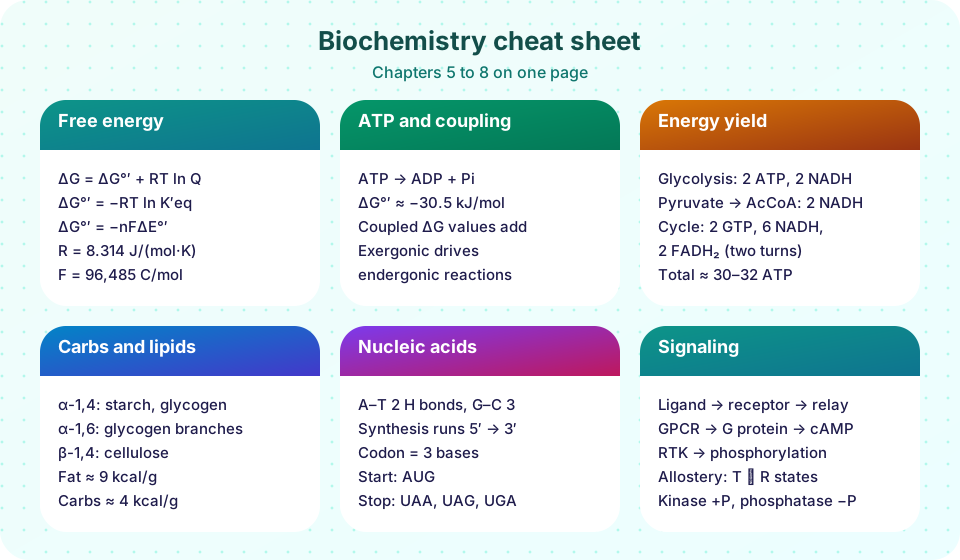
When revising, you want the essential numbers and rules on one page. The poster below collects them; the sections after it add the formulas with units, a few reminders, and a calculator you can reuse. Memorize the structure of the facts, not just the digits: most of the numbers follow from a handful of ideas.
What you will learn
- Recall the main equations and constants with their units.
- Find the right formula for a given problem type.
- Use a calculator to check free energy, equilibrium and redox values.
Equations and constants
| Quantity | Formula | Notes |
|---|---|---|
| Gibbs free energy | ΔG = ΔH − TΔS |
T in kelvin |
| Real free energy | ΔG = ΔG°′ + RT ln Q |
Q = products / reactants |
| Equilibrium | ΔG°′ = −RT ln K′eq |
factor of 10 in K′ per 5.7 kJ/mol at 25 °C |
| Redox | ΔG°′ = −nFΔE°′ |
ΔE°′ = E°′(acceptor) − E°′(donor) |
| Gas constant | R = 8.314 J mol⁻¹ K⁻¹ |
RT = 2.479 kJ/mol at 25 °C; 2.579 at 37 °C |
| Faraday constant | F = 96.485 kJ V⁻¹ mol⁻¹ |
96,485 C/mol |
| Hill equation | Y = pⁿ / (pⁿ + P₅₀ⁿ) |
Hb: n ≈ 2.8, P₅₀ ≈ 26 mmHg |
| ATP hydrolysis | ΔG°′ ≈ −30.5 kJ/mol |
much more negative in cells |
Pathway numbers
| Process | Result |
|---|---|
| Glycolysis | 2 ATP spent, 4 made: net 2 ATP, 2 NADH, 2 pyruvate |
| Pyruvate dehydrogenase | 1 NADH and 1 CO₂ per pyruvate |
| Citric acid cycle (one turn) | 3 NADH, 1 FADH₂, 1 GTP, 2 CO₂ |
| P/O ratios | about 2.5 ATP per NADH, 1.5 per FADH₂ |
| Total per glucose | about 30 to 32 ATP |
| Proton pumping | I: 4, III: 4, IV: 2 H⁺ per 2 e⁻; II: none |
Structure reminders
- Sugars: aldohexose has 16 stereoisomers; α anomer has C1 OH opposite the CH₂OH; equilibrium about 36 % α and 64 % β.
- Bonds: maltose α-1,4; lactose β-1,4; sucrose α-1,β-2; cellulose β-1,4; glycogen branches α-1,6.
- Lipids: cis double bonds kink and lower the melting point; fat about 9 kcal/g, carbohydrate about 4 kcal/g.
- DNA: A–T two hydrogen bonds, G–C three; strands antiparallel; polymerases extend 3′ ends only.
- Code: 64 codons, 61 sense and 3 stop (UAA, UAG, UGA); AUG starts.
Common misconceptions
"A negative ΔG°′ means the reaction runs in the cell." The real ΔG depends on concentrations. Use Q.
"ATP bonds store energy." Hydrolysis is favorable because the products are more stable.
"P/O ratios are exact integers." They are estimates; 30 to 32 is the modern range for ATP per glucose.
Try it
A free energy calculator. Enter ΔG°′ and the concentrations of products and reactants.
Press Run (or Ctrl + Enter) to see the result here.
Program input · what you'd type while the program runs
Type the answers before you press Run, one per line. Each time the program reads a line (with input()), it gets the next line from this box.
A yield and energy density table for quick comparison.
Press Run (or Ctrl + Enter) to see the console output here.
No output.
Check your understanding
Quick check · 3 questions
of 3 answered You scored / 3 · perfect!
-
1. Which equation links standard free energy to the equilibrium constant?
ΔG°′ = −RT ln K′eq. The others are the Gibbs equation and the redox relation. -
2. ATP yield per glucose with textbook P/O ratios is about
4 direct + 10 NADH × 2.5 + 2 FADH₂ × 1.5 = 32. -
3. Which codon is a stop codon?
UAA, UAG and UGA are the three stop codons.
Summary
- Keep five equations at hand: Gibbs, ΔG with Q, ΔG°′ and K, redox and Hill.
- Remember the stage numbers: 2, 2, then 3-1-1-2 per turn, and 30 to 32 ATP in total.
- Link bond types to structures: α-1,4, α-1,6, β-1,4.
- DNA pairing and the genetic code follow simple counting rules.
Track your progress
Create a free account to tick off lessons and pick up where you left off on any device.
of Biochemistry lessons completed