


















Lesson 7 of 43 · Water, pH and Biomolecules
Weak forces that shape biomolecules
Compare hydrogen bonds, ionic interactions, van der Waals forces and the hydrophobic effect in energy and in function, using thermal energy RT as a ruler.
A covalent bond is strong enough to hold a molecule together for years. Yet most of the interactions that make biology work are far weaker: individually they last billionths of a second. They are what let a protein fold and unfold, an enzyme grab and release a substrate, and a DNA strand separate for copying. This lesson ranks these weak forces by energy and shows why many weak bonds together can be both stable and reversible.
What you will learn
- Distinguish covalent from noncovalent interactions by strength and role.
- Describe hydrogen bonds, ionic interactions, van der Waals forces and the hydrophobic effect.
- Use RT as a yardstick for how stable an interaction is.
- Explain why water weakens ionic interactions and why many weak bonds give specific binding.
Key terms
Noncovalent interaction: an attraction between molecules or parts of a molecule that does not involve sharing electrons.
Salt bridge: an ionic interaction between a positively charged group and a negatively charged group, often assisted by hydrogen bonding.
van der Waals force: a weak, short-range attraction between all atoms in close contact, including induced-dipole (London dispersion) forces.
Dielectric constant (ε): how strongly a medium weakens electrostatic forces compared with vacuum.
Thermal energy: the energy scale of random molecular motion, about RT.
RT as a ruler
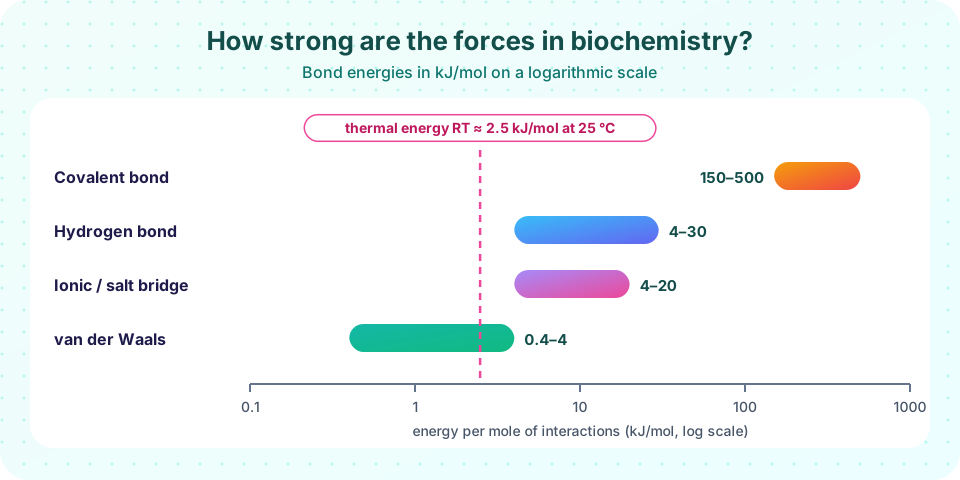
At 25 °C, RT = 8.314 × 298 J/mol ≈ 2.5 kJ/mol. Random collisions give molecules energies of this order. An interaction with energy much smaller than RT is erased almost at once; one that is many times RT persists. A covalent bond (about 346 kJ/mol for C–C) is over a hundred times RT and effectively permanent at body temperature. The noncovalent forces sit between 0.4 and 30 kJ/mol, so they fluctuate.
The four noncovalent forces
Hydrogen bonds
A hydrogen bond links a donor (N–H or O–H) to an acceptor atom with a lone pair (O or N). The strength depends on geometry: it is greatest when donor, hydrogen and acceptor are in a straight line, with a donor–acceptor distance of roughly 0.27 to 0.30 nm. In biological systems hydrogen bonds range from about 4 to 30 kJ/mol. They give specificity: in DNA, A–T pairs form two hydrogen bonds and G–C pairs form three, so base pairing is selective.
In water there is a catch. An unfolded protein can bond with water instead, so the net gain from forming an internal hydrogen bond is smaller than the bond's raw energy. Hydrogen bonds still matter for specificity and for secondary structure, but the hydrophobic effect is usually considered the main driver of folding.
Ionic interactions
Opposite charges attract according to Coulomb's law. The energy of two opposite unit charges separated by a distance r in a medium of dielectric constant ε is:
E = −138.9 / (ε · r) in kJ/mol, with r in nm
At the typical contact distance of r = 0.28 nm: in vacuum (ε = 1) the attraction is about 496 kJ/mol; in a protein interior (ε about 4) about 124 kJ/mol; and in water (ε about 78) only about 6 kJ/mol. This is why salt bridges on a protein surface are fairly weak (the surrounding water screens them) but can be very stabilizing when buried in a nonpolar interior, where charges are unscreened and have a high desolvation cost.
van der Waals forces
Even nonpolar atoms attract at close range, because the electron cloud fluctuates and creates brief dipoles that induce dipoles in neighbors (London dispersion). The attraction falls off as 1/r⁶ and turns into strong repulsion when electron clouds overlap, so each pair of atoms has a favorable "contact distance" (the sum of their van der Waals radii, about 0.34 nm for two carbon atoms). One contact is worth only 0.4 to 4 kJ/mol, but a tightly packed protein core has thousands of them, so they add up and reward good shape fit.
The hydrophobic effect
Described in the previous lesson, this is an entropy-driven preference for hiding nonpolar surfaces from water. It is not a bond at all, but it often contributes the largest share of the free energy of folding and of binding nonpolar ligands.
Many weak bonds, one strong binding
Because free energies add, a handful of weak contacts can produce a strong yet reversible bond. Suppose a protein binds a ligand with a total ΔG = −45 kJ/mol. The dissociation constant follows from Kd = e^(ΔG/RT):
Kd = e^(−45/2.479) ≈ 1.3 × 10⁻⁸ M = 13 nM
If each hydrogen bond or contact contributed about 4 kJ/mol net, you would need roughly eleven of them. Individually each can break many times per microsecond, but at any instant most of them are in place. This also explains specificity: a ligand that is missing even a couple of contacts binds noticeably more weakly, so a protein can pick one molecule out of a crowd.
The same logic explains reversibility: the energy scale is low enough that the complex can dissociate again, which is essential for signaling and catalysis.
Common misconceptions
"Weak interactions are unimportant." Weak refers to the energy of each single contact. Together they determine protein structure, DNA pairing, membrane assembly and drug binding.
"Ionic bonds are always very strong." In a crystal of NaCl they are. In water, high ε and hydration shells weaken them greatly.
"Hydrogen bonds alone fold proteins." They contribute, but water competes for hydrogen bonds and the hydrophobic effect and packing are major forces as well.
Try it
The first plot shows how the medium changes electrostatic attraction. It evaluates E = −138.9/(ε·r) for three media at distances of 0.2 to 1.0 nm.
Press Run (or Ctrl + Enter) to see the result here.
Program input · what you'd type while the program runs
Type the answers before you press Run, one per line. Each time the program reads a line (with input()), it gets the next line from this box.
The second example converts binding free energy into a dissociation constant and shows how many weak contacts are needed.
Press Run (or Ctrl + Enter) to see the result here.
Program input · what you'd type while the program runs
Type the answers before you press Run, one per line. Each time the program reads a line (with input()), it gets the next line from this box.
Check your understanding
Quick check · 5 questions
of 5 answered You scored / 5 · perfect!
-
1. Which interaction is the strongest?
A covalent bond is hundreds of kJ/mol; the others are tens of kJ/mol or less. -
2. Thermal energy RT at 25 °C is about:
R × 298 K = 2.48 kJ/mol. -
3. Why is a salt bridge weaker on the surface of a protein than in its buried core?
Water (ε about 78) screens electrostatics; the nonpolar interior (ε about 4) does not. -
4. A G-C base pair has how many hydrogen bonds?
G-C pairs have three; A-T pairs have two. -
5. A protein-ligand complex has ΔG = −45 kJ/mol at 25 °C. Kd is closest to:
Kd = exp(−45/2.479) ≈ 1.3 × 10^-8 M, or 13 nM.
Summary
- Noncovalent forces are 0.4 to 30 kJ/mol, comparable to RT ≈ 2.5 kJ/mol, so they continually break and reform.
- Hydrogen bonds give directionality and specificity; ionic attraction depends strongly on the medium; van der Waals forces reward close packing; the hydrophobic effect drives burial of nonpolar groups.
- Free energies add: many weak contacts give strong, selective and reversible binding.
Kd = e^(ΔG/RT)links binding energy and affinity.
Next: pH, pKa and buffers
Track your progress
Create a free account to tick off lessons and pick up where you left off on any device.
of Biochemistry lessons completed