


















Lesson 41 of 43 · Projects and Practice
Glossary of key terms
A searchable glossary of 40 biochemistry terms from carbohydrates, lipids, metabolism, nucleic acids and signaling, with flashcards and a quick lookup tool.
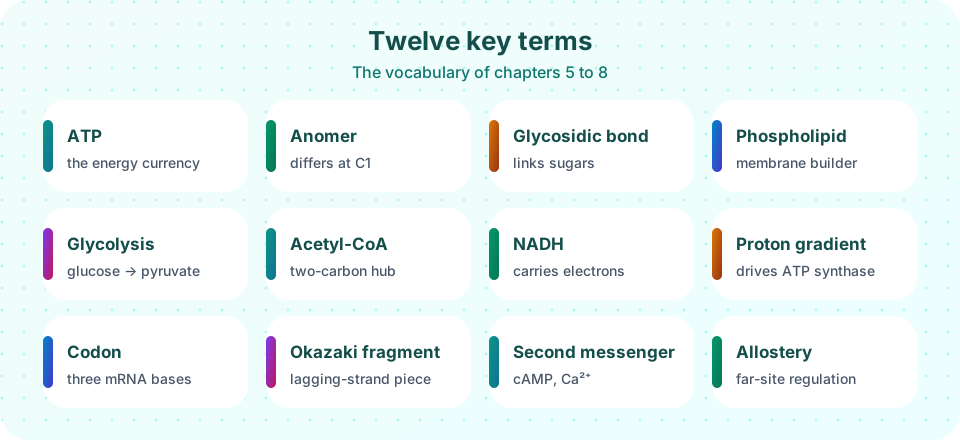
Biochemistry has a large vocabulary, and most of it is built from a few repeated pieces. This glossary collects the terms of chapters 5 to 8 in one place, grouped by topic, with plain-language definitions. Use it as a reference, then test yourself with the flashcards and the lookup tool below.
What you will learn
- Recall the meaning of the main terms from chapters 5 to 8.
- Notice shared word parts (glyco-, -ase, -lysis, kinase) that make new terms easy to guess.
- Practice with flashcards and a lookup tool.
Terms by topic
Carbohydrates and lipids
| Term | Meaning |
|---|---|
| Aldose / ketose | A sugar with an aldehyde / a ketone group |
| Anomer | One of two ring forms differing at the anomeric carbon (α or β) |
| Epimer | Sugars differing at exactly one stereocenter |
| Glycosidic bond | Bond joining the anomeric carbon of a sugar to another molecule |
| Reducing sugar | A sugar with a free anomeric carbon that can reduce oxidants |
| Amylose / amylopectin | Unbranched / branched forms of plant starch |
| Glycogen | Highly branched glucose polymer, the animal energy reserve |
| Cellulose | β-1,4-glucose polymer of plant cell walls |
| Fatty acid | Long hydrocarbon chain with a carboxylic acid end |
| Triacylglycerol | Glycerol with three fatty acids; the main fat store |
| Phospholipid | Lipid with a polar head and hydrophobic tails; builds membranes |
| Amphipathic | Having both hydrophilic and hydrophobic parts |
| Fluid mosaic model | Membranes as fluid lipid bilayers with floating proteins |
Metabolism
| Term | Meaning |
|---|---|
| Catabolism / anabolism | Breakdown pathways releasing energy / building pathways using energy |
| ATP | Adenosine triphosphate; the cell's energy-transfer molecule |
| Phosphoryl transfer potential | Tendency of a phosphate compound to donate its phosphate |
| NADH / FADH₂ | Reduced electron carriers made in catabolism |
| NADPH | Electron carrier used mainly for biosynthesis |
| Coenzyme A | Carrier of acyl groups, such as acetyl |
| Glycolysis | Ten-step cytosolic pathway from glucose to pyruvate |
| Substrate-level phosphorylation | ATP made by direct phosphate transfer from a substrate |
| Fermentation | Anaerobic regeneration of NAD⁺ |
| Citric acid cycle | Matrix pathway oxidizing acetyl-CoA to CO₂ |
| Electron transport chain | Inner-membrane complexes passing electrons to O₂ |
| Proton-motive force | Energy stored in the proton gradient across the inner membrane |
| ATP synthase | Rotary enzyme that makes ATP using the proton gradient |
| Uncoupler | Agent that lets protons leak, wasting the gradient as heat |
Nucleic acids
| Term | Meaning |
|---|---|
| Nucleotide | Base plus sugar plus phosphate |
| Phosphodiester bond | Bond linking nucleotides in a strand |
| Purine / pyrimidine | Two-ring (A, G) / one-ring (C, T, U) bases |
| Semi-conservative | Each daughter duplex keeps one old strand |
| Okazaki fragment | Short piece of the lagging strand |
| Helicase / primase | Enzyme that unwinds DNA / makes the RNA primer |
| Transcription | Making RNA from a DNA template |
| Codon / anticodon | mRNA triplet / the tRNA triplet that pairs with it |
| Ribozyme | RNA that catalyzes a reaction, such as the ribosome's rRNA |
| Frameshift | Insertion or deletion that shifts the reading frame |
Signaling and regulation
| Term | Meaning |
|---|---|
| Ligand | Molecule that binds specifically to a receptor |
| GPCR | G-protein-coupled receptor with seven helices |
| Second messenger | Small intracellular signal such as cAMP or Ca²⁺ |
| Kinase / phosphatase | Enzyme that adds / removes phosphate groups on proteins |
| Allostery | Control of a protein by binding at a separate site |
| Cooperativity | Binding at one site affects the others |
| Feedback inhibition | End product inhibits an early enzyme |
| Zymogen | Inactive enzyme precursor activated by cleavage |
Word parts that help
-ase marks an enzyme (kinase, phosphatase, polymerase). -ose marks a sugar (glucose, ribose). -lysis means breakdown (glycolysis, hydrolysis). Glyco- refers to sugar. Phospho- means a phosphate group is present. Dehydrogenase removes hydrogen (electrons); kinase transfers a phosphate from ATP; synthase builds; mutase moves a group within a molecule.
Common misconceptions
"A kinase and a phosphatase do the same thing." They do opposite things: one adds a phosphate, the other removes it.
"Synthase and synthetase are the same." By convention a synthetase uses ATP directly to join molecules, while a synthase does not, though the names are not always used consistently.
"Reduction means gaining hydrogen only." Reduction is gaining electrons; in biochemistry this often appears as gaining hydrogen atoms.
Try it
Flip through the cards: click a card to reveal the definition, then mark whether you knew it.
A tiny lookup tool: pick any word part and the code lists the matching terms from a small dictionary.
Press Run (or Ctrl + Enter) to see the console output here.
No output.
Check your understanding
Quick check · 4 questions
of 4 answered You scored / 4 · perfect!
-
1. Which pair of terms are opposites?
A kinase adds a phosphate group to a protein; a phosphatase removes it. -
2. A molecule with a polar head and nonpolar tails is
Amphipathic molecules have hydrophilic and hydrophobic regions. -
3. What does the suffix -lysis mean?
Glycolysis is the breakdown of sugar; hydrolysis is breakdown by water. -
4. The tRNA triplet that pairs with an mRNA codon is the
The anticodon base-pairs with the codon on the mRNA.
Summary
- The terms of chapters 5 to 8 follow patterns: -ase for enzymes, -ose for sugars, -lysis for breakdown.
- Pairs such as kinase and phosphatase, catabolism and anabolism, codon and anticodon are best learned together.
- Regular flashcard practice turns recognition into recall.
Next: Biochemistry cheat sheet
Track your progress
Create a free account to tick off lessons and pick up where you left off on any device.
of Biochemistry lessons completed