


















Lesson 27 of 43 · Metabolism and Bioenergetics
ATP, phosphoryl transfer and redox carriers
See how ATP, phosphorylated intermediates, NADH, FADH2 and NADPH carry energy and electrons, with phosphoryl transfer potentials and worked free energy calculations.
Cells cannot burn glucose in one explosive step: the heat would cook them. Instead they release energy in small steps and park it in a few reusable carriers. Chapter 1 introduced free energy and the idea of coupling. This lesson puts names and numbers on the carriers you will meet in every pathway: ATP for group transfer, and NADH, FADH₂ and NADPH for electron transfer.
What you will learn
- Explain why ATP works as an energy shuttle using the phosphoryl-transfer ladder.
- Distinguish substrate-level phosphorylation from oxidative phosphorylation.
- Describe NAD⁺/NADH, FAD/FADH₂, NADPH and coenzyme A and what each carries.
- Calculate a coupled ΔG and the free energy released by electron transfer.
Key terms
Phosphoryl transfer potential: the tendency of a phosphorylated compound to give up its phosphate group, measured by its ΔG°′ of hydrolysis.
Substrate-level phosphorylation: making ATP by transferring a phosphate directly from a high-potential substrate to ADP.
Reduction potential (E°′): how strongly a redox pair holds on to electrons; more positive means a stronger electron acceptor.
Coenzyme: a small organic helper molecule that carries groups or electrons between enzymes.
ATP and the phosphoryl-transfer ladder
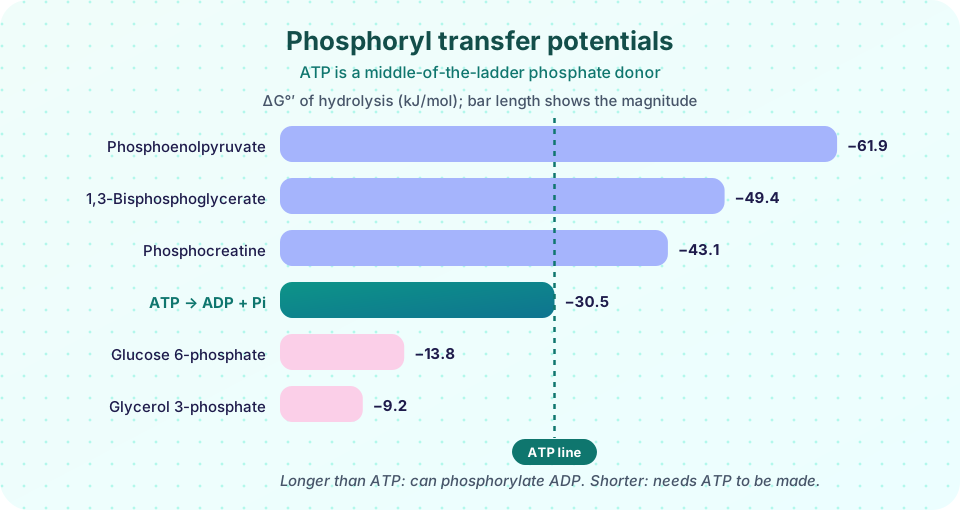
ATP is an adenosine ribonucleotide with three phosphate groups. Hydrolysis to ADP and inorganic phosphate has a standard ΔG°′ of about −30.5 kJ/mol. Other phosphorylated compounds have larger or smaller values, as the chart above shows. A compound with a more negative hydrolysis value can donate its phosphate to ADP and make ATP; one with a less negative value must be phosphorylated by ATP.
This ladder explains several pathway steps you will see next. Phosphoenolpyruvate (PEP, −61.9 kJ/mol) and 1,3-bisphosphoglycerate (−49.4 kJ/mol) both sit above ATP, so glycolysis can make ATP directly from them. Glucose 6-phosphate (−13.8 kJ/mol) sits below ATP, so ATP can phosphorylate glucose. Muscle keeps a reserve of phosphocreatine (−43.1 kJ/mol): when ATP falls, creatine kinase refills it from phosphocreatine and ADP within seconds.
ATP is a good shuttle because it is in the middle: it can be made by compounds above it and can pay for reactions below it. Cells also keep the ATP/ADP ratio far from equilibrium, which makes the real ΔG much more negative than the standard value.
Making ATP: two routes
- Substrate-level phosphorylation: a high-potential phosphate (PEP, 1,3-bisphosphoglycerate, or the thioester succinyl-CoA) is transferred to ADP. This happens in glycolysis and the citric acid cycle and needs no oxygen.
- Oxidative phosphorylation: electrons from NADH and FADH₂ flow down the electron transport chain, which pumps protons; the proton gradient drives ATP synthase. This makes most of the ATP in an aerobic cell, and you will study it in two lessons.
A human adult is commonly said to turn over roughly their own body weight of ATP each day, because each molecule is recycled thousands of times. The cell holds only seconds' worth of ATP at any moment. Adenylate kinase (2 ADP ⇌ ATP + AMP) also helps, and AMP is a sensitive signal that energy is running low.
Electron carriers
NAD⁺/NADH. NAD⁺ is made from the vitamin niacin. It accepts a hydride ion (a proton and two electrons) from a substrate to become NADH. NADH is a freely diffusing carrier that delivers electrons to the respiratory chain. Its reduction potential is E°′ = −0.32 V, a strong electron donor.
FAD/FADH₂. Derived from riboflavin (vitamin B₂), FAD is usually bound tightly to its enzyme (a prosthetic group), for example in succinate dehydrogenase. FADH₂ passes electrons into the chain at a slightly later point than NADH, so it yields less ATP.
NADPH. Differs from NADH only by one extra phosphate. The cell keeps NADPH mostly reduced and uses it for biosynthesis (fatty acids, cholesterol) and defence against oxidative damage, while NAD⁺ is kept mostly oxidized for catabolism. Different ratios give two separate "electron pools".
Coenzyme A. Derived from pantothenic acid (vitamin B₅), it carries acyl groups on a reactive thioester. Acetyl-CoA is the most important such carrier; its thioester has a hydrolysis ΔG°′ of about −31 kJ/mol, similar to ATP.
Free energy of electron transfer
For a redox reaction, ΔG°′ = −n·F·ΔE°′, where n is the number of electrons, F is the Faraday constant (96.485 kJ V⁻¹ mol⁻¹) and ΔE°′ = E°′(acceptor) − E°′(donor). Passing two electrons from NADH (−0.32 V) to oxygen (+0.82 V) gives ΔE°′ = 1.14 V, so ΔG°′ = −2 × 96.485 × 1.14 ≈ −220 kJ/mol. That is enough to pay for several ATP (about 30.5 kJ/mol each at standard conditions), which is why the chain pumps protons in steps instead of making ATP directly.
Common misconceptions
"ATP stores energy in its bonds." Breaking a bond always costs energy. ATP hydrolysis is favorable because its products are more stable (better solvated, less charge repulsion, resonance in phosphate) than ATP.
"ATP is stored in large amounts." A cell holds only a small pool and regenerates it constantly. Long-term energy is stored as fat and glycogen.
"NADH and NADPH do the same job." They carry the same kind of electrons but serve different pathways because the cell maintains different redox ratios for each.
Try it
How negative is ΔG in a living cell? The code uses ΔG = ΔG°′ + RT ln([ADP][Pi]/[ATP]) with illustrative concentrations (typical textbook-scale values, not measurements of a particular cell) and ignores the effect of magnesium.
Press Run (or Ctrl + Enter) to see the result here.
Program input · what you'd type while the program runs
Type the answers before you press Run, one per line. Each time the program reads a line (with input()), it gets the next line from this box.
Now the coupling and redox arithmetic from the text.
Press Run (or Ctrl + Enter) to see the result here.
Program input · what you'd type while the program runs
Type the answers before you press Run, one per line. Each time the program reads a line (with input()), it gets the next line from this box.
Check your understanding
Quick check · 4 questions
of 4 answered You scored / 4 · perfect!
-
1. Why can phosphoenolpyruvate make ATP from ADP?
PEP has a hydrolysis ΔG°′ of about −61.9 kJ/mol, more negative than ATP's −30.5, so it can donate phosphate to ADP. -
2. Which pair describes NADPH's main role compared with NADH?
The cell keeps NADPH mostly reduced for anabolism and NAD⁺ mostly oxidized for catabolism. -
3. ΔE°′ for NADH (−0.32 V) donating to O₂ (+0.82 V) is
ΔE°′ = E°′(acceptor) − E°′(donor) = 0.82 − (−0.32) = 1.14 V. -
4. Which statement about ATP is accurate?
Hydrolysis releases free energy because of charge repulsion relief, solvation and resonance in the products.
Summary
- ATP is a mid-ladder phosphate donor: higher compounds make it, lower ones are made by it.
- Substrate-level phosphorylation and oxidative phosphorylation are the two routes to ATP.
- NADH and FADH₂ carry electrons for the respiratory chain; NADPH serves biosynthesis; CoA carries acyl groups.
ΔG°′ = −nFΔE°′links voltage to free energy; NADH to O₂ releases about 220 kJ/mol.
Next: Glycolysis
Track your progress
Create a free account to tick off lessons and pick up where you left off on any device.
of Biochemistry lessons completed