


















Lesson 34 of 43 · Nucleic Acids and Information Flow
Chapter 7 review: nucleic acids and information flow
Review DNA structure, replication, transcription, the genetic code and translation with a side-by-side summary card and a ten-question mixed quiz.
Three processes carry information from DNA to protein, and all three are template-directed polymerizations that grow chains in a fixed direction using energy-rich monomers. The picture compares them side by side; the table below it adds the numbers and names you should be able to recall.
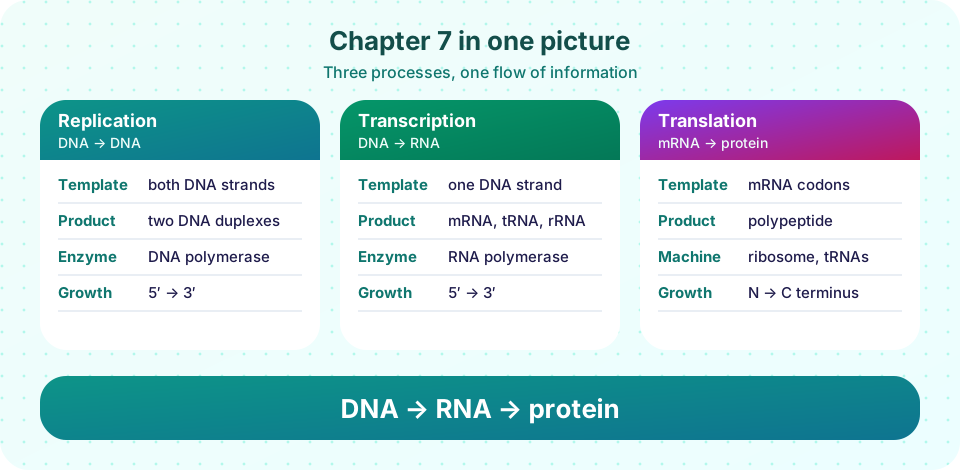
Recap table
| Topic | Key facts | Lesson |
|---|---|---|
| Nucleotides | Base + sugar + phosphate; phosphodiester bonds; chains have 5′ and 3′ ends | DNA structure |
| Double helix | Antiparallel; A–T 2 and G–C 3 hydrogen bonds; ~10 bp per turn; ~2 nm wide | DNA structure |
| Replication | Semi-conservative; helicase, primase, DNA polymerase, ligase; leading and lagging strands | DNA structure |
| Transcription | RNA polymerase reads the template 3′→5′ and makes RNA 5′→3′; no primer | Transcription and translation |
| Genetic code | 64 codons: 61 sense, 3 stop; AUG start; degenerate | Transcription and translation |
| Translation | tRNA charging by synthetases; A, P, E sites; rRNA is the catalyst | Transcription and translation |
| Mutations | Silent, missense, nonsense, frameshift | Transcription and translation |
Connecting the lessons
One rule of direction. DNA, RNA and (in a different sense) proteins each have a built-in direction. Polymerases extend 3′ ends, which explains the lagging strand, and ribosomes add amino acids at the carboxyl end.
Energy everywhere. Each nucleotide addition uses a nucleoside triphosphate and the release of pyrophosphate, which is hydrolyzed to make the reaction irreversible. Each tRNA charging step and each GTP-dependent step of translation draws on the cell's ATP and GTP pools from chapter 6.
Accuracy by several layers. Base pairing, polymerase proofreading, mismatch repair and synthetase editing all reduce errors; each layer adds specificity.
Check your understanding
Quick check · 10 questions
of 10 answered You scored / 10 · perfect!
-
1. Which statement about DNA polymerase is true?
DNA polymerases extend a 3′ hydroxyl of a primer, copying a template. -
2. How many hydrogen bonds join a G–C base pair?
G–C has three; A–T has two. -
3. Okazaki fragments are found
The lagging strand is made discontinuously in short fragments. -
4. The mRNA codon for the start of most proteins is
AUG codes for methionine and marks the usual start. -
5. Which enzyme seals the nicks between Okazaki fragments?
DNA ligase forms the final phosphodiester bond. -
6. In which direction does RNA polymerase synthesize RNA?
Like every polymerase, it extends the 3′ end of the growing chain. -
7. A mutation changes GAA (Glu) to GAG (Glu). This is a
The amino acid is unchanged, so the mutation is silent. -
8. What catalyzes peptide bond formation on the ribosome?
The peptidyl transferase center is RNA, so the ribosome is a ribozyme. -
9. How does the cell ensure that the right amino acid is linked to a tRNA?
The synthetases are the enforcers of the code; the ribosome checks only the codon–anticodon match. -
10. Meselson and Stahl showed that DNA replication is
After one generation all DNA was hybrid; after two, half was hybrid and half light.
Summary
- DNA is copied by semi-conservative replication; RNA is made by transcription; protein by translation.
- All three are template-directed and grow in a fixed direction.
- The genetic code, tRNA charging and ribosome decoding link a base sequence to an amino acid sequence.
- Mutations are classified by their effect on codons.
Track your progress
Create a free account to tick off lessons and pick up where you left off on any device.
of Biochemistry lessons completed