


















Lesson 21 of 43 · Carbohydrates and Lipids
Carbohydrates and lipids: the big picture
See how sugars and fats work as fuel, structure and membranes, and get a map of the four lessons in this chapter before you dive into the details.
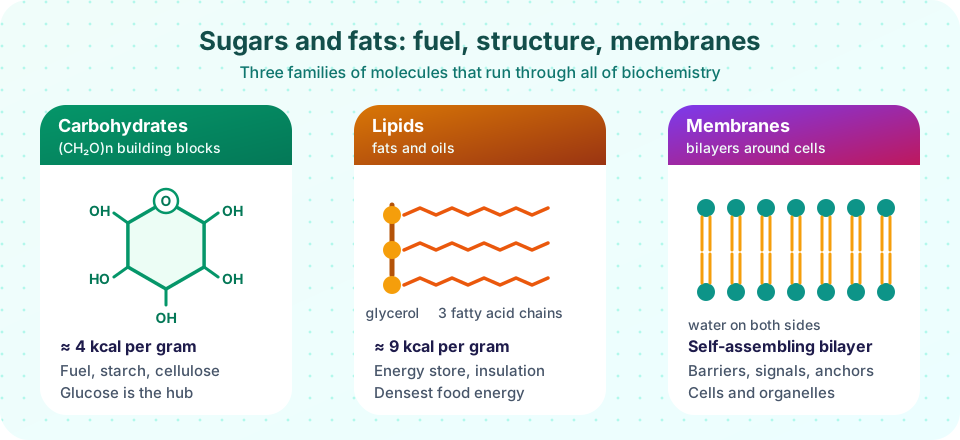
Every meal you eat is mostly carbohydrate, fat and protein. Chapter 3 covered the proteins. This chapter covers the other two big families: carbohydrates (sugars and their polymers) and lipids (fats, membrane lipids and steroids). Between them they supply most of your dietary energy, build the walls and membranes of every cell, and carry some of the most important recognition signals on cell surfaces.
The chapter at a glance
Why sugars and fats?
Carbohydrates
Lipids
The big idea
α versus β links make starch edible and cellulose not.
What you will learn in this chapter
| Lesson | Question it answers |
|---|---|
| Monosaccharides and glycosidic bonds | What is a sugar, why does glucose have two ring forms, and how do sugars join? |
| Polysaccharides: starch, glycogen and cellulose | How can one monomer give a food, a fuel reserve and the stuff of wood? |
| Lipids: fats, fatty acids and membranes | Why do fats store so much energy and why do membranes form on their own? |
| Chapter review | Can you connect all of it? |
Three ideas to carry with you
1. Structure is chemistry you can draw. A glucose molecule is a six-carbon chain with one carbonyl group and five hydroxyl groups. Almost every property of a sugar follows from where those groups sit in space. Swap one hydroxyl and you get a different sugar with a different fate in your body.
2. Polymers are built by condensation. Cells join monomers by removing water, and they take polymers apart by adding it back (hydrolysis). You will see the same pattern in proteins and nucleic acids.
3. Oxidation state explains energy. Fats are more reduced than sugars (more C–H bonds, fewer C–O bonds), so oxidizing them releases more energy per gram: about 9 kcal for fat against about 4 kcal for carbohydrate or protein. Chapter 6 shows how the cell harvests that energy.
Key terms
Carbohydrate: a compound with the general formula (CH₂O)n, or a derivative of one: sugars and their polymers.
Lipid: a biological molecule defined by poor solubility in water and good solubility in organic solvents; not a single chemical family.
Condensation (dehydration) reaction: a reaction that joins two molecules and releases water.
Amphipathic: having a water-loving part and a water-fearing part in the same molecule.
Check your understanding
Quick check · 3 questions
of 3 answered You scored / 3 · perfect!
-
1. Why does fat store more energy per gram than carbohydrate?
Fats have many C–H bonds and little oxygen. Oxidizing a more reduced carbon releases more energy. -
2. A reaction that joins two sugars and releases water is called
Condensation (dehydration) joins monomers and releases a water molecule; hydrolysis is the reverse. -
3. Which word describes a molecule with a polar head and nonpolar tails?
Amphipathic molecules have both hydrophilic and hydrophobic regions, which is why phospholipids form bilayers.
Summary
- Carbohydrates and lipids supply energy, build structures and carry signals.
- Both families are built by condensation and broken down by hydrolysis.
- Fats are more reduced than sugars, so they release more energy per gram.
- This chapter has three content lessons and a review.
Track your progress
Create a free account to tick off lessons and pick up where you left off on any device.
of Biochemistry lessons completed