


















Lesson 40 of 43 · Projects and Practice
Case studies: from molecule to consequence
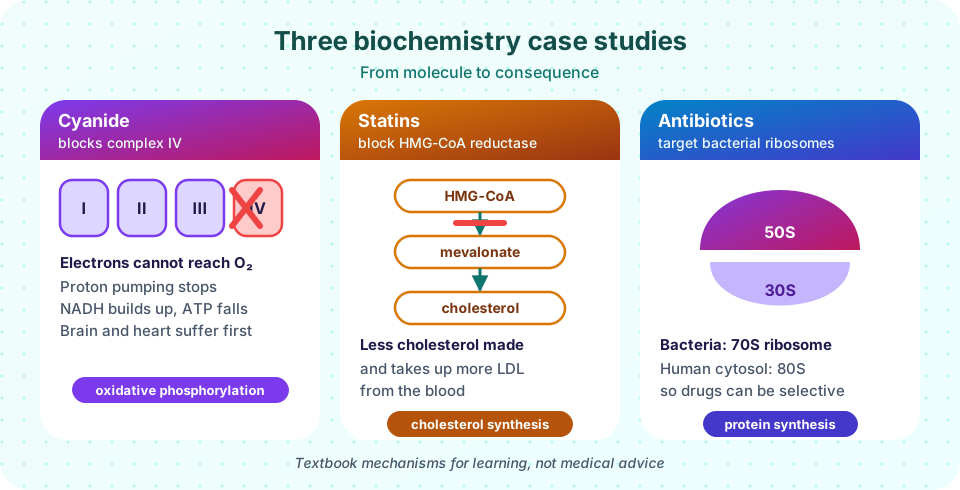
Apply what you learned to three real examples: cyanide and the respiratory chain, statins and cholesterol synthesis, and antibiotics that target bacterial ribosomes.
Biochemistry is useful because it lets you reason from a molecule to its consequence. In each case below you will start with a small chemical fact (a drug binds an enzyme, a poison fits a metal site), follow it through the pathways you have learned, and predict what happens to the cell and the body. Practise the habit of asking three questions: what does it bind, which pathway does that block, and what builds up or runs short as a result?
What you will learn
- Reason from an inhibitor's target to its metabolic consequences.
- Connect the respiratory chain, cholesterol synthesis and translation to real situations.
- Use simple models to see how inhibition changes output.
Key terms
Inhibitor: a molecule that reduces an enzyme's or complex's activity.
IC50: the inhibitor concentration that halves the activity.
Selective toxicity: harming a pathogen without equally harming the host, by exploiting differences between their molecules.
Rate-limiting step: the slowest, most controlled step of a pathway.
Case 1: cyanide and the respiratory chain
Cyanide binds the iron of the heme at the oxygen-reduction site of complex IV (cytochrome c oxidase). Electrons can no longer reach oxygen, so the whole chain backs up: the carriers stay reduced, proton pumping stops and ATP synthase has no gradient to use. Cells cannot make most of their ATP, NADH accumulates and cells fall back on glycolysis, which converts pyruvate to lactate to regenerate NAD⁺ (as in anaerobic exercise). Glycolysis alone makes 2 ATP per glucose instead of about 30 to 32, so tissues with the highest ATP demand, the brain and heart, fail first.
A striking sign is that venous blood stays rich in oxygen, because the tissues cannot use it. Carbon monoxide and azide also block complex IV; the other classic respiratory inhibitors act at other complexes (rotenone at complex I, antimycin A at complex III, oligomycin at ATP synthase). Some plants such as cassava contain cyanide-releasing compounds that must be processed before eating, and cyanide is a good reminder that regulating one enzyme complex can stop a whole organism. This is educational background, not treatment advice.
Case 2: statins and cholesterol synthesis
Cells make cholesterol from acetyl-CoA through a long pathway whose early, rate-limiting step is the conversion of HMG-CoA to mevalonate by HMG-CoA reductase. Statins, first discovered by Akira Endo in a fungal extract in the 1970s, are structural look-alikes of the substrate and inhibit this enzyme. The liver, which makes much of the body's cholesterol, then senses lower intracellular cholesterol. A regulatory protein (SREBP-2) switches on more LDL receptor genes, and the liver pulls more LDL particles out of the blood. The overall effect is lower circulating LDL cholesterol.
Notice how many themes of the course appear: an enzyme controlling a pathway, competitive inhibition, gene regulation (chapter 7) and receptor-mediated uptake. The cell itself regulates this enzyme by feedback, a natural parallel to the feedback inhibition you studied. Statins are also a reminder that doses matter and that no single lesson substitutes for medical advice.
Case 3: antibiotics and the ribosome
Selective toxicity depends on molecular differences. Bacterial ribosomes are 70S (50S plus 30S subunits) and human cytosolic ribosomes are 80S (60S plus 40S), with different rRNAs and proteins, so a drug can bind the bacterial ribosome much better.
- Tetracyclines bind the 30S subunit and block aminoacyl-tRNA from entering the A site.
- Aminoglycosides (streptomycin, gentamicin) bind 30S and cause misreading of codons.
- Macrolides (erythromycin) bind 50S and block the exit tunnel.
- Chloramphenicol blocks the peptidyl transferase center.
Other antibiotics target other steps from the same chapters: rifampicin blocks bacterial RNA polymerase, and quinolones inhibit bacterial topoisomerases needed for replication. Resistance evolves by mutations or enzymes that modify the drug, which is why understanding mechanisms matters. Because mitochondria evolved from bacteria and keep bacteria-like ribosomes, some side effects of ribosome-targeting drugs are thought to involve mitochondrial protein synthesis.
A method for any new case
- Identify the target and its normal job.
- Find the pathway that includes it and the steps just before and after.
- Predict what accumulates upstream and what runs short downstream.
- Ask about compensation: which other pathway can step in, and at what cost?
- Check selectivity: how does the target differ among tissues or species?
Common misconceptions
"Blocking an enzyme stops the pathway completely." Cells often have alternate routes, partial inhibition and feedback that readjusts the flux.
"A poison must damage everything equally." The tissues that depend most on the blocked process fail first.
"An antibiotic that blocks protein synthesis will harm human cells just as much." Selectivity comes from structural differences, though it is rarely perfect.
Try it
A toy model of respiratory inhibition. Slide the fraction of complex IV that is blocked and see the ATP per glucose and the glucose consumption that would be needed to keep ATP supply constant. The model is deliberately simple (30 ATP from oxidative steps scaled by the fraction left, plus 2 from glycolysis); real physiology is far more complex.
Dose-response for any inhibitor can be sketched with a simple rule: activity = 1 / (1 + [I]/IC50). This model assumes one binding site and no cooperativity, so it is generic, not specific to any drug.
Press Run (or Ctrl + Enter) to see the result here.
Program input · what you'd type while the program runs
Type the answers before you press Run, one per line. Each time the program reads a line (with input()), it gets the next line from this box.
Check your understanding
Quick check · 4 questions
of 4 answered You scored / 4 · perfect!
-
1. Why do the brain and heart fail first when complex IV is blocked?
These tissues depend on a continuous large ATP supply that glycolysis alone cannot match. -
2. Which enzyme do statins inhibit?
HMG-CoA reductase catalyzes the rate-limiting step of cholesterol synthesis. -
3. Which antibiotic class blocks the peptidyl transferase center?
Chloramphenicol binds the 50S subunit's catalytic center; tetracyclines block A-site entry and aminoglycosides cause misreading. -
4. What makes selective toxicity possible for ribosome-targeting antibiotics?
Structural differences allow drugs to bind the bacterial ribosome preferentially.
Summary
- Cyanide blocks complex IV: the chain backs up, ATP falls and high-demand tissues fail first.
- Statins inhibit HMG-CoA reductase; the liver compensates by taking up more LDL.
- Antibiotics exploit the differences between bacterial and human ribosomes and other bacterial enzymes.
- A good method asks what is bound, which pathway is blocked, what builds up or runs short, and how the cell compensates.
Next: Glossary of key terms
Track your progress
Create a free account to tick off lessons and pick up where you left off on any device.
of Biochemistry lessons completed