


















Lesson 16 of 43 · Enzymes and Kinetics
Chapter 4 overview: enzymes and kinetics
Overview of chapter 4: how enzymes speed up reactions by factors of millions, how to describe their rates with Michaelis-Menten kinetics, and how inhibitors work.
Left alone, many of the reactions in a cell would take years, centuries or longer at body temperature. Yet cells run them in milliseconds. The difference is enzymes: protein (and in a few cases RNA) catalysts that speed up specific reactions by factors of a million or more without being used up. Without them, there would be no metabolism, no replication, no life as we know it.
What you will learn
- See how the four lessons of this chapter fit together.
- Understand what an enzyme does and does not change.
- Classify enzymes by the type of reaction they catalyze.
The chapter at a glance
What enzymes do
Catalysts change rate, not direction.
How they work
The active site stabilizes the transition state.
How fast?
Saturation: rate has a ceiling.
How to slow them
Drugs and cells use both.
Where each lesson fits
- How enzymes work: activation energy, the transition state, active sites, induced fit and catalytic mechanisms, with the serine protease chymotrypsin as a worked example.
- Michaelis–Menten kinetics: the rate equation, Km, Vmax, kcat, catalytic efficiency and the Lineweaver–Burk plot.
- Enzyme inhibition and regulation: competitive, uncompetitive and noncompetitive inhibition, irreversible inhibitors, allostery, and the effects of pH, temperature and cofactors.
- Chapter 4 review: summary picture and ten questions.
Six classes of enzymes
The International Union of Biochemistry and Molecular Biology classifies enzymes by reaction type (the EC system); a seventh class, translocases, was added in 2018.
| EC class | Reaction | Example |
|---|---|---|
| 1 Oxidoreductases | electron transfer, oxidation and reduction | lactate dehydrogenase |
| 2 Transferases | move a group from one molecule to another | hexokinase (phosphate) |
| 3 Hydrolases | cleave bonds by adding water | trypsin, lipases |
| 4 Lyases | cleave bonds without water or oxidation, often making double bonds | aldolase |
| 5 Isomerases | rearrange atoms within a molecule | triose phosphate isomerase |
| 6 Ligases | join molecules, using ATP | DNA ligase |
| 7 Translocases | move ions or molecules across membranes | ATP synthase (EC 7.1.2.2) |
Common misconceptions
"Enzymes make impossible reactions happen." They accelerate reactions that are thermodynamically favorable; they cannot change ΔG or the equilibrium position.
"Enzymes are used up." An enzyme emerges unchanged from each cycle and can run again; one molecule can process thousands of substrates per second.
"All enzymes are proteins." Nearly all are, but ribozymes (RNA enzymes), such as the ribosomal RNA that forms peptide bonds, also exist.
Try it
First, a look at how much faster some enzymes make reactions. The bars show approximate rate enhancements as powers of ten (values rounded from published estimates of uncatalyzed versus catalyzed rates).
Press Run (or Ctrl + Enter) to see the result here.
Program input · what you'd type while the program runs
Type the answers before you press Run, one per line. Each time the program reads a line (with input()), it gets the next line from this box.
Second, an EC class finder. Choose a reaction type and see which enzyme class it belongs to.
Check your understanding
Quick check · 4 questions
of 4 answered You scored / 4 · perfect!
-
1. An enzyme changes which of the following?
Enzymes lower the activation barrier and speed up both directions; they do not change delta G or K. -
2. Which enzyme class uses water to break bonds?
Hydrolases catalyze hydrolysis. -
3. Which is NOT true of enzymes?
Enzymes are regenerated and can catalyze many cycles. -
4. The induced fit model says that:
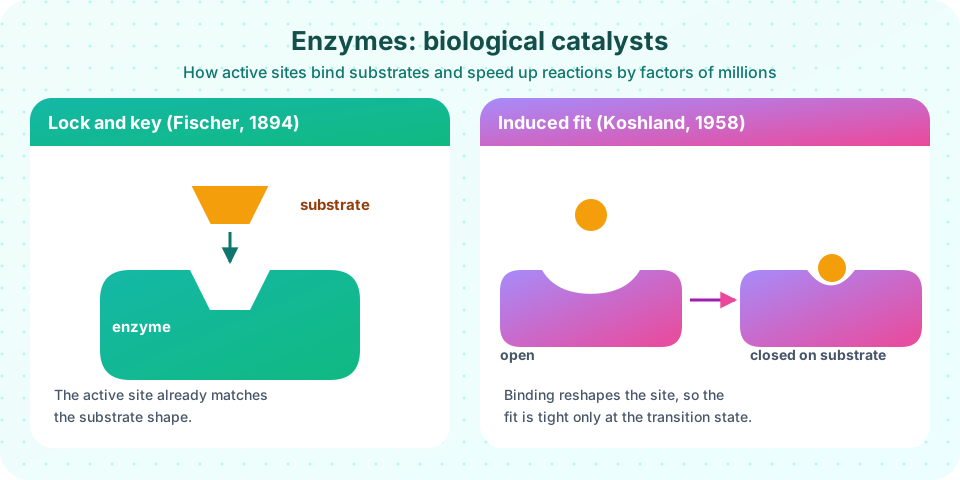
Koshland proposed that binding reshapes the enzyme so the site fits the substrate closely.
Summary
- Enzymes accelerate reactions by lowering activation energy, not by changing ΔG or equilibrium.
- Active sites bind substrates specifically; induced fit and chemical catalysis stabilize the transition state.
- Rates follow Michaelis–Menten kinetics, summarized by Km, Vmax and kcat.
- Inhibitors, pH, temperature and cofactors control enzyme activity.
Next: How enzymes work
Track your progress
Create a free account to tick off lessons and pick up where you left off on any device.
of Biochemistry lessons completed