


















Lesson 26 of 43 · Metabolism and Bioenergetics
Metabolism: the big picture
Get a map of metabolism: the three stages of catabolism, how anabolism builds cell parts, and what the next four lessons on ATP, glycolysis and respiration cover.
Metabolism is the sum of all the chemical reactions in a cell. A human cell runs thousands of them, but they are organized into a few central pathways that you can learn as a map. This chapter walks the main route from food to ATP: how energy is carried, how glucose is split, and how the final oxidation in the mitochondrion makes most of the ATP.
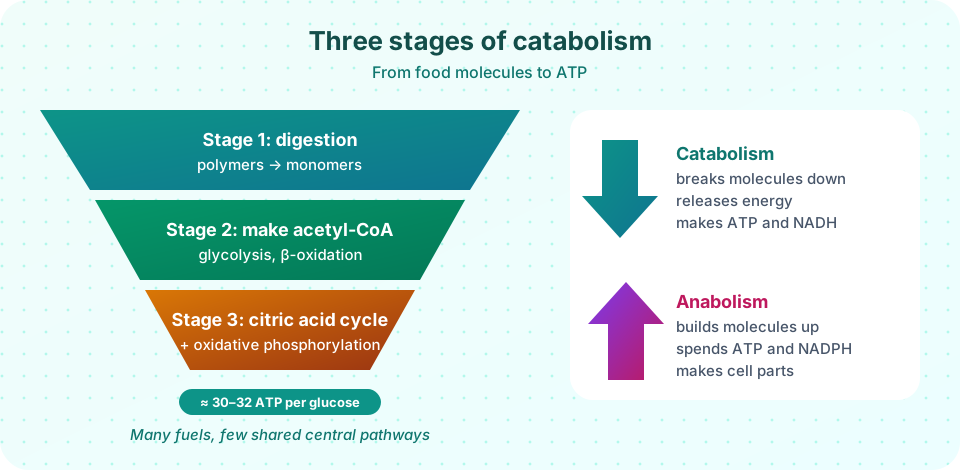
The chapter at a glance
Two directions
Energy carriers
Three stages
- Digest
- Acetyl-CoA
- Oxidize
The payoff
About 30 to 32 ATP per glucose.
What each lesson covers
| Lesson | What you will learn |
|---|---|
| ATP, phosphoryl transfer and redox carriers | How cells move energy and electrons with ATP, NADH and FADH₂ |
| Glycolysis | The ten steps from glucose to pyruvate and the 2 ATP net gain |
| The citric acid cycle and oxidative phosphorylation | How acetyl-CoA is burned and how a proton gradient makes ATP |
| Chapter review | One picture of where everything happens |
Three principles of metabolic design
Pathways share intermediates. Glycolysis, the citric acid cycle and fatty acid oxidation meet at a few molecules such as pyruvate and acetyl-CoA. This lets many fuels use the same machinery.
Reactions are controlled at a few key steps. Most steps in a pathway sit near equilibrium and run either way. A few, usually the ones with a large negative ΔG, are committed steps that enzymes regulate. You will meet these in chapter 8.
Location matters. Glycolysis occurs in the cytosol, the citric acid cycle in the mitochondrial matrix, and the electron transport chain in the inner mitochondrial membrane. Separating them lets the cell run opposite pathways at once, and it creates the compartments needed for a gradient.
Key terms
Metabolism: all the enzyme-catalyzed reactions in a cell.
Catabolism / anabolism: pathways that break molecules down and release energy / build molecules and consume energy.
Intermediate: a molecule that is produced by one step and consumed by the next.
Coenzyme: a small organic molecule, often derived from a vitamin, that carries chemical groups or electrons for an enzyme.
Check your understanding
Quick check · 3 questions
of 3 answered You scored / 3 · perfect!
-
1. Which describes catabolism?
Catabolic pathways degrade fuels and capture energy as ATP and reduced carriers. -
2. Where does glycolysis take place?
Glycolysis enzymes are soluble proteins in the cytosol. -
3. Which molecule is the common entry point from sugars and fats into the citric acid cycle?
Acetyl-CoA collects two-carbon units from glycolysis (via pyruvate) and from fatty acid oxidation.
Summary
- Metabolism is organized into a few central pathways shared by many fuels.
- Catabolism releases energy and builds ATP, NADH and FADH₂; anabolism spends ATP and NADPH.
- Digestion, acetyl-CoA formation and oxidation are the three stages of catabolism.
- Pathways are located in specific compartments.
Track your progress
Create a free account to tick off lessons and pick up where you left off on any device.
of Biochemistry lessons completed