


















Lesson 28 of 43 · Metabolism and Bioenergetics
Glycolysis: from glucose to pyruvate
Walk through all ten steps of glycolysis, count the ATP and NADH, learn the three regulated steps and see what happens to pyruvate with and without oxygen.
Glycolysis ("splitting sugar") is the oldest central pathway in metabolism. It runs in the cytosol of nearly every living cell, needs no oxygen, and turns one six-carbon glucose into two three-carbon pyruvate molecules while capturing a small amount of energy as ATP and NADH. Red blood cells, which have no mitochondria, depend on it completely; your muscles use it for short, intense bursts; and it feeds the mitochondria in every other cell.
What you will learn
- Name the ten steps of glycolysis, the key enzymes and where ATP and NADH are used or made.
- Calculate the net yield of ATP and NADH from one glucose.
- Identify the three regulated steps and the signals that control them.
- Describe the fates of pyruvate and why fermentation regenerates NAD⁺.
Key terms
Glycolysis: the ten-step pathway converting glucose to two pyruvate in the cytosol.
Substrate-level phosphorylation: ATP made by direct phosphate transfer from a pathway intermediate (steps 7 and 10).
Committed step: the first step that is irreversible and unique to a pathway; in glycolysis, phosphofructokinase-1.
Fermentation: anaerobic regeneration of NAD⁺ by reducing pyruvate (or a derivative) so glycolysis can continue.
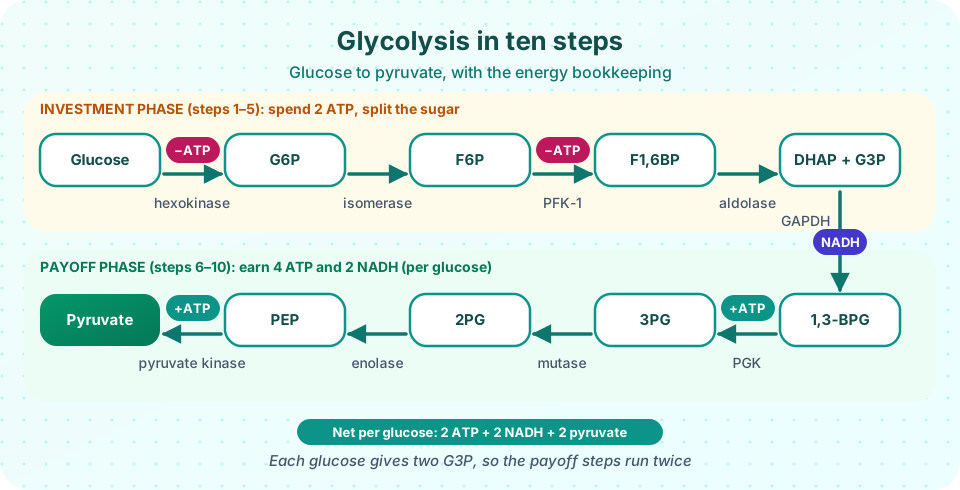
The investment phase (steps 1 to 5)
- Hexokinase transfers a phosphate from ATP to glucose, making glucose 6-phosphate (G6P). This traps glucose inside the cell, because the charged product cannot leave through the glucose transporter. (Liver cells use a related enzyme, glucokinase.)
- Phosphoglucose isomerase converts the aldose G6P into the ketose fructose 6-phosphate (F6P).
- Phosphofructokinase-1 (PFK-1) uses a second ATP to make fructose 1,6-bisphosphate. This is the committed, most tightly regulated step.
- Aldolase splits the six-carbon bisphosphate into two three-carbon sugars: dihydroxyacetone phosphate (DHAP) and glyceraldehyde 3-phosphate (G3P).
- Triose phosphate isomerase converts DHAP into G3P, so both halves of the sugar continue down the pathway.
Net result of this phase: two ATP spent, and one glucose has become two G3P.
The payoff phase (steps 6 to 10, each run twice)
- Glyceraldehyde 3-phosphate dehydrogenase (GAPDH) oxidizes the aldehyde and adds inorganic phosphate, making 1,3-bisphosphoglycerate and reducing NAD⁺ to NADH. This is the only oxidation step in glycolysis.
- Phosphoglycerate kinase moves a phosphate from 1,3-bisphosphoglycerate to ADP, making ATP and 3-phosphoglycerate. This is substrate-level phosphorylation.
- Phosphoglycerate mutase shifts the phosphate from carbon 3 to carbon 2, giving 2-phosphoglycerate.
- Enolase removes water, creating phosphoenolpyruvate (PEP), a compound with a very high phosphoryl-transfer potential (see the previous lesson).
- Pyruvate kinase transfers the phosphate of PEP to ADP, making ATP and pyruvate.
Per glucose the payoff phase makes 4 ATP and 2 NADH. Subtract the 2 ATP invested: net 2 ATP and 2 NADH.
Glucose + 2 NAD⁺ + 2 ADP + 2 Pi → 2 pyruvate + 2 NADH + 2 H⁺ + 2 ATP + 2 H₂O
Control of glycolysis
Three steps have large negative ΔG values in cells and are the sites of control: hexokinase, PFK-1 and pyruvate kinase.
- PFK-1 is inhibited by high ATP and by citrate (plenty of fuel and building blocks) and activated by AMP and by fructose 2,6-bisphosphate, a regulator whose level is set by hormones. This is the main throttle.
- Hexokinase (in most tissues) is inhibited by its own product, G6P, so glucose is not trapped faster than it is used.
- Pyruvate kinase is activated by fructose 1,6-bisphosphate (a feed-forward signal) and is switched off by phosphorylation when blood glucose is low, in the liver.
Regulation by allosteric effectors and covalent modification is the topic of chapter 8.
What happens to pyruvate
- With oxygen: pyruvate enters the mitochondrion and is converted to acetyl-CoA (releasing CO₂ and forming NADH), then oxidized in the citric acid cycle.
- Without oxygen in muscle: lactate dehydrogenase reduces pyruvate to lactate, oxidizing NADH back to NAD⁺. Glycolysis needs NAD⁺ at step 6, so without this step it would stop. Lactate is carried to the liver, which can turn it back to glucose.
- In yeast: pyruvate is decarboxylated to acetaldehyde, which is reduced to ethanol, again regenerating NAD⁺.
Many tumors also run glycolysis at a high rate even with oxygen present, a phenomenon called the Warburg effect; the reasons are still being studied.
Common misconceptions
"Glycolysis makes lots of ATP." The net gain is only 2 ATP per glucose; the large yield comes later from oxidative phosphorylation.
"Lactic acid causes the burn and the next-day soreness." Muscle lactate is a fuel and a shuttle. Delayed soreness is caused mainly by microscopic muscle damage, not lactate.
"All glycolysis reactions are irreversible." Seven of the ten steps operate close to equilibrium and run backward during gluconeogenesis; only three are bypassed.
Try it
Standard free energy change of each step (values from standard biochemistry tables, kJ/mol). Several steps are uphill under standard conditions, yet the pathway runs because cell concentrations and downstream steps pull it along. The aldolase example uses illustrative concentrations chosen for the demonstration.
Press Run (or Ctrl + Enter) to see the result here.
Program input · what you'd type while the program runs
Type the answers before you press Run, one per line. Each time the program reads a line (with input()), it gets the next line from this box.
A stepper that keeps the books. Click through the steps and watch the ATP and NADH counters; from step 6 on, everything counts twice because one glucose gives two G3P.
Check your understanding
Quick check · 5 questions
of 5 answered You scored / 5 · perfect!
-
1. What is the net ATP yield of glycolysis per glucose?
Two ATP are spent in the investment phase and four are made in the payoff phase, a net of two. -
2. Which enzyme catalyzes the committed step of glycolysis?
PFK-1 makes fructose 1,6-bisphosphate and is the main regulated step. -
3. Why does muscle make lactate during intense exercise?
Lactate dehydrogenase oxidizes NADH to NAD⁺ while reducing pyruvate, keeping step 6 supplied with NAD⁺. -
4. Which step makes NADH?
GAPDH is the only oxidation step in glycolysis and reduces NAD⁺ to NADH. -
5. Which signal activates PFK-1?
AMP signals low energy and activates PFK-1; ATP and citrate inhibit it.
Summary
- Glycolysis converts glucose to two pyruvate in ten cytosolic steps with a net of 2 ATP and 2 NADH.
- The investment phase spends 2 ATP and ends with two G3P; the payoff phase runs twice per glucose.
- Hexokinase, PFK-1 and pyruvate kinase are the regulated steps; PFK-1 is the main control point.
- Pyruvate goes to acetyl-CoA with oxygen or is fermented to lactate or ethanol without it, regenerating NAD⁺.
Track your progress
Create a free account to tick off lessons and pick up where you left off on any device.
of Biochemistry lessons completed