


















Lesson 18 of 43 · Enzymes and Kinetics
Michaelis–Menten kinetics: Km, Vmax and kcat
Derive the Michaelis-Menten equation, interpret Km, Vmax, kcat and catalytic efficiency, and analyze data with nonlinear fits and Lineweaver-Burk plots.
How fast does an enzyme work? The question has two halves. How fast can it go when it is fully loaded with substrate? And how much substrate does it need to get there? In 1913 Leonor Michaelis and Maud Menten answered both with a short equation that is still the foundation of enzyme kinetics. In this lesson you will derive it, read it and use it on data.
What you will learn
- State the Michaelis–Menten model and its assumptions.
- Interpret Km, Vmax, kcat and kcat/Km.
- Calculate rates from the equation and estimate parameters from data.
- Use and criticize the Lineweaver–Burk plot.
Key terms
Initial rate (v): the rate measured early, before substrate is depleted or product accumulates.
Vmax: the maximum rate, reached when all enzyme is bound to substrate: Vmax = kcat [E]total.
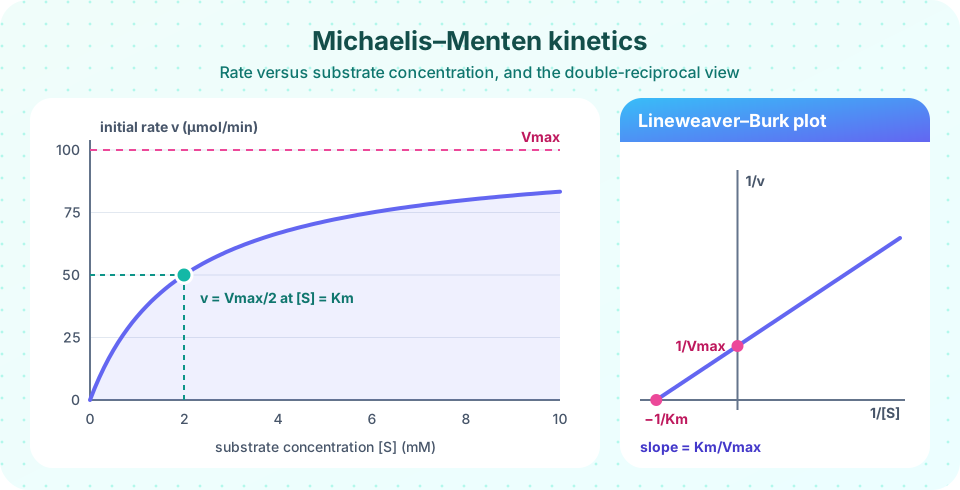
Km: the substrate concentration at which v = Vmax/2.
kcat (turnover number): substrate molecules converted per enzyme active site per second at saturation.
Catalytic efficiency: kcat/Km, which describes how well an enzyme works at low substrate concentration.
The model
Michaelis and Menten proposed that the enzyme E and substrate S first form a complex ES, which then yields product P and free enzyme:
E + S ⇌ ES → E + P with rate constants k₁ (forward), k₋₁ (back) and k_cat (catalytic step).
Assume that initial rates are measured (product is negligible, so the reverse reaction of P can be ignored) and that after a very short time the ES complex is in a steady state: it forms as fast as it breaks down. (Briggs and Haldane introduced the steady-state assumption in 1925; Michaelis and Menten originally assumed rapid equilibrium.) Then:
k₁[E][S] = (k₋₁ + k_cat)[ES]
Define Km = (k₋₁ + k_cat)/k₁. With total enzyme [E]t = [E] + [ES], solving for [ES] and using v = k_cat[ES] gives the Michaelis–Menten equation:
v = Vmax [S] / (Km + [S]), with Vmax = k_cat [E]t.
Reading the equation
- When
[S] << Km, the equation reduces tov ≈ (Vmax/Km)[S]: the rate is first order in substrate. - When
[S] = Km,v = Vmax/2. - When
[S] >> Km,v ≈ Vmax: the rate is zero order, because every enzyme is busy. Adding more substrate no longer helps.
Worked example. An enzyme has Km = 2 mM and Vmax = 100 µmol/min. At [S] = 0.5 mM, v = 100 × 0.5/(2 + 0.5) = 20 µmol/min. At 2 mM, v = 50. At 20 mM, v = 100 × 20/22 = 90.9. To reach 90 percent of Vmax you need [S] = 9 Km = 18 mM, a general result.
What the parameters mean
- Km is a combination of rate constants. If the catalytic step is slow compared with dissociation (
k_cat << k₋₁), Km approximates the dissociation constant Kd of ES, so a small Km often means high affinity. But it is not always Kd. Typical Km values are about 10⁻⁶ to 10⁻² M, and an enzyme's Km is often close to the physiological concentration of its substrate, which keeps the rate responsive to changes. - Vmax depends on how much enzyme is present, so it is not a constant of the enzyme itself. Doubling [E]t doubles Vmax.
- k_cat is the turnover number,
Vmax/[E]t. Values range widely: roughly 1 s⁻¹ for slow enzymes to about 10⁶ s⁻¹ for carbonic anhydrase and about 4 × 10⁷ s⁻¹ for catalase. - k_cat/Km is the second-order rate constant for reaction at low substrate. It has an upper limit set by how often enzyme and substrate collide by diffusion, about 10⁸ to 10⁹ M⁻¹ s⁻¹. Enzymes near this limit, such as triose phosphate isomerase, are called catalytically perfect.
From data to parameters
Experimentally one measures initial rates at several substrate concentrations. The best method is a nonlinear least-squares fit of the hyperbola to the data. Before computers, people linearized the equation. The Lineweaver–Burk (double-reciprocal) plot uses
1/v = (Km/Vmax)(1/[S]) + 1/Vmax
giving a straight line with slope Km/Vmax, y-intercept 1/Vmax and x-intercept −1/Km. It is useful for seeing how inhibitors change the lines (next lesson) but poor for fitting: small rates at low [S] become large 1/v values with large errors, and the points are not evenly spread, so the fit is dominated by the least reliable measurements.
Assumptions to keep in mind: [S] >> [E]t, initial rate conditions, a single substrate and a single active site type. Many enzymes violate these (cooperative enzymes follow sigmoidal curves, allosteric enzymes can have more than one substrate), and then more general models apply.
Common misconceptions
"Km is a measure of how fast the enzyme works." Km is a concentration. Speed is described by kcat and Vmax.
"A high Km means high affinity." It means low apparent affinity: more substrate is needed to reach half Vmax.
"Vmax is a constant of the enzyme." It scales with the amount of enzyme; kcat is the per-enzyme constant.
Try it
The first example simulates noisy rate data from an enzyme with known parameters, then recovers them with a nonlinear fit and with a Lineweaver–Burk line. The random numbers are seeded so you will see the same data on each run.
Press Run (or Ctrl + Enter) to see the result here.
Program input · what you'd type while the program runs
Type the answers before you press Run, one per line. Each time the program reads a line (with input()), it gets the next line from this box.
The second example is an interactive curve. Change Km, Vmax and the substrate concentration to see the rate and the fraction of Vmax. It evaluates the equation only.
Check your understanding
Quick check · 6 questions
of 6 answered You scored / 6 · perfect!
-
1. At [S] = Km, the reaction rate is:
From v = Vmax[S]/(Km + [S]), setting [S] = Km gives v = Vmax/2. -
2. An enzyme with Km = 4 mM and Vmax = 80 µmol/min has what rate at [S] = 4 mM?
At [S] = Km the rate is Vmax/2 = 40 µmol/min. -
3. Doubling the amount of enzyme (same Km and kcat) will:
Vmax = kcat [E]t, so Vmax scales with enzyme concentration; Km and kcat do not change. -
4. What is the x-intercept of a Lineweaver-Burk plot?
Setting 1/v = 0 gives 1/[S] = -1/Km. -
5. The upper limit for kcat/Km for most enzymes is set by:
An enzyme cannot react faster than substrate and enzyme meet by diffusion. -
6. How much substrate is needed for 90% of Vmax?
0.9 = [S]/(Km + [S]) gives [S] = 9 Km.
Summary
- Michaelis–Menten:
v = Vmax[S]/(Km + [S])withVmax = kcat[E]t. - Km is the [S] giving half of Vmax; kcat is turnover per site; kcat/Km measures efficiency at low [S] and is limited by diffusion.
- Fit data with nonlinear regression; Lineweaver–Burk plots are valuable for visualizing inhibition but poor for estimation.
- The model assumes initial rates, steady-state ES and [S] >> [E].
Track your progress
Create a free account to tick off lessons and pick up where you left off on any device.
of Biochemistry lessons completed