


















Lesson 17 of 43 · Life Insurance Benefits
Whole life and term insurance
Compute the actuarial present value of whole life and term insurance, discrete and continuous, with the variance of the benefit, the recursion A(x) and runnable code.
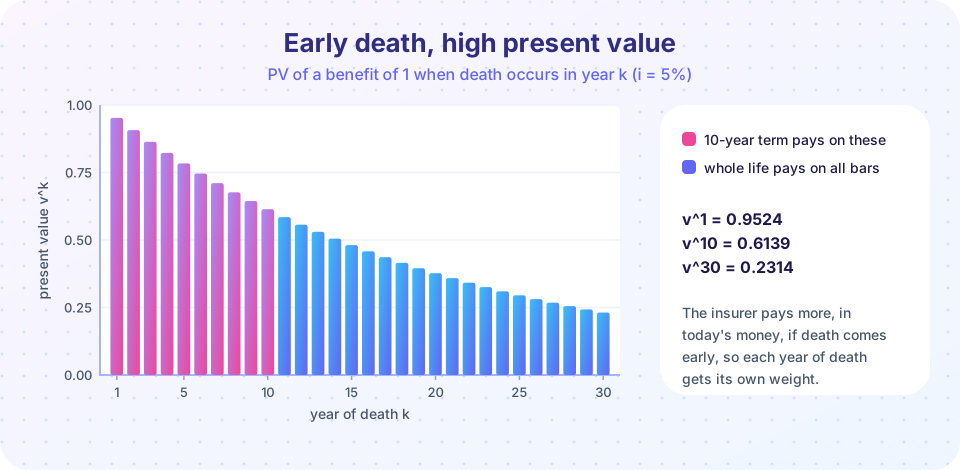
Life insurance is the oldest product of the profession and the cleanest example of the method: pay a sum when someone dies, and price it as the expected present value. This lesson works out two products. Whole life insurance pays whenever death occurs, however late. Term insurance pays only if death occurs within a stated period, so it costs much less and is the cheap, temporary protection a young family buys.
You will compute the APV, compare discrete payments (end of the year of death) with continuous ones (at the moment of death), and find the variance of the benefit, which tells the insurer how risky one policy is.
What you will learn
- The formula for
A xand for term insuranceA^1 x:n. - How to find the second moment
2A xand the variance ofZ. - The recursion
A x = v q x + v p x A (x+1). - How continuous benefits relate to discrete ones.
Key terms
A x: APV of whole life insurance of 1 paid at the end of the year of death.
A^1 x:n: APV of n-year term insurance (pays 1 if death within n years).
Abar x: APV of whole life insurance of 1 paid at the moment of death.
Sum assured: the amount paid on death.
Net single premium: the APV paid at issue as one lump sum.
Whole life, discrete
For a life aged x, K = curtate future lifetime and Z = v^(K+1). Then
A x = E[v^(K+1)] = sum over k = 0, 1, 2, ... of v^(k+1) * k p x * q (x+k).
In the illustrative model with i = 5%, a 40-year-old has A 40 = 0.2258, and a 65-year-old has A 65 = 0.5323. For a sum assured of 200,000 on a 40-year-old, the net single premium is about 200,000 x 0.2258 = 45,160. For a 65-year-old it is 106,460. Older lives cost much more per unit because death is much closer (and the discounting less) even though the benefit is the same.
Term insurance
An n-year term insurance pays 1 at the end of the year of death only if death occurs in the next n years:
A^1 x:n = sum over k = 0 to n-1 of v^(k+1) * k p x * q (x+k).
For a 40-year-old and n = 10 the APV is 0.0329. A 100,000 ten-year term policy therefore has a net single premium of about 3,285; a 40-year-old is unlikely to die within ten years, and any payment is discounted. For a 65-year-old, A^1 65:10 = 0.2578, about eight times as expensive per unit, because death in the next decade is far more likely. A whole life policy equals term policies stacked: A x = A^1 x:n + n E x * A (x+n), which says: term cover for n years, then, if you survive, whole life from age x+n (the n E x factor is the discounted survival probability, covered in the next lesson).
Press Run (or Ctrl + Enter) to see the result here.
Program input · what you'd type while the program runs
Type the answers before you press Run, one per line. Each time the program reads a line (with input()), it gets the next line from this box.
Variance of the benefit
One policy's benefit is a random variable, and its variability matters to the insurer: with a whole life of 1 on a 40-year-old, the present value ranges from near 1 (early death) to almost 0 (very late death). The variance is Var(Z) = 2A x - (A x)^2, where 2A x is the APV computed with v^2 in place of v (the same as using interest rate i2 = 2i + i^2, because v^2 = 1/(1+i2)). For a 40-year-old: 2A 40 = 0.0761, so Var(Z) = 0.0761 - 0.2258^2 = 0.0251 and the standard deviation is 0.158. The standard deviation is about 70% of the mean: one policy is very risky, which is why insurers pool thousands of them.
For a portfolio of N independent identical policies of 100,000, the total standard deviation is 100,000 x 0.158 x sqrt(N), while the total mean is 100,000 x 0.2258 x N. With N = 1,000 the standard deviation is about 500,000 against a mean of 22.6 million, a relative spread of 2.2%. This is the law of large numbers from chapter 1 at work.
Continuous benefits and a recursion
If the benefit is paid at the moment of death, the present value is Z = v^T and
Abar x = integral from 0 to infinity of v^t * t p x * mu(x+t) dt.
If deaths are uniform in each year (UDD), the benefit is on average paid half a year earlier than year end, so Abar x = (i/delta) A x, and i/delta = 0.05/0.04879 = 1.0248. For x = 40: Abar 40 = 1.0248 x 0.2258 = 0.2314, which matches direct numerical integration.
A powerful recursion follows from conditioning on the first year. Either the person dies in the first year (probability q x, benefit paid at time 1, value v), or survives (probability p x, then the value at time 1 is A (x+1), discounted one year):
A x = v q x + v p x A (x+1).
Recursions let you build a whole column of APVs backwards from the oldest age, where the benefit is certain: with A 110 ≈ v. They are how most software computes these values.
Press Run (or Ctrl + Enter) to see the result here.
Program input · what you'd type while the program runs
Type the answers before you press Run, one per line. Each time the program reads a line (with input()), it gets the next line from this box.
Common misconceptions
"Whole life is always more expensive per year than term." Per year of cover that is usually true, but whole life must be compared with a term policy of the same duration plus the savings element; it always pays out, so its APV is higher.
"The APV for a sum assured of S is S times the APV for 1." True (linearity), but many real policies have benefits that vary by year, so you must sum year by year.
"Variance goes to zero for a big enough portfolio." The relative variance does; the absolute variance of total claims grows with N.
Check your understanding
Quick check · 5 questions
of 5 answered You scored / 5 · perfect!
-
1. A 10-year term policy of 50,000 has A^1 = 0.0329 per unit. What is the net single premium?
50,000 x 0.0329 = 1,645. -
2. Var(Z) for whole life equals
Var(Z) = E[Z^2] - (E[Z])^2 and E[Z^2] = 2A x, the APV at force 2 delta. -
3. Which recursion is correct?
Die in the first year (probability q x, value v), or survive (probability p x) and then carry A(x+1) back one year. -
4. Under UDD, the APV of a benefit paid at the moment of death is related to the end-of-year APV by
On average the payment is made half a year earlier, and i/delta is about (1+i)^(1/2). -
5. For a 40-year-old, A = 0.2258 and 2A = 0.0761. The standard deviation of Z is about
Var = 0.0761 - 0.0510 = 0.0251; the square root is 0.158.
Summary
- Whole life:
A x = sum of v^(k+1) * k p x * q (x+k); term: the same sum overk < n. Var(Z) = 2A x - (A x)^2;2Ais computed withv^2.- The recursion
A x = v q x + v p x A (x+1)builds APVs backwards. - Continuous benefit:
Abar x = integral of v^t * t p x * mu(x+t) dt, about(i/delta) A xunder UDD. - One policy is very risky; a portfolio of many is not, relative to its mean.
Track your progress
Create a free account to tick off lessons and pick up where you left off on any device.
of Actuarial Mathematics lessons completed