


















Lesson 28 of 43 · Risk Theory and Loss Models
Deductibles, Limits and Reinsurance
Value insurance contracts with deductibles, limits and coinsurance, compute loss elimination ratios, and compare quota share, excess of loss and stop loss reinsurance.
Few insurance contracts pay every cent of every loss. A car policy has an excess of 500; a liability policy has a limit of 1 million; a property insurer passes part of its own risk to a reinsurer. Each of these features changes what the insurer actually pays, and each changes the price. They also change behaviour: a policyholder with a deductible takes more care and does not report trivial claims.
This lesson gives you the arithmetic of these modifications. The core idea is that every modification is a function applied to the ground-up loss X, and its expected value is an integral of the survival function.
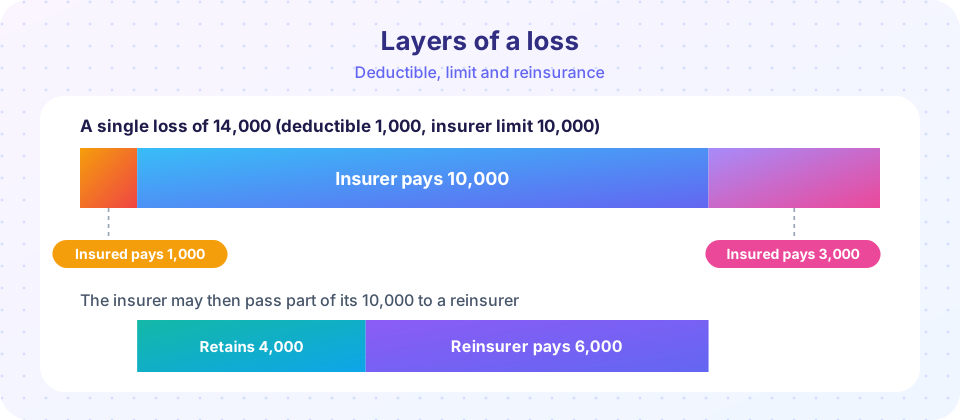
What you will learn
- Compute the expected payment per loss with a deductible, a limit and coinsurance.
- Read a loss elimination ratio and explain why it depends on the tail.
- Describe quota share, excess of loss and stop loss reinsurance.
- Compare the effect of reinsurance on the insurer's retained risk.
Key terms
Ordinary deductible d: the insurer pays (X − d)⁺, that is, the part of the loss above d.
Policy limit u: the maximum the insurer will pay.
Coinsurance α: the insurer pays the fraction α of the covered loss.
Loss elimination ratio (LER): the share of expected losses removed by a deductible.
Retention: the part of a loss the insurer keeps after reinsurance.
Modifying a single loss
Let X be the ground-up loss. Write X ∧ d = min(X, d) for the loss capped at d.
- Deductible
d: payment(X − d)⁺ = X − (X ∧ d). - Limit on the payment
Labove a deductibled: paymentmin((X − d)⁺, L) = (X ∧ (d + L)) − (X ∧ d). - Coinsurance
α: multiply the payment byα.
Order matters: contracts usually apply the deductible first, then the limit, then coinsurance. Expectations follow from the limited expected value E[X ∧ d] = ∫₀^d S(x) dx, where S is the survival function of X:
E[(X − d)⁺]            = E[X] − E[X ∧ d]
E[payment with limit]  = α · ( E[X ∧ (d + L)] − E[X ∧ d] )
Exponential example
For an exponential loss with mean θ = 1000, E[X ∧ d] = θ (1 − e^(−d/θ)).
- With
d = 500:E[X ∧ 500] = 1000 (1 − e^(−0.5)) ≈ 393.5, so the expected payment per loss is1000 − 393.5 ≈ 606.5. - The loss elimination ratio is
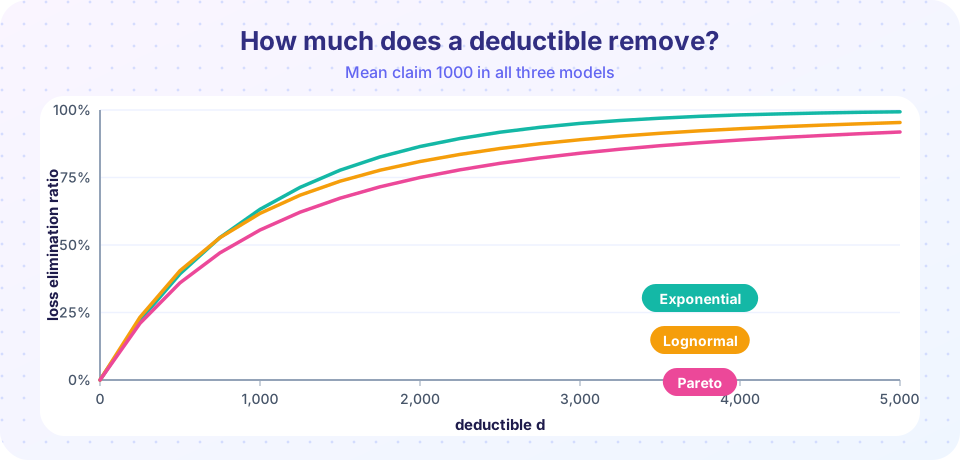
393.5 / 1000 ≈ 39.3%: the deductible removes about 39% of expected losses.
For other distributions, the limited expected value has its own formula: for the lognormal it involves the standard normal distribution function Φ, and for the Pareto it is E[X ∧ d] = θ/(α − 1) · [1 − (θ/(d + θ))^(α − 1)]. Heavy tails mean fewer losses are eliminated by the same deductible because large losses dominate the mean.
Inflation and leverage
Suppose claim costs inflate by a factor r (say 10%, so r = 1.10). The deductible stays at d, but the loss is now rX. The insurer's expected payment becomes r · E[(X − d/r)⁺], which grows by more than 10%. A deductible therefore leverages inflation, which is why contracts with deductibles need frequent repricing.
Reinsurance
An insurer can buy insurance on its own losses. Three standard treaty types:
| Treaty | Reinsurer pays | Typical use |
|---|---|---|
| Quota share | A fixed fraction q of every claim (and premium) |
Capacity and capital relief |
| Excess of loss (per claim) | (X − M)⁺, the part of each claim above the retention M (often with a limit) |
Protection against single large claims |
| Stop loss | (S − a)⁺, the part of the aggregate above a |
Protection against a bad year |
Quota share reduces every risk in proportion but does not remove the shape of the distribution. Excess of loss chops the right tail of each claim. Stop loss chops the right tail of the total, so it protects directly against the bad year; it is also the most expensive per unit of protection because it covers the entire tail of S.
Try it
Press Run (or Ctrl + Enter) to see the result here.
Program input · what you'd type while the program runs
Type the answers before you press Run, one per line. Each time the program reads a line (with input()), it gets the next line from this box.
Press Run (or Ctrl + Enter) to see the result here.
Program input · what you'd type while the program runs
Type the answers before you press Run, one per line. Each time the program reads a line (with input()), it gets the next line from this box.
Common misconceptions
"Doubling the deductible halves the insurer's cost." The expected payment falls, but by far less than half for light-tailed losses and by even less for heavy tails.
"Reinsurance always lowers the insurer's expected profit." It lowers expected profit if the reinsurer charges a loading, but it reduces variance and capital, so it can raise return on capital.
"Quota share protects against large claims." It scales everything down; a single huge claim is still large. Excess of loss is the cover aimed at individual large claims.
Check your understanding
Quick check · 5 questions
of 5 answered You scored / 5 · perfect!
-
1. A loss has expected value 1000 and E[X ∧ 500] = 400. What is the expected payment per loss with a 500 deductible?
E[(X − d)⁺] = E[X] − E[X ∧ d] = 1000 − 400 = 600. -
2. For the same mean and deductible, which tail gives the lowest loss elimination ratio?
The heavier the tail, the more of the mean comes from losses far above the deductible. -
3. A per-claim excess of loss treaty with retention 8,000 and a claim of 20,000: how much does the reinsurer pay?
The reinsurer pays (X − M)⁺ = 20,000 − 8,000 = 12,000. -
4. Which treaty protects directly against a year with an unusually high total?
Stop loss pays the part of the aggregate above the attachment point. -
5. With claim inflation of 10% and a fixed deductible, the insurer's expected payment rises by
Inflation pushes more losses above the deductible, so the payment grows faster than the losses themselves.
Summary
- Deductibles, limits and coinsurance modify the payment; its mean follows from limited expected values
E[X ∧ d]. - The loss elimination ratio is
E[X ∧ d]/E[X]; it is smaller for heavy-tailed losses. - Fixed deductibles leverage inflation.
- Quota share scales risk, excess of loss trims large claims, and stop loss trims the aggregate.
Track your progress
Create a free account to tick off lessons and pick up where you left off on any device.
of Actuarial Mathematics lessons completed