


















Lesson 33 of 43 · Credibility and Ruin Theory
Credibility and Ruin Theory: Chapter Review
Review limited fluctuation and Bühlmann credibility and the Cramér-Lundberg ruin model in one place, work a combined example and answer ten mixed questions.
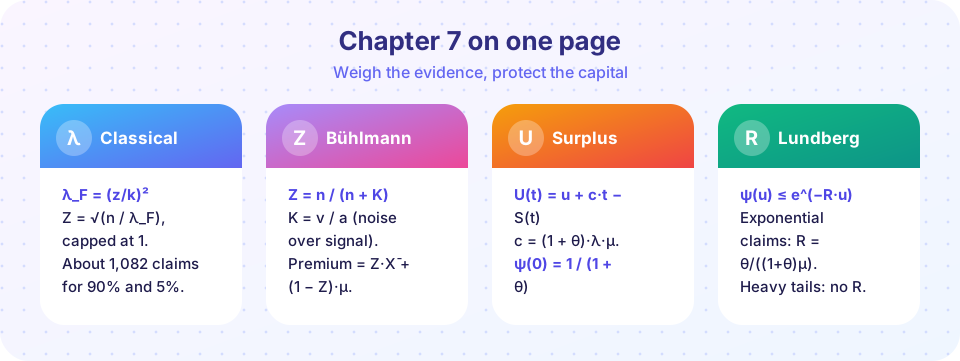
This chapter answered two questions with two small pieces of mathematics. How much should data count? The credibility factor Z blends evidence and prior knowledge. How much capital is enough? The ruin probability ψ(u) and the Lundberg bound connect capital, loading and survival.
What you will learn
- Recall the credibility and ruin formulas in one table.
- Apply both to a single portfolio.
- Check your understanding with ten mixed questions.
The chapter in one table
| Topic | Formula | Notes |
|---|---|---|
| Full credibility (claims) | λ_F = (z/k)² |
p = 90%, k = 5% gives about 1,082 |
| Partial credibility | Z = min(1, √(n/λ_F)) |
Square-root rule |
| Bühlmann | Z = n/(n + K), K = v/a |
EPV over VHM |
| Credibility premium | Z·X̄ + (1 − Z)·μ |
Best linear estimate |
| Surplus | U(t) = u + c·t − S(t) |
c = (1 + θ)·λ·μ |
| Ruin at zero | ψ(0) = 1/(1 + θ) |
Any claim distribution |
| Lundberg | ψ(u) ≤ e^(−R·u) |
Light tails only |
| Exponential claims | R = θ/((1 + θ)μ), ψ(u) = e^(−Ru)/(1 + θ) |
Exact |
A combined worked example
A broker has a small client whose last five years of average claim cost were 80 per policy-year, against a group mean of 100. The expected process variance is v = 3,000 and the variance of hypothetical means is a = 500.
K = 3000/500 = 6,Z = 5/(5 + 6) ≈ 0.4545.- Premium
= 0.4545 × 80 + 0.5455 × 100 ≈ 90.9: a discount, but only about half of what the raw data suggest.
The insurer carrying this book has λ = 50 claims a year with exponential sizes of mean 2,000 and a loading of 10%:
R = 0.1 / (1.1 × 2000) ≈ 4.545 × 10⁻⁵.- For a 1% ruin probability:
u = ln(1/(0.01 × 1.1)) / R ≈ 4.51 / (4.545 × 10⁻⁵) ≈ 99,200: about 50 mean claims.
Try it
Press Run (or Ctrl + Enter) to see the result here.
Program input · what you'd type while the program runs
Type the answers before you press Run, one per line. Each time the program reads a line (with input()), it gets the next line from this box.
Press Run (or Ctrl + Enter) to see the result here.
Program input · what you'd type while the program runs
Type the answers before you press Run, one per line. Each time the program reads a line (with input()), it gets the next line from this box.
Common misconceptions
"Credibility and ruin theory belong to different worlds." Both separate signal from noise. Credibility asks how much of an observed average is signal; ruin theory asks how much noise a company can absorb.
"A high Z means the data are good." It means the data are plentiful relative to the differences between risks.
Check your understanding
Quick check · 10 questions
of 10 answered You scored / 10 · perfect!
-
1. With n = 6 and K = 3, the Bühlmann credibility factor is
Z = 6/(6 + 3) = 2/3. -
2. The EPV measures
EPV is the average of the within-risk variances. -
3. A full credibility standard for p = 95%, k = 5% (z = 1.96) is about
(1.96/0.05)² = 39.2² ≈ 1,537. -
4. ψ(0) with loading 25% is
1/(1 + 0.25) = 0.8. -
5. If capital u is doubled, the Lundberg bound e^(−Ru) is
e^(−2Ru) = (e^(−Ru))². -
6. Larger loading θ (with the same claims) means the adjustment coefficient R is
R = θ/((1 + θ)μ) increases with θ. -
7. Which statement about heavy-tailed claims is correct?
The moment generating function is infinite, so there is no positive root. -
8. Which claim about credibility estimates is correct?
With 0 ≤ Z ≤ 1 the estimate is a weighted average. -
9. If Z = 0, the estimate equals
No weight on the data leaves only the group mean. -
10. Ruin is certain when
Without a positive loading the surplus has no upward drift.
Summary
- Credibility:
Z = n/(n + K)withK = v/a; premiumZ·X̄ + (1 − Z)·μ. - Ruin:
ψ(0) = 1/(1 + θ)andψ(u) ≤ e^(−Ru); exact for exponential claims. - Loading and capital are substitutes; heavy tails break the exponential decay.
Track your progress
Create a free account to tick off lessons and pick up where you left off on any device.
of Actuarial Mathematics lessons completed