


















Lesson 36 of 43 · Pensions and Applications
Pension Funding and Solvency
Learn how pension plans are funded: funding levels, normal cost, deficit recovery contributions, duration, interest rate hedging and stress tests, with a worked plan and code.
Valuing the promise is half of the pension actuary's job. The other half is making sure the money will be there. A funding plan says how much the sponsor will pay in each year, a recovery plan says how a shortfall will be repaired, and a stress test asks whether the plan could survive a bad decade.
This lesson works through a small, invented pension plan: its liabilities, its funding level, the contributions needed to close a deficit, and the single most important risk, falling interest rates.
What you will learn
- Compute a funding level and a deficit.
- Split contributions into normal cost and deficit recovery.
- Define and compute the duration of pension liabilities.
- Compare a hedged and an unhedged asset strategy under interest rate shocks.
- Run simple stress tests for rates and longevity.
Key terms
Funding level: assets divided by the value of the liabilities.
Deficit: liabilities minus assets, when positive.
Recovery plan: a schedule of extra contributions that removes the deficit over a set period.
Duration: the percentage change in liabilities for a one-percentage-point change in the discount rate, roughly.
Hedging: holding assets whose value moves with the liabilities.
An example plan
The plan has 400 active members in four groups of 100 (aged 30, 40, 50 and 60 with 5, 10, 20 and 25 years of service), each earning 50,000 with 3% salary growth and a 1/60 accrual to age 65, plus 200 pensioners aged 70 on 20,000 a year each. Interest is 4% and mortality is the illustrative Makeham law used throughout this chapter. Using the projected unit credit method from the previous lesson, the TryIt below finds:
- liabilities of about 73.8 million,
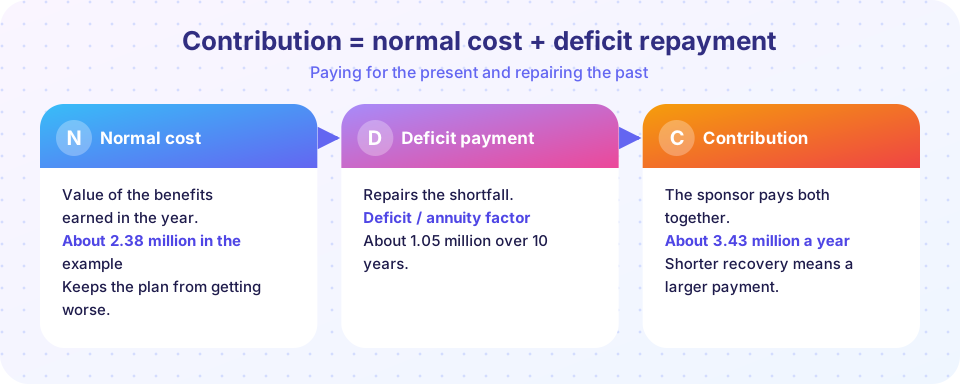
- a normal cost (the value of benefits earned in the next year) of about 2.38 million,
- assets of 88% of liabilities, about 64.9 million (an assumption of the example).
The funding level is 64.9 / 73.8 = 88% and the deficit is about 8.86 million.
Contributions: normal cost plus deficit repayment
If the sponsor spreads the deficit over a 10-year recovery period using level payments in advance at the 4% valuation rate, the annual deficit payment is
deficit payment = D / ä(10 years at 4%) = 8.86 million / 8.4353 ≈ 1.05 million
Total yearly contribution is therefore about 2.38 + 1.05 = 3.43 million, of which roughly 31% pays down the past. The recovery period is a policy decision, not a formula: a shorter period repairs the plan faster but burdens the sponsor more.
Interest rates: the dominant risk
Pension liabilities are long-dated, so their present value reacts strongly to the discount rate. The modified duration D_mod = −(1/L) · dL/di measures how strongly. In this plan, revaluing at 3.95% and 4.05% gives a duration of about 12.7: a one-percentage-point fall in the discount rate raises the liability by roughly 12.7% to first order. Revaluing exactly at 3% gives about 14.3%; the difference is convexity.
Assets must be chosen with this in mind.
- An unhedged strategy, with short-dated assets (we use a 5-year zero-coupon bond as a stand-in), loses funding level when rates fall because assets rise much less than liabilities.
- A hedged strategy matches duration: a bond whose maturity equals the liability's Macaulay duration
D_mod × (1 + i)moves almost as much as the liabilities.
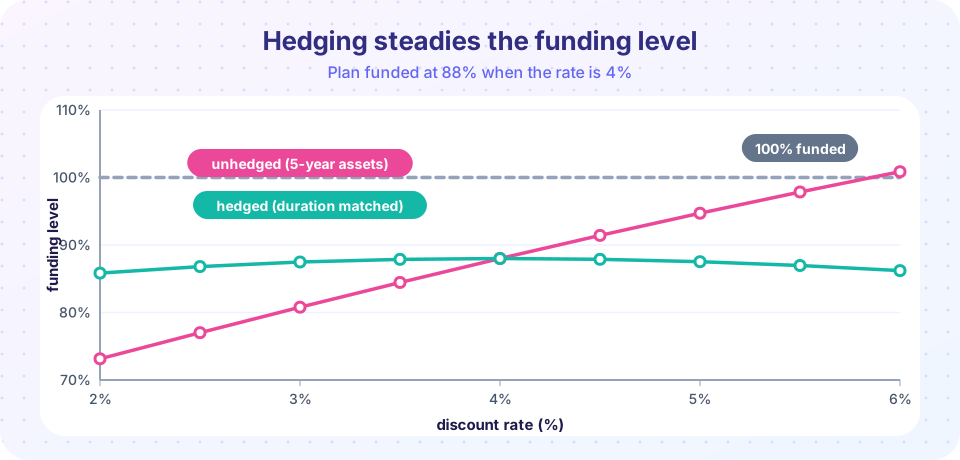
Hedging does not remove risk by magic. It leaves a deficit as a deficit, and it gives up the upside when rates rise. It does, however, remove the biggest single source of uncertainty in the funding level.
Stress tests and solvency
Regulators and trustees want to know how large a buffer the plan needs. A simple stress test revalues liabilities under adverse scenarios:
- Interest: discount rate down by one percentage point.
- Longevity: mortality rates 20% lower (people live longer).
- Combined: both together, and an asset shock such as equities falling 20%.
In this example, the 1% fall in the discount rate raises liabilities by about 14.3%, and the lower mortality by about 11.1%. A prudence margin in the valuation assumptions, or a capital buffer held by the sponsor, answers the question "how much extra do we need so that a bad but plausible scenario does not break the plan?". Exact regulatory formulas differ between countries, so this lesson treats the tests as general principles.
Try it
Press Run (or Ctrl + Enter) to see the result here.
Program input · what you'd type while the program runs
Type the answers before you press Run, one per line. Each time the program reads a line (with input()), it gets the next line from this box.
Press Run (or Ctrl + Enter) to see the result here.
Program input · what you'd type while the program runs
Type the answers before you press Run, one per line. Each time the program reads a line (with input()), it gets the next line from this box.
Common misconceptions
"A funding level of 100% means the plan is safe." It only means assets equal today's best-estimate value. Any adverse move in rates, markets or longevity can reopen a gap.
"Hedging eliminates pension risk." It removes a major part of the interest rate risk but not longevity, inflation, salary or sponsor risk, and it limits gains when rates rise.
"Deficits must be repaid immediately." Recovery plans spread them over years, balancing the sponsor's affordability against the members' security.
Check your understanding
Quick check · 5 questions
of 5 answered You scored / 5 · perfect!
-
1. Assets are 90 and liabilities are 120. The funding level is
90/120 = 0.75. -
2. A deficit of 6 is repaid over 3 years by level yearly payments with no interest. Each payment is
With no interest, 6/3 = 2 per year. -
3. Liabilities with a modified duration of 12 fall in value by about how much when the discount rate rises by 1 percentage point?
Percentage change ≈ −duration × change in rate. -
4. When interest rates fall, an unhedged plan with short assets usually sees its funding level
Liabilities rise by much more than the short assets. -
5. A longevity stress test lowers mortality rates. The effect on pension liabilities is
People live longer, so more pension payments are made.
Summary
- Funding level is assets over liabilities; contributions are normal cost plus a deficit repayment
D/ä(n). - Long-dated liabilities have high duration, so interest rate falls raise liabilities sharply.
- Duration-matched assets steady the funding level; stress tests on rates, longevity and salaries reveal the buffer needed.
Track your progress
Create a free account to tick off lessons and pick up where you left off on any device.
of Actuarial Mathematics lessons completed