


















Lesson 8 of 43 · Interest and Annuities
Annuities-certain
Value streams of level payments with annuity-immediate and annuity-due formulas, accumulations, deferred annuities and perpetuities, with worked examples and code.
Many financial promises are streams of equal payments: rent, a pension of 20,000 a year, loan repayments, a retirement saving plan. An annuity-certain is such a stream of payments with fixed amounts and fixed dates (no uncertainty about whether they are made). Annuities-certain are the building block of life annuities in chapter 4: you will simply multiply each payment by the probability that it is made.
The formulas below come from one idea, the sum of a geometric series. Learn the derivation once and you can rebuild every formula in the lesson from memory.
What you will learn
- The formulas for annuity-immediate
a_nand annuity-dueä_n. - How to accumulate a stream to the end with
s_nands̈_n. - How to value deferred annuities and perpetuities.
- How to solve for the payment, the term or the rate.
Key terms
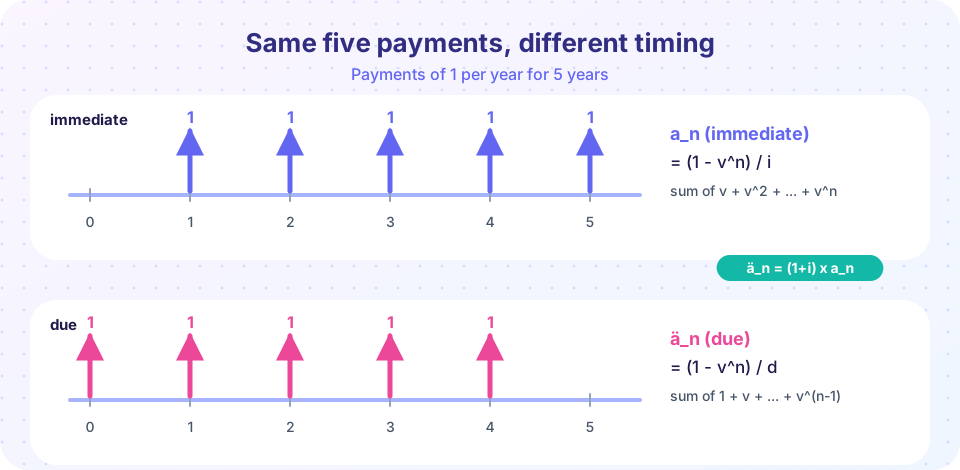
Annuity-immediate a_n: n payments of 1, at the end of each year; present value at time 0. Read "a angle n".
Annuity-due ä_n: n payments of 1, at the start of each year; present value at time 0.
Accumulated value s_n: the value at time n of the immediate annuity's payments.
Perpetuity: a payment stream that never ends.
Deferred annuity: an annuity whose first payment starts after a delay.
Annuity-immediate
Payments of 1 at times 1, 2, ..., n. The present value is
a_n = v + v^2 + ... + v^n.
This is a geometric series with first term v, ratio v, and n terms, so a_n = v (1 - v^n)/(1 - v) = (1 - v^n)/i, using 1 - v = d = i v. Hence
a_n = (1 - v^n) / i.
Worked example. At i = 5% with n = 5: v^5 = 0.783526, so a_5 = (1 - 0.783526)/0.05 = 4.32948. Five payments of 1,000 are worth 4,329.48 today.
The accumulated value at time n is s_n = (1+i)^(n-1) + ... + (1+i) + 1 = ((1+i)^n - 1)/i, and the two are tied by s_n = a_n (1+i)^n. With the numbers above s_5 = (1.276282 - 1)/0.05 = 5.52563.
Annuity-due
Payments at times 0, 1, ..., n-1. Each payment comes a year earlier than in the immediate annuity, so the value is multiplied by (1+i):
ä_n = 1 + v + ... + v^(n-1) = (1 - v^n)/d = (1+i) a_n.
At 5%, ä_5 = 4.32948 x 1.05 = 4.54595. Equivalently ä_n = 1 + a_(n-1): the payment at time 0 plus an immediate annuity of n-1 payments. The accumulated value of the due annuity is s̈_n = (1+i) s_n.
Press Run (or Ctrl + Enter) to see the result here.
Program input · what you'd type while the program runs
Type the answers before you press Run, one per line. Each time the program reads a line (with input()), it gets the next line from this box.
Perpetuities and deferred annuities
If payments never stop, let n grow: v^n tends to 0 for i > 0, so
a_infinity = 1/i and ä_infinity = 1/d.
A payment of 1,000 a year forever at 4% is worth 1000/0.04 = 25,000. The intuition: invest 25,000 and withdraw the 4% interest each year without touching the capital.
A deferred annuity has its first payment later. A payment stream of n payments of 1 starting at time m + 1 has present value v^m a_n, or equivalently a_(m+n) - a_m. At 5%, 10 payments deferred by 5 years: v^5 a_10 = 0.783526 x 7.72173 = 6.0502.
Solving for the payment, the term and the rate
Often the unknown is not the present value. To find the level payment P that accumulates to a target F in n years: P = F / s_n. To find the term, solve a_n = PV/P for v^n, so n = -ln(1 - i PV/P) / ln(1+i). To find the rate, there is no closed form in general; solve numerically, which is what spreadsheets and the brentq function in code do.
Worked example. You want 100,000 in 15 years by saving at the end of each year at 4%. s_15 = (1.04^15 - 1)/0.04 = 20.02359, so P = 100,000/20.02359 = 4,994.11.
Press Run (or Ctrl + Enter) to see the result here.
Program input · what you'd type while the program runs
Type the answers before you press Run, one per line. Each time the program reads a line (with input()), it gets the next line from this box.
Increasing annuities (a brief look)
If the payments rise by 1 each year (1, 2, 3, ..., n at times 1 to n), the present value is (Ia)_n = (ä_n - n v^n)/i. At 5% with n = 5: ä_5 = 4.54595, n v^n = 5 x 0.783526 = 3.91763, so (Ia)_5 = (4.54595 - 3.91763)/0.05 = 12.5664. You can check this directly: v + 2v^2 + 3v^3 + 4v^4 + 5v^5.
Try it: how annuity values behave
Plot a_n against n for several rates. Each curve flattens towards the perpetuity value 1/i, and a higher rate means a lower, earlier-flattening curve.
Press Run (or Ctrl + Enter) to see the result here.
Program input · what you'd type while the program runs
Type the answers before you press Run, one per line. Each time the program reads a line (with input()), it gets the next line from this box.
Common misconceptions
"The annuity-due is the one that starts at time 1." The opposite: due payments are at the START of each period (time 0 first); immediate payments are at the END (time 1 first).
"A longer annuity is always worth proportionally more." Present value grows more and more slowly because distant payments are heavily discounted, and it can never exceed 1/i.
"s_n is the present value." s_n is the value at time n, the end of the term. Multiply by v^n to get back to time 0.
Check your understanding
Quick check · 5 questions
of 5 answered You scored / 5 · perfect!
-
1. At i = 5%, what is a_5 (to 3 decimals)?
a_5 = (1 - 1.05^-5)/0.05 = 4.329. (5.526 is s_5 and 4.546 is the annuity-due.) -
2. Which identity is correct?
Each due payment is made one year earlier, so the present value is larger by the factor (1 + i). -
3. What is the present value of 2,000 per year forever at 8%?
2,000 / 0.08 = 25,000. -
4. Ten payments of 1 each year start at the END of year 6 (i.e. times 6 to 15). The present value is
The annuity-immediate a_10 would start at time 1; delaying it by 5 years multiplies by v^5. -
5. How is s_n related to a_n?
Accumulating the present value forward n years gives the value at the end of the term.
Summary
a_n = (1 - v^n)/i,ä_n = (1 - v^n)/d = (1 + i) a_n,s_n = ((1+i)^n - 1)/i = a_n (1+i)^n.- Perpetuities:
a_infinity = 1/i,ä_infinity = 1/d. - A deferred annuity has value
v^m a_n. - Unknown payment, term or rate: rearrange the formula or solve numerically.
- Life annuities (chapter 4) multiply each payment by a survival probability.
Next: Loans and amortization
Track your progress
Create a free account to tick off lessons and pick up where you left off on any device.
of Actuarial Mathematics lessons completed