


















Lesson 43 of 43 · Projects and Practice
Further Study: Where to Go After Actuarial Mathematics
What to learn next after this course: advanced actuarial topics, the statistics, simulation and Python skills behind them, and related tracks on this site.
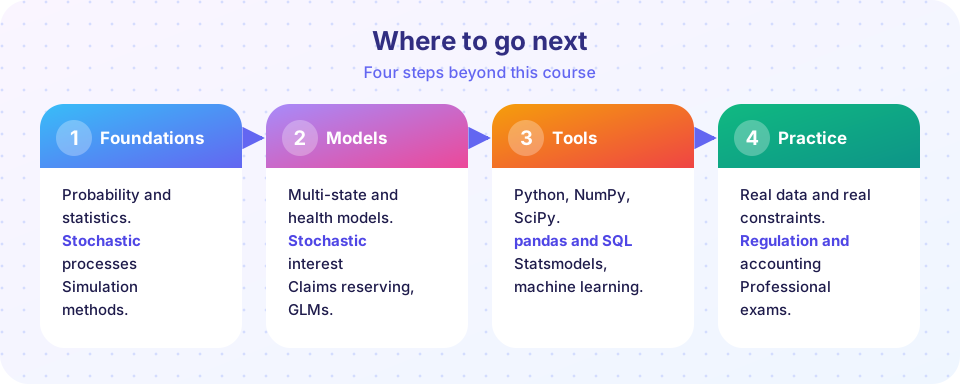
You now know how premiums, reserves, loss models, credibility, ruin and pensions work. That is the core of actuarial science, and it is also the starting point: the profession spends most of its time on the next layer, where models meet messy data, long horizons and regulation. This lesson maps that layer and shows which other tracks on this site prepare you for it.
You do not have to learn everything. Pick the direction that matches your goal: life and pensions, general insurance, risk management, or data science with an insurance flavour.
What you will learn
- Which advanced actuarial topics follow this course.
- Which mathematical and programming skills support them.
- Which tracks on this site to study next.
- How to plan your own study path.
Key terms
Generalized linear model (GLM): a regression framework for counts and claim amounts, widely used for pricing.
Claims reserving: estimating the money still to be paid on claims already incurred.
Extreme value theory: statistics for the tail of a distribution.
Stochastic interest: modelling interest rates as random processes rather than a fixed rate.
Multi-state model: a model with several states (healthy, sick, dead) and transitions between them.
Advanced topics that follow
| Area | What it adds |
|---|---|
| Multi-state and health models | Sickness, disability and long-term care, with transition intensities |
| Stochastic interest rates | Interest as a random process; effects on reserves and guarantees |
| Mortality improvement | Models that project how mortality changes over time |
| Claims reserving | Methods such as run-off triangles to estimate outstanding claims |
| GLMs and pricing | Regression models that price risk factors such as age, vehicle or region |
| Extreme value theory and copulas | Tails of loss distributions and dependence between risks |
| Capital and solvency | How regulators measure the buffer an insurer must hold |
| Accounting for insurance | How reserves and profit appear in financial statements |
Foundations worth strengthening
Actuarial work rests on probability and statistics. If any part of the loss models or credibility chapters felt shaky, work through these tracks:
- Statistics and probability: distributions, estimation, hypothesis tests.
- Stochastic processes: Poisson processes, random walks and the mathematics under ruin theory.
- Monte Carlo simulation: the simulation methods you used in the projects, with their error analysis.
- Queueing theory: another application of Poisson-type arrival processes.
- Real analysis: if you want rigorous proofs of limit theorems.
Tools worth learning
| Skill | Where on this site |
|---|---|
| Python itself | Python |
| Arrays and numerical computing | NumPy and SciPy |
| Data tables | pandas |
| Regression and time series | Statsmodels |
| Predictive models | Machine learning |
| Databases | SQL |
Related subjects
- Financial accounting shows where reserves and profit appear in company reports.
- Microeconomics explains adverse selection and moral hazard, the reasons for deductibles and underwriting.
- Macroeconomics puts interest rates and inflation, which drive reserves and pensions, in context.
- Personal finance applies annuities, saving and risk to household decisions.
- Mathematical modelling teaches the general craft of building and validating models.
Professional path
In many countries, actuaries qualify through professional bodies that set examinations in probability, financial mathematics, life and general insurance, and risk management. Syllabuses and exam rules differ, so check the current requirements of the body in your country before planning. Many people begin with a degree in mathematics, statistics or economics and take the first exams while studying.
Try it
Press Run (or Ctrl + Enter) to see the result here.
Program input · what you'd type while the program runs
Type the answers before you press Run, one per line. Each time the program reads a line (with input()), it gets the next line from this box.
Common misconceptions
"Actuarial science is only formulas." The formulas are the easy part; judgement about assumptions, data and communication takes the most time.
"I need to master everything before starting a job or exams." Study in layers: foundations first, then one specialty, then breadth.
Check your understanding
Quick check · 4 questions
of 4 answered You scored / 4 · perfect!
-
1. Which topic estimates the money still to be paid on claims already incurred?
Claims reserving projects outstanding claim payments. -
2. Which track on this site best prepares you for the mathematics under ruin theory?
Poisson processes and random walks are the building blocks of the surplus process. -
3. A GLM is mostly used for
GLMs relate claim frequency and severity to risk factors such as age or region. -
4. Adverse selection and moral hazard are explained in
They are information problems studied in economics.
Summary
- The next layer of actuarial work includes multi-state models, stochastic interest, mortality improvement, reserving, GLMs, extremes and capital.
- Strengthen probability, statistics and simulation, then learn Python tools.
- Related tracks on this site cover foundations, tools and the economics and accounting context.
Track your progress
Create a free account to tick off lessons and pick up where you left off on any device.
of Actuarial Mathematics lessons completed