


















Lesson 10 of 43 · Interest and Annuities
Chapter 2 review: Interest and annuities
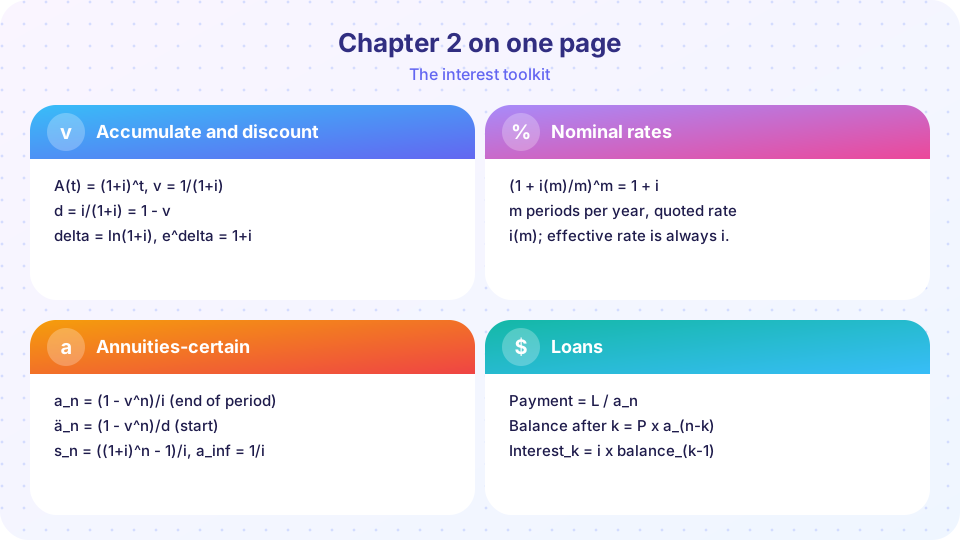
One-page summary of rates, discounting, annuities and loans with a formula picture, a self-checking calculator and a mixed ten-question quiz.
Chapter 2 gave you the time value of money: how to grow a sum, how to discount a future payment, how to value a stream of payments, and how to run a loan. These tools appear in every later chapter, so make sure the formulas are automatic before moving on to survival models.
What you will learn
- The key formulas of the chapter and when to use each.
- How to check your own answers with an independent calculation.
- Which mistakes are most common and how to avoid them.
Key terms
v: discount factor, 1/(1+i). d: discount rate, i v. delta: force of interest, ln(1+i).
a_n, ä_n, s_n: present value (end payments), present value (start payments), accumulated value.
Equation of value: present value in equals present value out at a chosen date.
Balance B_k: loan outstanding after k payments, P a_(n-k).
The chapter in a table
| If you need... | Use | Notes |
|---|---|---|
value today of 1 at time t |
v^t = (1+i)^(-t) |
discounting |
| effective rate from nominal | 1 + i = (1 + i(m)/m)^m |
more compounding gives higher i |
| payments at the end of each year | a_n = (1 - v^n)/i |
"immediate" |
| payments at the start of each year | ä_n = (1 - v^n)/d = (1+i) a_n |
"due" |
| value at the end of the term | s_n = a_n (1+i)^n |
accumulation |
| payments for ever | 1/i (immediate), 1/d (due) |
perpetuity |
| a loan's level payment | P = L / a_n |
amortization |
balance after k payments |
P a_(n-k) |
prospective |
Lessons: compound interest and discount rates, annuities-certain and loans and amortization.
Try it
The first calculator evaluates the most-used quantities at once. Change the rate and watch the whole family move together, then check the inequality d < delta < i.
Press Run (or Ctrl + Enter) to see the result here.
Program input · what you'd type while the program runs
Type the answers before you press Run, one per line. Each time the program reads a line (with input()), it gets the next line from this box.
The second one checks a loan answer two independent ways. If the retrospective and prospective balances disagree, there is a mistake somewhere.
Press Run (or Ctrl + Enter) to see the result here.
Program input · what you'd type while the program runs
Type the answers before you press Run, one per line. Each time the program reads a line (with input()), it gets the next line from this box.
Common misconceptions
Mixing up immediate and due. Check the first payment: at time 1 it is immediate, at time 0 it is due.
Using the nominal rate as the effective rate. Always convert first: (1 + i(m)/m)^m - 1.
Forgetting to match the time unit. If payments are monthly, n and i must both be monthly.
Check your understanding
Quick check · 10 questions
of 10 answered You scored / 10 · perfect!
-
1. At i = 10%, v equals
v = 1/1.10 = 0.9091. (0.0909 is d.) -
2. The effective annual rate of 6% per year compounded monthly is
(1 + 0.06/12)^12 - 1 = 1.005^12 - 1 = 0.061678. -
3. At 4%, a_10 is about
a_10 = (1 - 1.04^-10)/0.04 = (1 - 0.675564)/0.04 = 8.111. -
4. At 4%, the annuity-due ä_10 is about
ä_10 = (1.04)(8.111) = 8.435. -
5. A perpetuity-immediate pays 500 a year at 5%. Its value is
500 / 0.05 = 10,000. -
6. At 10%, s_3 equals
s_3 = (1.1^3 - 1)/0.1 = 0.331/0.1 = 3.31. -
7. A loan of 1,000 is repaid in two equal year-end payments at 10%. Each payment is about
a_2 = 1/1.1 + 1/1.21 = 1.73554, so P = 1000/1.73554 = 576.19. -
8. In that loan, the balance just after the first payment is about
Balance = 1,000 x 1.1 - 576.19 = 523.81, which also equals P a_1 = 576.19/1.1. -
9. For i = 25%, d equals
d = i/(1+i) = 0.25/1.25 = 0.2. -
10. A force of interest delta = 1 (unrealistic, but a good test) corresponds to the effective annual rate
i = e^delta - 1 = e - 1 = 1.71828.
Summary
- Rates:
i,v,d,deltadescribe one rate;d < delta < i. - Annuities:
a_n,ä_n,s_nare geometric sums; perpetuities are1/iand1/d. - Loans:
P = L / a_n, balanceP a_(n-k), interesti x balance. - Always match time units and convert nominal rates first.
Next: Survival models overview
Track your progress
Create a free account to tick off lessons and pick up where you left off on any device.
of Actuarial Mathematics lessons completed