


















Lesson 39 of 43 · Projects and Practice
Project: Simulate an Insurer's Year
A simulation project: model a life portfolio's annual result, separate diversifiable from systematic risk, find the capital for a 99.5% safety level and test a reinsurance treaty.
Pricing tells you what a year looks like on average. Risk management asks how bad it could get. In this project you build a Monte Carlo model of a small life insurer's year, measure the chance of a loss, estimate the capital needed for a 99.5% safety level, and test whether reinsurance is worth its price.
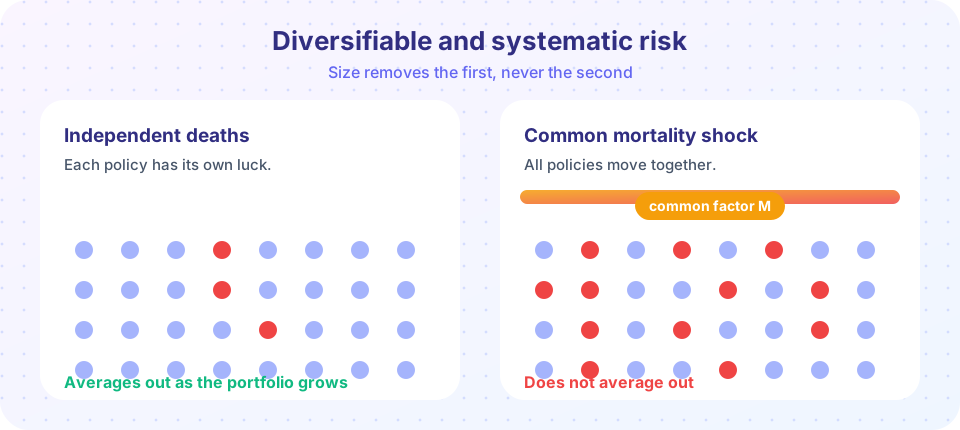
You will meet a fact that surprises many students: adding policies makes the random part of the result vanish, but it cannot remove systematic risk, a shared factor such as an epidemic or a wrong mortality table that hits every policy at once. That difference is the reason capital requirements never fall to zero, however large the company.
What you will learn
- Build a portfolio-level Monte Carlo simulation of annual claims.
- Distinguish diversifiable from systematic risk and see both in the results.
- Estimate a 99.5% capital requirement from the simulated profit distribution.
- Evaluate a per-life excess of loss reinsurance treaty.
Key terms
Diversifiable risk: independent randomness that averages out as the portfolio grows.
Systematic risk: a common factor, such as a mortality shock, that affects all policies together.
Capital requirement: the buffer needed so that losses exceed it with probability at most 0.5%.
Per-life excess of loss: reinsurance of the part of each death claim above a retention.
Value at risk: a quantile of the loss distribution.
The model
The portfolio has 5,000 one-year term policies. Each holder is aged between 30 and 59, and sums insured are lognormal with a mean of about 120,000 (a few are very large). The premium for each policy is 20% above its expected claim S · q. For each simulated year:
- Draw a mortality factor
M(1 means a normal year; its spread, 10%, is the systematic risk). In the "independent" runM = 1. - Each policy dies with probability
q · M, independently. - Profit is premiums minus claims.
Premium income is about 4.18 million against expected claims of about 3.49 million. The expected profit is therefore about 0.7 million, but the distribution is wide. With the settings below, the independent-only simulation gives a loss probability of roughly 18%, and the standard deviation of about 0.77 million is driven by a few large policies. The systematic factor widens it and fattens the lower tail.
Reinsurance
A per-life excess of loss treaty with retention 250,000 reimburses the part of any single claim above 250,000. We assume the reinsurer charges the expected ceded claims plus 30%. It removes most of the damage from a handful of very large policies, which raises the cost by only a small amount of expected profit but lowers the capital requirement. It does not help against the systematic shock, which affects many small claims at once.
Capital
The 99.5% capital requirement is the loss that is exceeded in only one year in two hundred: −(0.5% quantile of profit). Estimating a 0.5% quantile needs many simulations (the code uses a few thousand, so results are noisy at the level of a few percent); regulators use far more.
Try it
Press Run (or Ctrl + Enter) to see the result here.
Program input · what you'd type while the program runs
Type the answers before you press Run, one per line. Each time the program reads a line (with input()), it gets the next line from this box.
Press Run (or Ctrl + Enter) to see the result here.
Program input · what you'd type while the program runs
Type the answers before you press Run, one per line. Each time the program reads a line (with input()), it gets the next line from this box.
Common misconceptions
"Law of large numbers means a big insurer has no risk." It removes independent noise; systematic risk, such as a pandemic or a mortality table that is simply wrong, stays.
"Reinsurance always lowers risk at no cost." It lowers some risks and costs expected profit; the saving in capital must be weighed against the premium paid.
"Capital is the maximum possible loss." It is a quantile, here the loss exceeded with probability 0.5%.
Check your understanding
Quick check · 4 questions
of 4 answered You scored / 4 · perfect!
-
1. Which risk shrinks (relative to the portfolio) as the number of policies grows?
Independent deaths average out; common factors do not. -
2. A 99.5% capital requirement means
It is the 99.5% quantile of the loss distribution. -
3. A per-life excess of loss treaty mainly helps with
It caps the cost of any single large death claim. -
4. If the systematic factor has sd 10% and profit loading is 20% of expected claims, the loss probability in the limit of a huge portfolio is about
Normal tail beyond 0.20/0.10 = 2 standard deviations: about 2.3%.
Summary
- A portfolio simulation combines independent deaths, a common mortality factor and optional reinsurance.
- Capital for a 99.5% safety level is read off the simulated profit distribution.
- Size cures independent risk but not systematic risk; reinsurance trims individual large claims.
Next: Practice set
Track your progress
Create a free account to tick off lessons and pick up where you left off on any device.
of Actuarial Mathematics lessons completed