


















Lesson 19 of 43 · Life Insurance Benefits
Life annuities
Value life annuities that pay while the annuitant survives: whole life, temporary and deferred annuities, the link A(x) = 1 - d*ä(x), and variance, with code.
A pension is a life annuity: a payment of fixed size, each year, for as long as the retiree lives. It is the opposite risk to life insurance. The insurer fears early death when it has promised a death benefit; it fears long life when it has promised an annuity. A person who retires at 65 and lives to 100 collects 35 payments, while one who dies at 66 collects one. The annuity price must reflect the whole distribution.
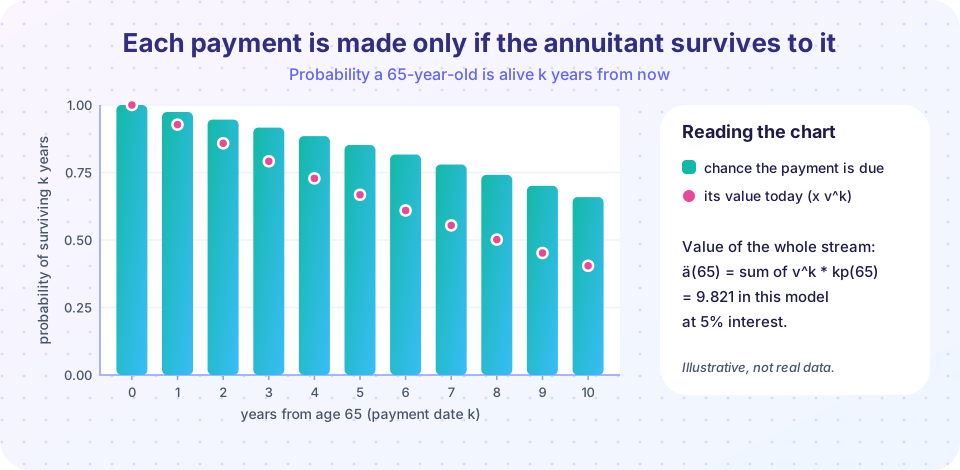
You already have all the tools. A life annuity is a sum of pure endowments: the payment due at time k is made only if the annuitant is alive at time k, and its APV is k E x = v^k * k p x. Add them up and you have the annuity.
What you will learn
- The formulas for life annuity-due
ä xand immediatea x. - Temporary and deferred life annuities, and how to price a pension for a younger person.
- The identity
A x = 1 - d * ä xlinking insurances and annuities. - The variance of the annuity present value.
Key terms
Whole life annuity-due ä x: 1 at the start of each year while the person aged x is alive.
Whole life annuity-immediate a x: 1 at the end of each year while alive: a x = ä x - 1.
Temporary annuity ä x:n: like ä x, but at most n payments.
Deferred annuity n|ä x: payments start at time n, if alive.
Annuitant: the person receiving the annuity.
Whole life annuity-due and immediate
The payment at the start of year k+1 (time k) is made if the person is alive at age x + k:
ä x = sum over k = 0, 1, 2, ... of v^k * k p x = sum of k E x.
The immediate annuity pays at times 1, 2, ... instead, so a x = ä x - 1. In the illustrative model at 5%, ä 40 = 16.2583 and ä 65 = 9.8212, so a 65 = 8.8212. A 65-year-old can expect about 14.3 payments (one now plus a curtate expectation of about 13.3 more), yet the annuity is worth only 9.82 because every payment is discounted at 5%. At 40 the value is larger because many more payments are expected.
Worked example. A pension of 20,000 a year payable annually in advance from age 65: the value at 65 is 20,000 x 9.8212 = 196,424. That is the lump sum an insurer in this model would need for a 65-year-old; a person's expected total of payments (20,000 x 14 or so years) exceeds it because of interest and because some die early.
Temporary and deferred annuities
- Temporary:
ä x:n = sum over k = 0 to n-1 of k E x. It models payments that stop at a fixed date, such as a 10-year guaranteed income. - Deferred:
n|ä x = n E x * ä (x+n). Waitnyears (discount and survival) and then start a whole life annuity at the new age. This is the price of a pension, bought by a 40-year-old, starting at 65:25|ä 40 = 25 E 40 * ä 65.
Worked example. At 5%: 25 E 40 = v^25 * 25 p 40 = 0.29530 x 0.7780 = 0.2297, so 25|ä 40 = 0.2297 x 9.8212 = 2.256. A pension of 10,000 a year starting at 65 therefore costs about 22,560 today at age 40. Because it is deferred and subject to mortality and discounting, it costs only about 23% of the value of the same annuity at the moment of retirement (98,212 for 10,000 a year at 65): that 23% is exactly 25 E 40.
Press Run (or Ctrl + Enter) to see the result here.
Program input · what you'd type while the program runs
Type the answers before you press Run, one per line. Each time the program reads a line (with input()), it gets the next line from this box.
The link between insurance and annuity
There is a beautiful identity connecting the previous lessons to this one:
A x = 1 - d * ä x, or equivalently ä x = (1 - A x) / d.
Think of an investor who deposits 1 and lives on its interest. Each year of life, an interest payment in advance of d per unit is "paid" by the insurer to the investor, and at death the 1 is returned. Written as a policy, "whole life insurance of 1" is the same as "1 paid at death", whose value is 1 minus the discounted payments d per year while alive. In the model, A 65 = 0.5323 and 1 - 0.047619 x 9.8212 = 0.5323: the same number two ways, which lets you obtain either from the other.
Recursions also exist: ä x = 1 + v * p x * ä (x+1). The payment now, plus, if the person survives the year, the discounted annuity from the next age.
Variance and continuous annuities
The present value Y of the whole life annuity-due is ä_(K+1) (the annuity-certain for the number of payments actually made). Since Y = (1 - Z)/d with Z = v^(K+1),
Var(Y) = Var(Z) / d^2.
For x = 65: Var(Z) = 0.03648, d = 0.047619, so Var(Y) = 0.03648 / 0.0022676 = 16.09 and the standard deviation is about 4.0, against a mean of 9.82. A single annuitant's payments are very uncertain, so pooling thousands of annuitants matters again.
If payments are made continuously (a pension paid weekly is very close), abar x = integral of v^t * t p x dt and under UDD abar x ≈ ä x - 1/2.
Try it: annuity values across ages
An annuity-due at each age shows the cost of a pension rising as the annuitant gets younger, because more payments are expected. The picture also compares with a certain annuity for the same expected number of years.
Press Run (or Ctrl + Enter) to see the result here.
Program input · what you'd type while the program runs
Type the answers before you press Run, one per line. Each time the program reads a line (with input()), it gets the next line from this box.
Common misconceptions
"A life annuity is just an annuity for the life expectancy." The value of a certain annuity is concave in the number of payments, so by Jensen's inequality the life annuity is worth less than the certain annuity for the expected number of years (see the gap in the plot).
"a x and ä x are the same." They differ by exactly 1: the immediate annuity skips the payment at time 0.
"A higher interest rate raises the price of an annuity." It lowers it, because future payments are discounted more.
Check your understanding
Quick check · 5 questions
of 5 answered You scored / 5 · perfect!
-
1. If ä 65 = 9.8212, what is a 65?
a x = ä x - 1 (the immediate annuity omits the payment at time 0). -
2. At i = 5% (d = 0.047619), if ä 50 = 13, what is A 50?
A x = 1 - d ä x = 1 - 0.047619 x 13 = 0.381. -
3. The deferred annuity n|ä x equals
Survive and discount to the start date, then value the whole life annuity from age x + n. -
4. Which recursion holds for annuities-due?
A payment now, plus, if alive at time 1 (probability p x), the discounted annuity from age x + 1. -
5. With Var(Z) = 0.04 and d = 0.05, Var(Y) for a whole life annuity-due is
Var(Y) = Var(Z) / d^2 = 0.04 / 0.0025 = 16.
Summary
ä x = sum of v^k * k p x;a x = ä x - 1; temporary and deferred versions follow.- A pension for a younger person is a pure endowment times an annuity:
n|ä x = n E x * ä (x+n). A x = 1 - d * ä xconnects insurance and annuity values.Var(Y) = Var(Z) / d^2; one annuitant is very uncertain.- The life annuity is worth more than the certain annuity for the expected lifetime.
Next: Chapter 4 review
Track your progress
Create a free account to tick off lessons and pick up where you left off on any device.
of Actuarial Mathematics lessons completed