


















Lesson 34 of 43 · Pensions and Applications
Pensions and Applications: Chapter Overview
A map of actuarial pension mathematics: defined benefit and defined contribution plans, how liabilities are valued, funded and stress tested.
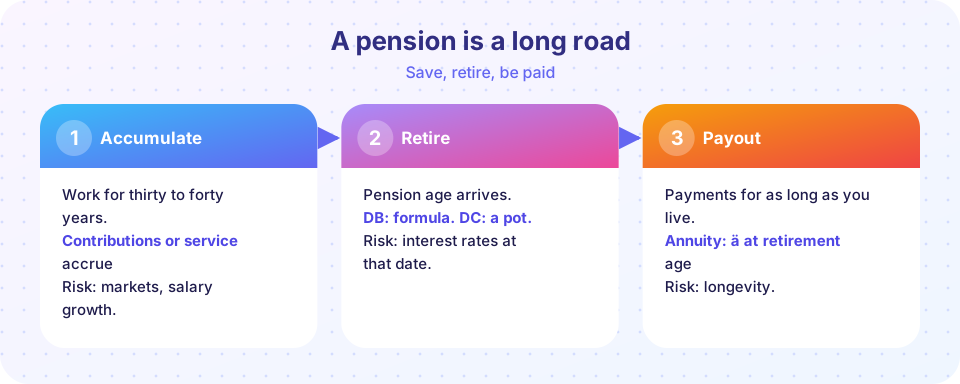
A pension is a promise that stretches across a whole lifetime, often sixty years or more: forty years of working and twenty or thirty of retirement. Nothing in finance asks for longer foresight, and nothing needs actuaries more. In this chapter you use everything from the earlier chapters (interest, survival, annuities, reserves and risk) on one of the largest financial promises in the world.
Pension plans come in two broad families. In a defined benefit (DB) plan the sponsor promises a pension formula and carries the risk that the money will not suffice. In a defined contribution (DC) plan the member and employer pay in contributions, the pot is invested, and the member carries the investment and longevity risk. The actuary's questions are different in each, but the mathematics is the same toolbox.
What you will learn
- The difference between DB and DC plans and who bears which risk.
- How a pension promise is valued as an actuarial present value.
- How funding, deficits and interest rates interact.
- How the chapter's lessons connect.
Key terms
Accrual rate: the fraction of salary earned as pension for each year of service, for example 1/60.
Final salary: the member's salary near retirement, used in many DB formulas.
Pension annuity: regular payments from retirement until death.
Funding level: assets divided by the value of liabilities.
Normal cost (service cost): the value of the benefits earned in one year.
The big picture
Consider a 40-year-old who will retire at 65. In a DB plan the pension might be one sixtieth of final salary for each year of service. Someone with 35 years earns 35/60, about 58%, of final salary. In a DC plan there is no formula: contributions of, say, 10% of salary go into an investment fund, and at 65 the pot buys an annuity.
Three activities fill the pension actuary's working year:
- Valuation: compute the present value of the promised benefits and compare it with the assets.
- Funding: decide how much the sponsor and members should contribute, including any deficit repayment.
- Risk management: test how the plan fares if interest rates fall, if people live longer, or if markets crash.
Two plan types
Who bears risk?
Three jobs
What each lesson covers
| Lesson | What you will be able to do |
|---|---|
| Defined benefit pension valuation | Value accrued and projected pension benefits and the cost of one more year of service. |
| Pension funding and solvency | Compute funding levels, deficit contributions and the effect of interest rates. |
| Chapter review | One picture and ten mixed questions. |
Try it
The first TryIt follows a member of a DC plan from 30 to 65 and shows how wide the range of outcomes is. Everything is invented: a salary of 40,000 growing 3% a year, a 10% contribution, and random annual investment returns.
Press Run (or Ctrl + Enter) to see the result here.
Program input · what you'd type while the program runs
Type the answers before you press Run, one per line. Each time the program reads a line (with input()), it gets the next line from this box.
Press Run (or Ctrl + Enter) to see the result here.
Program input · what you'd type while the program runs
Type the answers before you press Run, one per line. Each time the program reads a line (with input()), it gets the next line from this box.
Common misconceptions
"A DB plan guarantees the pension no matter what." The sponsor promises it; if the sponsor fails and the plan is underfunded, benefits may be cut or protected only partly by a guarantee fund.
"A DC pot is a pension." It is a lump sum; it only becomes a pension when converted into income, and the conversion rate depends on interest rates and mortality at that time.
Check your understanding
Quick check · 4 questions
of 4 answered You scored / 4 · perfect!
-
1. In a defined benefit plan, who mainly bears the investment risk?
The sponsor must make up shortfalls to pay the promised benefit. -
2. An accrual rate of 1/60 with 30 years of service gives a pension of what fraction of final salary?
30/60 = 1/2. -
3. The funding level of a plan is
A funding level below 100% means a deficit. -
4. In a DC plan, at retirement the pot is typically converted into income using
An annuity turns a lump sum into a regular income for life.
Summary
- DB plans promise a formula and the sponsor carries the risk; DC plans promise contributions and the member carries it.
- Pension actuaries value benefits, set contributions and stress test the plan.
- The core mathematics is the annuity and the survival model you already know.
Track your progress
Create a free account to tick off lessons and pick up where you left off on any device.
of Actuarial Mathematics lessons completed