


















Lesson 7 of 43 · Interest and Annuities
Compound interest and discount rates
Master effective and nominal interest rates, the discount factor v, the discount rate d and the force of interest, with present values and equations of value.
A single interest rate can be quoted in several different ways. A bank says "12% per year, compounded monthly". A bond market quotes a yield. A hire-purchase contract speaks of a "discount". An actuary needs to convert between them without error, and to find the value today of money due in the future. This lesson gives you the four quantities i, v, d and delta, the nominal-rate conversions, and the equation of value that ties them together.
The reward is large: nearly every formula in the rest of the course is built from v. Once v is second nature, annuities, insurance benefits and loans are all sums of powers of v.
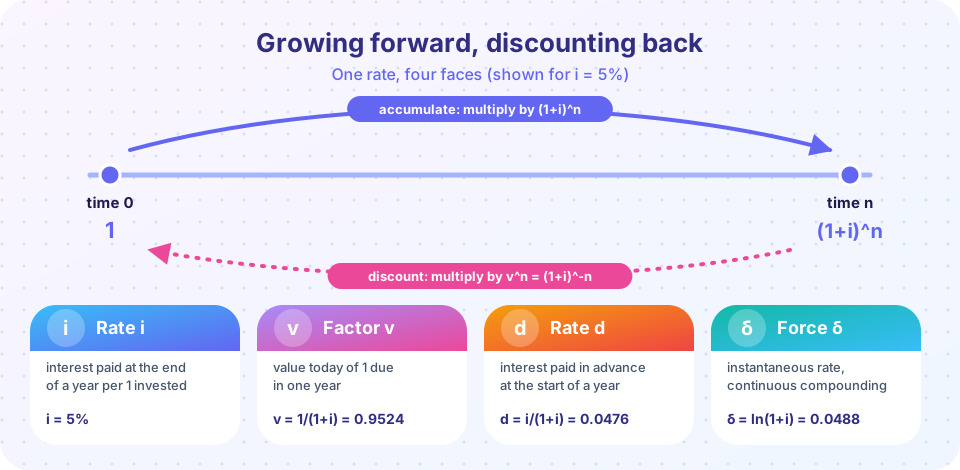
What you will learn
- The relationships among
i,v,danddelta. - How to convert nominal rates (compounded
mtimes a year) to effective rates. - How to find a present value and set up an equation of value.
- Why the force of interest
delta = ln(1 + i)is the continuous version.
Key terms
Effective annual rate i: interest paid at the end of the year, as a proportion of the amount at the start.
Discount factor v: v = 1 / (1 + i), the present value of 1 due in one year.
Effective discount rate d: interest paid at the start of the year, as a proportion of the amount at the end: d = i / (1 + i).
Nominal rate i(m): an annual rate quoted with m compounding periods per year.
Force of interest delta: the instantaneous growth rate, delta = ln(1 + i).
i, v and d
Invest 1 for a year at effective rate i: you have 1 + i at the end. Reverse it: to have 1 in a year you must invest v = 1 / (1 + i) now. The discount earned is 1 - v, and as a rate on the end amount it is d = (1 - v) / 1 = 1 - v. Substituting, d = 1 - 1/(1+i) = i/(1+i). Three equivalent identities follow.
d = i v(interest paid in advance is the end-of-year interest discounted one year).d = 1 - v.i - d = i d(interest at the end of a year differs from interest in advance by the interest on the advance).
Worked example. At i = 6%: v = 1/1.06 = 0.943396, d = 0.06/1.06 = 0.056604. Check: 1 - v = 0.056604 ✓ and i d = 0.06 x 0.056604 = 0.003396 = i - d ✓.
An advance rate is natural in some contracts. If someone lends you 1,000 now and you must repay 1,000 in one year, with a discount rate of 5% the lender gives you only 1,000 x (1 - 0.05) = 950 today. The effective interest rate for that deal is 50/950 = 5.26%, which equals d/(1-d).
Nominal rates
A bank quotes 12% per year compounded monthly. This means 1% per month, so 1 grows to (1.01)^12 = 1.126825 in a year. The effective annual rate is 12.6825%, higher than the nominal 12%.
In general a nominal rate i(m) compounded m times a year gives
1 + i = (1 + i(m)/m)^m.
To go the other way, i(m) = m x ((1 + i)^(1/m) - 1). For a nominal discount rate compounded m times a year, 1 - d = (1 - d(m)/m)^m. Notice the family tree: i(1) = i, and as m grows i(m) falls towards delta = ln(1 + i), the continuous limit.
Press Run (or Ctrl + Enter) to see the result here.
Program input · what you'd type while the program runs
Type the answers before you press Run, one per line. Each time the program reads a line (with input()), it gets the next line from this box.
The table below shows the ordering you should expect for the same effective rate. It is a quick sanity check on any answer.
| Quantity | Meaning | Order (for i = 6%) |
|---|---|---|
i |
interest at end of year | 0.060000 |
i(2), i(12) |
compounded more often, nominal rate lower | 0.059126, 0.058411 |
delta |
continuous limit | 0.058269 |
d(12), d(2), d |
advance rates, lower still | d = 0.056604 |
For any effective rate i > 0: d < delta < i, and i(m) decreases towards delta as m grows, while d(m) increases towards delta.
Force of interest
Let A(t) be the accumulation function. The force of interest at time t is the proportional rate of growth at that instant:
delta(t) = A'(t) / A(t).
For compound interest at a constant effective rate, A(t) = (1+i)^t and A'(t) = (1+i)^t ln(1+i), so delta = ln(1 + i), a constant. Conversely, A(t) = e^(delta t) and v^t = e^(-delta t). If the force varies, the accumulation is A(t) = exp(integral from 0 to t of delta(s) ds). This is the same structure as the survival function S(x) = exp(-integral of mu) in chapter 3: the force of interest is to money what the force of mortality is to survival. Learn it once and use it twice.
Present values and the equation of value
The present value of a payment C due at time t is C v^t. The present value of several payments is the sum. An equation of value sets the present value of all payments in equal to that of all payments out at a chosen comparison date.
Worked example. At i = 7%, what single payment today is equivalent to 5,000 at the end of year 2 and 8,000 at the end of year 5?
PV = 5000 x 1.07^(-2) + 8000 x 1.07^(-5) = 5000 x 0.873439 + 8000 x 0.712986 = 4367.19 + 5703.89 = 10,071.08.
Worked example (yield). You pay 9,000 today and receive 5,000 after 1 year and 5,000 after 2 years. What yield i makes it fair? Solve 9000 = 5000 v + 5000 v^2, which in v is 5000 v^2 + 5000 v - 9000 = 0. The positive root is v = (-5000 + sqrt(25,000,000 + 180,000,000)) / 10000 = (-5000 + 14,317.8)/10000 = 0.93178, so i = 1/v - 1 = 7.32%.
Press Run (or Ctrl + Enter) to see the result here.
Program input · what you'd type while the program runs
Type the answers before you press Run, one per line. Each time the program reads a line (with input()), it gets the next line from this box.
Common misconceptions
"12% compounded monthly is the same as 12% a year." It earns 12.68% effective, because interest is added each month.
"d is just a smaller version of i." d is a rate on the end amount, i is a rate on the start amount. They are linked by d = i/(1+i) and not interchangeable.
"Present values depend on the order of payments." They depend only on when each payment is made; the sum is the sum.
Check your understanding
Quick check · 5 questions
of 5 answered You scored / 5 · perfect!
-
1. If i = 8%, what is d?
d = i / (1 + i) = 0.08 / 1.08 = 0.074074. (0.9259 is v.) -
2. What is the effective annual rate of 8% per year compounded quarterly?
(1 + 0.08/4)^4 - 1 = 1.02^4 - 1 = 0.082432. -
3. At i = 5% the present value of 1,000 due in 10 years is
1,000 x 1.05^(-10) = 613.91. -
4. For i > 0, which ordering is correct?
i is the largest; delta = ln(1+i) is smaller; d = i/(1+i) is smaller still. Example: 6%, 5.83%, 5.66%. -
5. If delta = 0.05 is constant, then v^10 equals
v^t = e^(-delta t) = e^(-0.5) = 0.6065. Note this equals 1.0513^(-10), not 1.05^(-10): delta = 0.05 corresponds to i = e^0.05 - 1 = 5.13%.
Summary
v = 1/(1+i),d = i/(1+i) = 1 - v = i v, anddelta = ln(1+i).- A nominal rate
i(m)gives1 + i = (1 + i(m)/m)^m; more frequent compounding means a higher effective rate. - For
i > 0:d < delta < i. - The present value of
Cdue attisC v^t; an equation of value equates present values on both sides. - The force of interest
delta(t) = A'(t)/A(t)mirrors the force of mortality coming in chapter 3.
Next: Annuities-certain
Track your progress
Create a free account to tick off lessons and pick up where you left off on any device.
of Actuarial Mathematics lessons completed