


















Lesson 9 of 43 · Interest and Annuities
Loans and amortization
Compute level loan payments, outstanding balances and the interest and principal split of each payment, using annuity formulas, with schedules and plots in code.
A mortgage, a student loan, a car finance agreement: each is repaid with a stream of level payments, and each payment does two jobs at once. Part pays the interest owed on the outstanding balance, and the rest reduces the balance (the principal). The process of repaying a debt in installments is called amortization.
This is where the annuity formulas earn their keep. The loan amount is simply the present value of the payments, so the level payment is the loan divided by a_n. Actuaries meet amortization everywhere: policy loans, mortgage-backed assets that insurers hold, and the schedules inside pension funding.
What you will learn
- How to find the level payment for a loan from
L = P a_n. - Two ways to find the outstanding balance, retrospective and prospective.
- How to split a payment into interest and principal, and build an amortization schedule.
- Why the interest share falls over time and total interest is large for long loans.
Key terms
Amortization: repaying a loan in installments that cover interest and reduce principal.
Outstanding balance B_k: the amount still owed just after the k-th payment.
Principal repaid: the part of a payment that reduces the balance.
Prospective method: balance = present value of the remaining payments.
Retrospective method: balance = accumulated loan minus accumulated payments.
The level payment
A loan L is repaid by n level payments of P, one at the end of each year, at effective rate i. The loan equals the present value of the payments:
L = P a_n, so P = L / a_n.
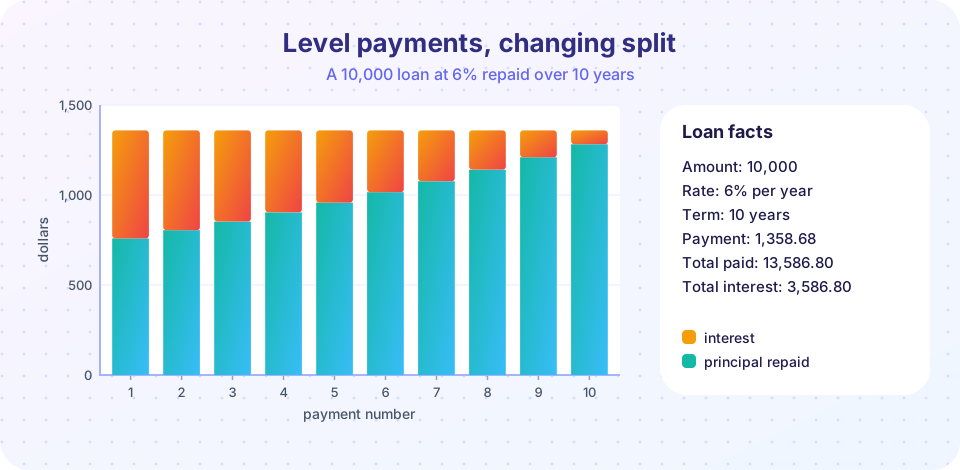
Worked example. L = 10,000, i = 6%, n = 10. We have a_10 = (1 - 1.06^(-10))/0.06 = 7.36009, so P = 10,000/7.36009 = 1,358.68. The borrower pays 10 x 1,358.68 = 13,586.80 in total, of which 3,586.80 is interest.
Outstanding balance
After k payments, n - k payments remain. By the prospective method the balance is the present value of what is still to be paid:
B_k = P a_(n-k).
By the retrospective method, B_k = L (1+i)^k - P s_k: the original loan accumulated, minus the payments accumulated. The two always agree because L = P a_n. In the example after 5 payments, B_5 = 1,358.68 x a_5 = 1,358.68 x 4.21236 = 5,723.2. You can see why the prospective method is popular: it needs only the payment and a short annuity.
Interest and principal in each payment
In period k the interest is I_k = i B_(k-1), and the principal repaid is P - I_k, so B_k = B_(k-1) - (P - I_k). The first interest payment is 0.06 x 10,000 = 600, so the first principal repayment is only 758.68. As the balance falls, interest falls and the principal share rises. A useful fact: the principal repaid grows geometrically, PR_(k+1) = PR_k (1+i). That is why the principal bars on the picture rise at a steady percentage rate.
Press Run (or Ctrl + Enter) to see the result here.
Program input · what you'd type while the program runs
Type the answers before you press Run, one per line. Each time the program reads a line (with input()), it gets the next line from this box.
The balance in the last row is zero (to rounding), which is a good check on any schedule you build.
The cost of long loans
Interest is paid on the balance, so a longer term lowers the payment but raises the total interest sharply. A mortgage of 200,000 at a nominal 5% a year with monthly payments: over 15 years the payment is about 1,581 a month and total interest about 84,700; over 30 years the payment falls to about 1,074, but total interest is about 186,500. The interactive tool below lets you explore this trade-off. It divides the nominal annual rate by 12 to get the monthly rate.
Sinking funds, briefly
An alternative to amortization is a sinking fund: the borrower pays only the interest each year and separately saves a level amount into a fund that will accumulate to the loan at the end. If the fund earns a lower rate than the loan costs, it is more expensive than amortizing. Bonds are often repaid this way. The calculations use s_n at the sinking-fund rate.
Try it: balance and split in a picture
Plot the balance and the interest versus principal for a loan, and watch the crossover when principal overtakes interest.
Press Run (or Ctrl + Enter) to see the result here.
Program input · what you'd type while the program runs
Type the answers before you press Run, one per line. Each time the program reads a line (with input()), it gets the next line from this box.
Common misconceptions
"Half the balance is gone after half the term." On a 10-year 6% loan the balance after 5 years is about 5,723, more than half. Early payments are mostly interest.
"The interest in each payment is constant." It falls every period because it is computed on a shrinking balance.
"Total interest is proportional to the term." It grows faster than proportionally because the balance stays high for longer.
Check your understanding
Quick check · 5 questions
of 5 answered You scored / 5 · perfect!
-
1. A loan of 20,000 at 5% is repaid with 4 level year-end payments. a_4 = 3.54595. The level payment is about
P = L / a_4 = 20,000 / 3.54595 = 5,640.2. -
2. Which formula gives the outstanding balance after k payments by the prospective method?
After k payments, n - k remain, and the balance is their present value. -
3. The first payment of a 10,000 loan at 6% is 1,358.68. How much of it is principal?
Interest in period 1 is 0.06 x 10,000 = 600, so principal is 1,358.68 - 600 = 758.68. -
4. How does the principal portion of successive level payments change?
Because the interest portion falls by i times the principal repaid, the principal portion grows by the factor (1 + i) each period. -
5. Lengthening the term of a loan at the same rate
Smaller payments mean the balance falls more slowly, so more interest accrues overall.
Summary
- A loan equals the present value of its payments:
L = P a_n, soP = L / a_n. - The balance after
kpayments isP a_(n-k)(prospective) orL(1+i)^k - P s_k(retrospective). - Interest in period
kisi B_(k-1); principal is the rest of the payment and grows by(1+i)per period. - Long loans carry far more total interest than short ones.
Next: Chapter 2 review
Track your progress
Create a free account to tick off lessons and pick up where you left off on any device.
of Actuarial Mathematics lessons completed