


















Lesson 20 of 43 · Life Insurance Benefits
Chapter 4 review: Life insurance benefits
A one-page recap of whole life, term, endowment and annuity APVs and their identities, with a self-checking calculator and a mixed ten-question quiz.
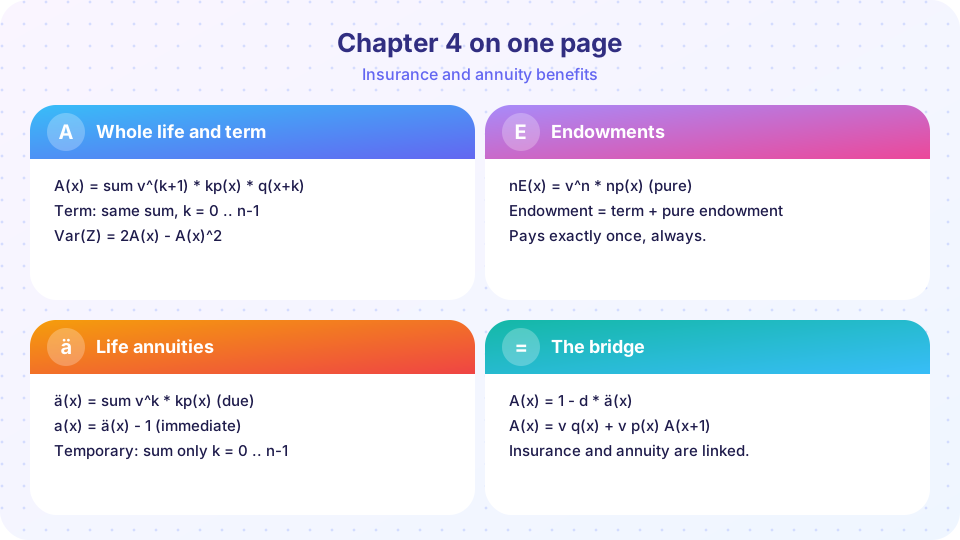
You can now price a life insurance, a pure endowment, an endowment and a life annuity from a survival model and an interest rate. All four are the same recipe: payment times discount factor times probability, summed over the possible times. This review gathers the formulas, links them, and tests them.
What you will learn
- How all the benefits of the chapter derive from one recipe.
- The identities that let you compute one benefit from another.
- Typical mistakes in timing and in age arguments.
Key terms
A x, A^1 x:n: whole life and term insurance APVs. n E x: pure endowment. A x:n: endowment insurance.
ä x, a x: life annuity-due and immediate. n|ä x: deferred annuity.
Z, Y: present value random variables for insurance and annuity.
APV: actuarial present value, E[Z].
The chapter in a table
| Benefit | APV | Key identity |
|---|---|---|
| whole life insurance | A x = sum of v^(k+1) * k p x * q (x+k) |
A x = 1 - d * ä x |
n-year term |
A^1 x:n: the sum for k < n |
A x = A^1 x:n + n E x * A (x+n) |
| pure endowment | n E x = v^n * n p x |
D (x+n) / D x |
| endowment insurance | A x:n = A^1 x:n + n E x |
paid for sure |
| life annuity-due | ä x = sum of k E x |
a x = ä x - 1 |
deferred annuity (starts in n years) |
n E x * ä (x+n) |
pension for a younger life |
| variance | Var(Z) = 2A x - (A x)^2 |
Var(Y) = Var(Z) / d^2 |
| recursions | A x = v q x + v p x A (x+1) |
ä x = 1 + v p x ä (x+1) |
The lessons: whole life and term, endowments and life annuities.
Try it
This calculator checks two identities for any age and interest rate: the link between insurance and annuity, and the decomposition of whole life into term plus deferred whole life.
Press Run (or Ctrl + Enter) to see the result here.
Program input · what you'd type while the program runs
Type the answers before you press Run, one per line. Each time the program reads a line (with input()), it gets the next line from this box.
The second calculator prices a small pension scheme: a group of employees each promised an annuity from 65, to see how the total price depends on the interest rate. It uses the illustrative model and simple invented numbers.
Press Run (or Ctrl + Enter) to see the result here.
Program input · what you'd type while the program runs
Type the answers before you press Run, one per line. Each time the program reads a line (with input()), it gets the next line from this box.
Common misconceptions
Wrong timing. Insurance is paid at the end of the year of death (v^(K+1)); annuity-due payments are at the start of each year (v^k).
Wrong age. In n|ä x, the annuity part uses age x + n.
Forgetting 2A. The second moment is a new APV with v replaced by v^2, not the square of A x.
Check your understanding
Quick check · 10 questions
of 10 answered You scored / 10 · perfect!
-
1. If A x = 0.4 and d = 0.05, what is ä x?
ä x = (1 - A x) / d = 0.6 / 0.05 = 12. -
2. v^n = 0.5 and n p x = 0.8. What is n E x?
n E x = v^n x n p x = 0.4. -
3. A term APV is 0.1 and the pure endowment is 0.5. The endowment insurance APV is
A x:n = A^1 x:n + n E x = 0.1 + 0.5 = 0.6. -
4. If ä x = 12.5, a x equals
a x = ä x - 1 = 11.5. -
5. If 2A x = 0.2 and A x = 0.3, Var(Z) is
0.2 - 0.3^2 = 0.2 - 0.09 = 0.11. -
6. Var(Z) = 0.09 and d = 0.1. What is Var(Y) for the whole life annuity-due?
Var(Y) = Var(Z) / d^2 = 0.09 / 0.01 = 9. -
7. 10 E x = 0.5 and ä (x+10) = 8. The deferred annuity 10|ä x is
n|ä x = n E x * ä (x+n) = 0.5 x 8 = 4. -
8. Which product pays only if the policyholder is alive at the end of the term?
A pure endowment pays nothing on death within the term. -
9. With v = 0.95, q x = 0.1 and A (x+1) = 0.5, what is A x by the recursion?
A x = v q x + v p x A (x+1) = 0.095 + 0.95 x 0.9 x 0.5 = 0.095 + 0.4275 = 0.5225. -
10. With A^1 x:n = 0.05, n E x = 0.6 and A (x+n) = 0.7, what is the whole life APV A x?
A x = A^1 x:n + n E x * A (x+n) = 0.05 + 0.6 x 0.7 = 0.47.
Summary
- Every benefit is a sum of payment x discount factor x probability.
A x = 1 - d * ä x; endowment= term + pure endowment;a x = ä x - 1;n|ä x = n E x * ä (x+n).- Variances:
Var(Z) = 2A x - (A x)^2,Var(Y) = Var(Z) / d^2. - Recursions in age give an efficient way to compute columns of APVs.
- Next chapters turn APVs into premiums and reserves.
Track your progress
Create a free account to tick off lessons and pick up where you left off on any device.
of Actuarial Mathematics lessons completed