


















Lesson 15 of 43 · Survival Models and Life Tables
Chapter 3 review: Survival models
One-page recap of survival functions, force of mortality, life tables, fractional ages and select mortality, with practice calculators and a ten-question quiz.
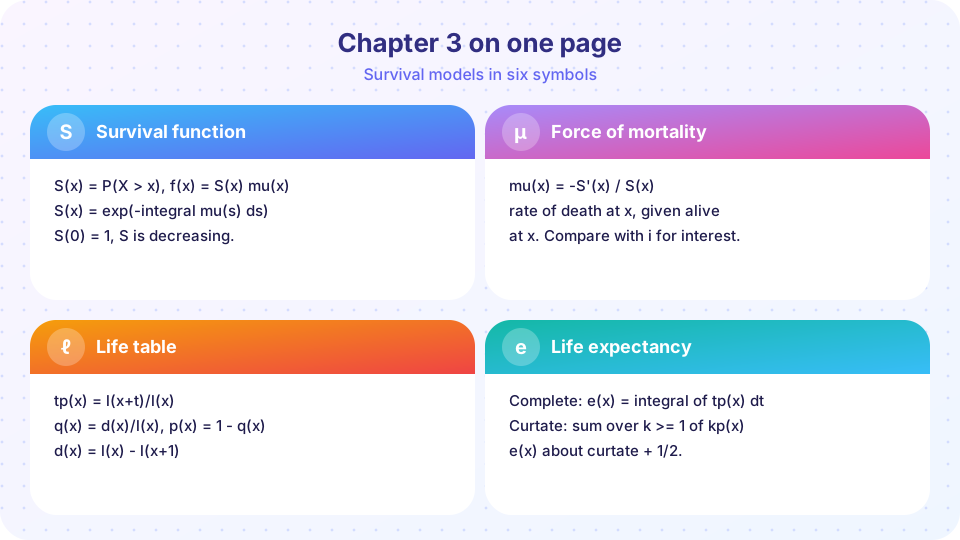
Chapter 3 turned the vague idea of "how long people live" into mathematics you can compute with: a survival function, a force of mortality, a table, and rules for the spaces between whole ages. Chapter 4 multiplies these probabilities by the discount factors of chapter 2 to price insurance, so each formula here will be used again within pages.
What you will learn
- How the survival function, force, density and table are linked.
- Which formula to use for each probability.
- Which assumptions you must state when working between whole ages.
Key terms
S(x), mu(x), f(x): survival function, force of mortality, density of age at death.
t p x, t q x: survive, or die within, t years from age x.
l(x), d(x): survivors and deaths in a life table.
UDD: uniform distribution of deaths within each year of age.
Select period: years after underwriting during which mortality is lower.
The chapter in a table
| Task | Formula |
|---|---|
| from force to survival | S(x) = exp(-integral of mu(s) ds from 0 to x) |
| force from survival | mu(x) = -S'(x) / S(x) |
survive t years |
t p x = S(x+t)/S(x) = l(x+t)/l(x) |
| die in a year | q x = d(x)/l(x) = 1 - p x |
survive t, die in next u |
(l(x+t) - l(x+t+u)) / l(x) |
| complete life expectancy | e x = integral of t p x dt |
| curtate life expectancy | sum over k >= 1 of k p x |
| UDD | s q x = s q x, l(x+s) = l(x) - s d(x) |
| constant force | s p x = (p x)^s |
Lessons: survival function, life tables, select tables and fractional ages.
Try it
Check a hand calculation with a short program. The first example computes the quantities from a tiny hand-made table, the kind of exercise you will meet in exams.
Press Run (or Ctrl + Enter) to see the result here.
Program input · what you'd type while the program runs
Type the answers before you press Run, one per line. Each time the program reads a line (with input()), it gets the next line from this box.
The second example verifies the integral formula for S(x) numerically, a useful habit when you work with a new force of mortality.
Press Run (or Ctrl + Enter) to see the result here.
Program input · what you'd type while the program runs
Type the answers before you press Run, one per line. Each time the program reads a line (with input()), it gets the next line from this box.
Common misconceptions
Dividing by the wrong l. Probabilities for a person aged x divide by l(x).
Confusing force with probability. mu(x) is a rate; q x is a probability.
Forgetting the assumption. Any fractional-age result needs UDD or constant force stated.
Check your understanding
Quick check · 10 questions
of 10 answered You scored / 10 · perfect!
-
1. If mu = 0.03 for all ages, what is 10 p x?
exp(-0.03 x 10) = exp(-0.3) = 0.7408. -
2. Given l(60) = 80,000 and l(70) = 64,000, 10 p 60 is
64,000 / 80,000 = 0.8. -
3. l(50) = 90,000 and l(51) = 89,400. What is q(50)?
d(50) = 600, q(50) = 600/90,000 = 0.006667. -
4. If S(x) = 1 - x/100 for 0 <= x < 100, then mu(40) equals
mu = -S'/S = (1/100) / 0.6 = 1/60 = 0.01667. -
5. With l(40) = 100, l(45) = 95, l(50) = 88 (in thousands), the probability a 40-year-old survives to 45 and dies before 50 is
(95 - 88) / 100 = 0.07. -
6. A cohort has l = 100, 90, 80, 70, 0 at ages x, x+1, x+2, x+3, x+4. The curtate expectation of life at x is
(90 + 80 + 70 + 0) / 100 = 2.4: the sum of l at later ages divided by l(x). -
7. Under UDD with q x = 0.05, the probability of dying within 0.4 years is
s q x = 0.4 x 0.05 = 0.02 under UDD. -
8. Which formula is correct for survival from the force of mortality?
Because mu = -d ln S / dx, so S = exp(-integral of mu). -
9. In a select-and-ultimate table with a 3-year select period, q [x] + 3 is
After the select period, mortality depends only on attained age. -
10. Which statement about T(x) is true?
T(x) is continuous; K(x) = floor(T(x)) is the curtate future lifetime.
Summary
S(x) = exp(-integral of mu);t p x = S(x+t)/S(x);q x = 1 - p x.- A life table gives all probabilities as ratios of
lvalues. - Life expectancy: complete
= integral of t p x, curtate= sum of k p x. - Fractions of a year need UDD or constant force; select tables reflect underwriting.
Track your progress
Create a free account to tick off lessons and pick up where you left off on any device.
of Actuarial Mathematics lessons completed