


















Lesson 21 of 43 · Premiums and Reserves
Premiums and Reserves: Chapter Overview
See the big picture of life insurance pricing: how premiums are set, why a company must hold reserves, and how the next lessons build the machinery.
An insurer promises to pay money in the future and is paid a little at a time in the present. That mismatch is the reason actuaries exist. This chapter answers two questions that follow directly from it: how much should each policyholder pay? (the premium) and how much money must the company hold back today to be able to keep its promises? (the reserve).
Earlier in the course you met survival probabilities, interest and the present value of insurance benefits. Here you put those tools to work on the two numbers that decide whether an insurance company survives. The ideas are simple, but they are used every day by pricing teams, valuation teams and regulators.
What you will learn
- Why premiums are level while risk rises with age, and what that does to the insurer's books.
- How the equivalence principle turns a promise into a price.
- What a prospective reserve is and why it is a liability.
- How the lessons of this chapter fit together.
Key terms
Premium: the payment the policyholder makes, usually level and regular. Benefit: the amount the insurer pays when the insured event happens. Reserve: the amount the insurer holds at a given time for one policy's future obligations. Loss: the benefits paid minus the premiums collected, discounted to a single date. Equivalence principle: set the premium so that the expected value of the loss at issue is zero.
The big picture
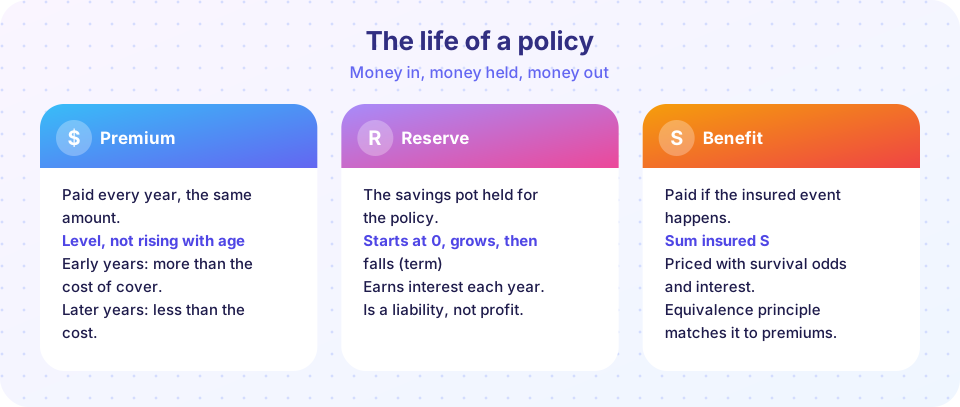
Think of a 40-year-old buying a 20-year term policy. The chance of dying in year one is tiny, the chance of dying in year twenty is several times larger. If the company charged a premium equal to each year's expected cost, the premium would rise every year and become unaffordable just when the policyholder is oldest. So the company charges a level premium. In the early years the premium is more than the cost of cover; in later years it is less.
The early surplus does not belong to shareholders. It is the policyholder's prepayment for the later years, and the insurer must set it aside. That pot is the reserve. Every year the reserve earns interest, receives a premium, and pays for the year's expected claims. At the end of the contract it has to be exactly enough.
Two numbers
Level premium
Equivalence principle
The reserve
What each lesson covers
| Lesson | Question it answers |
|---|---|
| Equivalence principle premiums | How do I turn a benefit promise into a level premium? |
| Prospective reserves | How much must be held at time t, and how does it evolve? |
| Chapter review | A one-page picture and ten mixed questions. |
Try it
The first TryIt draws the hidden story of a level premium: the cost of cover per year rises, the premium stays flat. The invented mortality used here follows a smooth law with one formula (Makeham's law) so that all examples in this chapter can be rerun by you.
Press Run (or Ctrl + Enter) to see the result here.
Program input · what you'd type while the program runs
Type the answers before you press Run, one per line. Each time the program reads a line (with input()), it gets the next line from this box.
Press Run (or Ctrl + Enter) to see the result here.
Program input · what you'd type while the program runs
Type the answers before you press Run, one per line. Each time the program reads a line (with input()), it gets the next line from this box.
Common misconceptions
"The premium is what the policy costs this year." Under a level premium it is an average over the whole contract; most years the premium and the true cost differ.
"The reserve is the insurer's profit." It is a liability: money earmarked for future claims. Profit is what is left after reserves are set.
Check your understanding
Quick check · 4 questions
of 4 answered You scored / 4 · perfect!
-
1. Why is a level premium higher than the cost of cover in the early years?
Mortality cost rises with age, so a flat premium over-collects early and under-collects late. The early surplus is held as reserve. -
2. The reserve held for a policy at time t is best described as
The reserve is the expected present value of future benefits minus the expected present value of future premiums. -
3. The equivalence principle sets the premium so that
Expected present value of premiums equals expected present value of benefits (before expenses and profit loadings). -
4. If interest rates rise and nothing else changes, the premium for a term policy
Higher interest lowers the present value of the benefits more than it lowers the annuity of premiums, so the net premium falls.
Summary
- A premium buys protection spread over time; the reserve is the savings pot that makes level premiums possible.
- The equivalence principle prices the promise; the prospective reserve values what is left of it.
- The Makeham law in this chapter is invented for practice, not a real mortality table.
Track your progress
Create a free account to tick off lessons and pick up where you left off on any device.
of Actuarial Mathematics lessons completed