


















Lesson 23 of 43 · Premiums and Reserves
Prospective Reserves
Learn how insurers value a policy after issue: prospective and retrospective reserves, the recursion for rolling them forward, and the net amount at risk, with code.
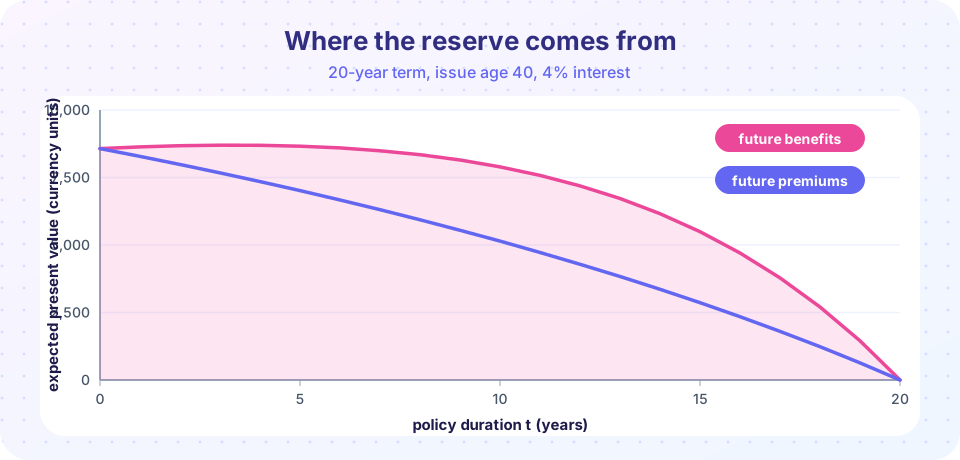
On the day a policy is issued, the equivalence principle makes the expected loss zero, so nothing needs to be held beyond the first premium. One year later the situation has changed: the insured is a year older, the cheap years are behind, and the expensive years are ahead. If the premium is level, the insurer is now holding more promises than it will receive premiums for. The difference is the policy reserve.
Reserves matter because they are a company's largest liability. Regulators ask for them, auditors check them, and mistakes in them can make a healthy company look insolvent, or the reverse. This lesson teaches the one formula you need and the neat recursion that connects reserves from year to year.
What you will learn
- Define the prospective reserve and compute it for a term policy.
- Show that the retrospective reserve gives the same number.
- Use the one-year recursion and the net amount at risk.
- Read a reserve curve and explain its shape.
Key terms
Prospective reserve tV: expected present value at time t of future benefits minus expected present value of future net premiums, given the insured is alive.
Retrospective reserve: accumulated premiums minus accumulated cost of cover, per surviving policy.
Net amount at risk: the sum insured minus the reserve at the end of the year, the amount the insurer really risks on a death.
Terminal reserve: the reserve at the end of a policy year, just before the next premium.
Initial reserve: the reserve at the start of a year, after the premium is paid.
The prospective formula
Take the net premium P from the equivalence principle. At time t (policy duration, the insured now aged x + t), the loss from that moment on is the present value of the remaining benefit minus the present value of the remaining premiums. Its expectation is the reserve:
tV = S · A¹(x+t : n−t) − P · ä(x+t : n−t)
For a whole life policy the term subscripts disappear: tV = S · A(x+t) − P · ä(x+t).
Two facts follow immediately.
0V = 0because of the equivalence principle at issue.- For an endowment policy
nV = S(the sum is due) and for a term policynV = 0(the contract has ended).
Between those endpoints the reserve of a term policy typically rises for a while and then falls back to zero, while the reserve of a whole life or endowment policy rises throughout.
Why the reserve is positive
In the two-year example from the previous lesson, P = 236.88, and the second year's expected cost is larger than the premium. At the start of year 2, the future benefit has expected value 100,000 × 0.003 / 1.05 = 285.71 (we use q₁ = 0.003 for an insured alive at time 1) and the future premium has present value 236.88. So 1V just before the second premium is 285.71 − 236.88 ≈ 48.83. You can see that this equals the money that was put aside in year one: premium collected, interest earned and claims paid, per surviving policy.
The retrospective view
Pick the same insurer and watch the money instead of the promise. After t years, the survivors' fund per policy is the premiums accumulated at interest minus the claims paid out, all divided by the number of survivors. Algebraically
tV = ( P · ä(x : t) − S · A¹(x : t) ) / tE_x where tE_x = v^t · l(x+t) / l(x)
For the net premium and the same assumptions, retrospective and prospective reserves are equal. It is a nice check: if your two numbers differ, you have an error. In practice, valuation systems use whichever is easier; prospective is dominant because it needs only the future.
The one-year recursion
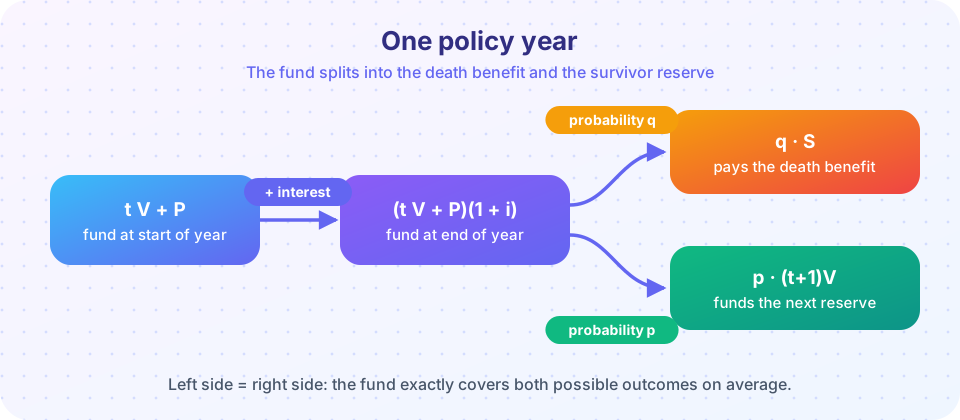
Take a policy at time t with the net premium P just paid. The fund per policy is tV + P. It earns interest to (tV + P)(1 + i). Then either the insured dies (probability q = q(x+t)) and the insurer pays S, or the insured survives (probability p = 1 − q) and the insurer must hold (t+1)V:
(tV + P) (1 + i) = q · S + p · (t+1)V
Older books call this Fackler's recursive formula. Rearrange it and you get the useful decomposition
(tV + P)(1 + i) − (t+1)V = q · ( S − (t+1)V )
The right side contains the net amount at risk S − (t+1)V. The reserve grows by interest and premium, and the part that exceeds what a survivor needs pays the deaths. Actuaries use this to compute mortality profits: if more people die than the table predicts, the company must pay S − (t+1)V extra for each excess death, not the full S, because the reserve for that policy is released.
A closer look at the reserve curve
For a 20-year term policy, the reserve starts at zero, rises through the middle years as the premium exceeds the cost of cover, and falls to zero at the end. At the start the net amount at risk is almost the whole sum insured; near the end it is the whole sum again, because the reserve returns to zero. For a whole life policy bought at age 40 the reserve instead keeps growing, reaching the sum insured only at the end of the mortality table.
This shape is important for two business reasons. First, the reserve shows how much capital the company must keep and invest. Second, if the policyholder lapses, the insurer will often owe a surrender value, which is some fraction of the reserve. Lapsing early costs the policyholder because the reserve (and hence the surrender value) starts at zero.
Try it
The first TryIt computes the reserve curve of a 20-year term and a 20-year endowment, checks the recursion at every duration, and plots the result.
Press Run (or Ctrl + Enter) to see the result here.
Program input · what you'd type while the program runs
Type the answers before you press Run, one per line. Each time the program reads a line (with input()), it gets the next line from this box.
Press Run (or Ctrl + Enter) to see the result here.
Program input · what you'd type while the program runs
Type the answers before you press Run, one per line. Each time the program reads a line (with input()), it gets the next line from this box.
Common misconceptions
"A reserve is a savings account the policyholder can withdraw." It is a statistical average over a group of policyholders held for the company; it is not individually owned, and surrender values are set by contract.
"If the reserve is negative, the company has made a gain." A negative net premium reserve can occur for some contracts (for example when premiums are high early); regulators often require it to be set to zero, because a negative liability would be an unsupported asset.
"Reserves only depend on mortality." They depend equally on the interest rate: a lower valuation rate means higher reserves.
Check your understanding
Quick check · 5 questions
of 5 answered You scored / 5 · perfect!
-
1. At issue, with net premium and the same assumptions for pricing and reserving, the reserve 0V is
The equivalence principle makes the expected loss at issue zero, so the expected future benefits equal the expected future premiums. -
2. For a 20-year term policy, the reserve at the end of the 20th year is
The contract has expired and there are no future benefits or premiums. -
3. In the recursion (tV + P)(1 + i) = q·S + p·(t+1)V, the term q·(S − (t+1)V) is called
The reserve of a person who dies is released, so the extra amount the insurer pays is S minus (t+1)V. -
4. If the valuation interest rate is lowered while mortality and benefits are unchanged, reserves
A lower discount rate raises the present value of future benefits more than that of premiums, so the reserve rises. -
5. The retrospective reserve divides accumulated premiums minus claims by
The fund is shared among the survivors, so you divide by tE_x (accumulation factor with survival).
Summary
- The prospective reserve is
tV = S · A − P · äevaluated at the current age and remaining term. - With the same basis for premium and reserve, prospective and retrospective reserves coincide.
- The recursion
(tV + P)(1 + i) = q·S + p·(t+1)Vlinks reserves year by year and exposes the net amount at riskS − (t+1)V. - Reserves rise with falling interest and are the key liability of a life insurer.
Track your progress
Create a free account to tick off lessons and pick up where you left off on any device.
of Actuarial Mathematics lessons completed