


















Lesson 38 of 43 · Projects and Practice
Project: Price a Term Life Product
A hands-on project: build a net and gross premium for a 20-year term policy, compute reserves, run a profit test and see how mortality and interest assumptions move the result.
In this project you act as a product actuary. Your company wants to launch a 20-year term life policy for 35-year-olds with a sum insured of 250,000. You must pick a premium that is competitive but profitable, compute the reserves the company will hold, and show management what happens if the assumptions turn out wrong.
The project reuses the equivalence principle, the reserve recursion and expense loadings from this course, and adds the practical technique that product teams use every day: the profit test. All figures, including the expense assumptions, are invented for the exercise.
What you will learn
- Build a complete pricing workflow from assumptions to a profit signature.
- Solve for the gross premium that meets a profit target.
- Compute and interpret new business strain and profit by year.
- Test the sensitivity of profit to mortality and investment returns.
Key terms
Pricing basis: the assumptions (mortality, interest, expenses) used to calculate premiums and reserves.
Profit signature: the expected profit emerging in each policy year, per policy issued.
New business strain: the loss in the first year, when commission and set-up costs exceed the premium margin.
Profit margin: the present value of profits divided by the present value of premiums.
Risk discount rate: the return the company requires on capital, used to discount profits.
The brief
| Item | Assumption |
|---|---|
| Product | 20-year term, level annual premium in advance, sum insured 250,000 at end of year of death |
| Age at issue | 35 |
| Pricing mortality | Illustrative Makeham law used throughout the course |
| Pricing interest | 4% (also used for the reserves) |
| Real-world mortality | 90% of the pricing table |
| Real-world investment return | 5% |
| Expenses | First year: 400 plus 30% of premium (commission). Later years: 40 plus 3% of premium |
| Profit target | Present value of profits equal to 6% of the present value of premiums, discounted at a risk rate of 8% |
Step 1 and 2: net premium and reserves
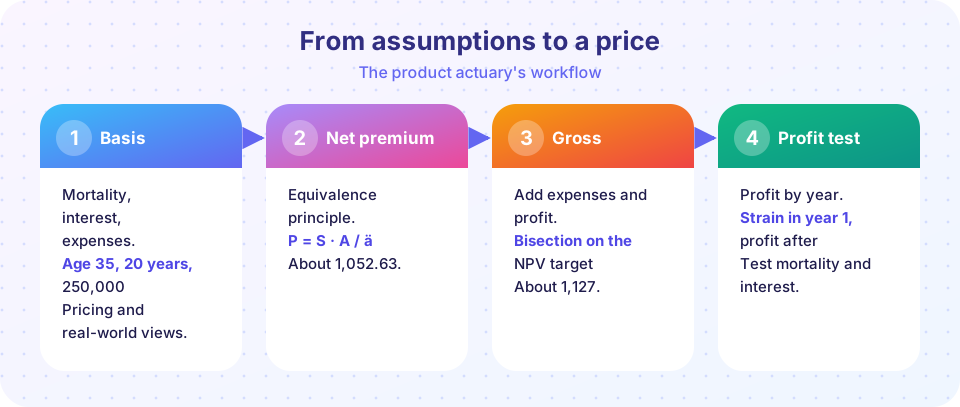
The net premium follows the equivalence principle from the first lesson of this chapter. The code reaches P ≈ 1,052.63. The reserves come from the backward recursion: at the end of the term the reserve is 0, and tV = (q · S + p · (t+1)V)/(1 + i) − P. In this run the reserve is about 553 after one year, 4,316 after ten, and returns to 0 at year 20.
Step 3: gross premium
The gross premium must pay for expenses and deliver profit under real-world assumptions, not the conservative pricing basis. For each year t the profit per policy in force is
Profit_t = (V_t + G − E_t)·(1 + i_actual) − q_actual · S − p_actual · V_(t+1)
where E_t are expenses. Multiplying by the probability that the policy is still in force (using the real-world mortality) gives the profit signature. A bisection search finds the premium G that makes the discounted profit exactly 6% of discounted premiums.
The result in the code is G ≈ 1,127: only about 7% above the net premium, because the company expects 10% lighter mortality than its pricing table and earns 5% rather than 4%.
Step 4: reading the profit test
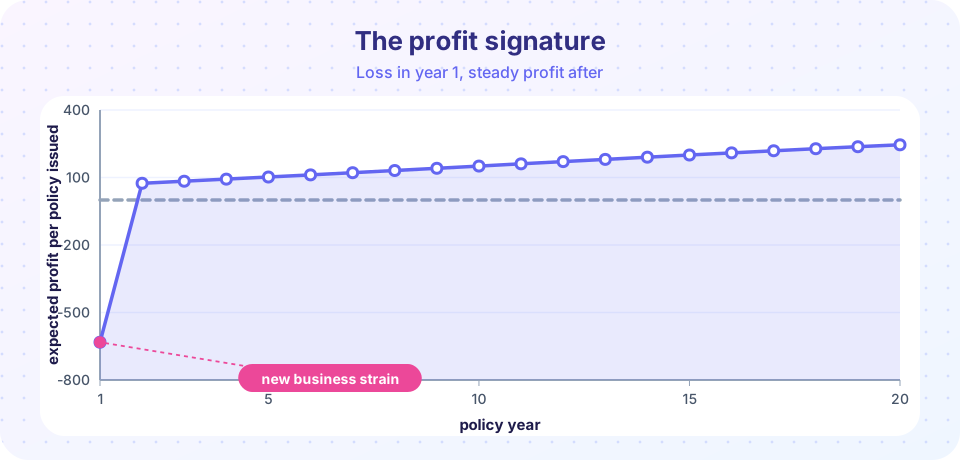
- Year 1: about −632. Commission and set-up costs exceed the premium margin.
- From year 2: positive and growing. The reserves earn more than the pricing rate and mortality is better than priced.
- Net present value: about +702 per policy, a margin of 6% by construction.
The sensitivity runs are the real lesson. At 100% of the pricing mortality (no safety margin) the NPV falls to about −320. At 3% investment return it is about −28. The product is profitable only if the assumptions hold, which is why companies price with explicit margins and monitor experience.
Try it
Press Run (or Ctrl + Enter) to see the result here.
Program input · what you'd type while the program runs
Type the answers before you press Run, one per line. Each time the program reads a line (with input()), it gets the next line from this box.
Press Run (or Ctrl + Enter) to see the result here.
Program input · what you'd type while the program runs
Type the answers before you press Run, one per line. Each time the program reads a line (with input()), it gets the next line from this box.
Common misconceptions
"The profit is the loading in the premium." Profit emerges only if the real experience matches the assumptions; a loading is a cushion, not profit.
"A first-year loss means the product is bad." New business strain is normal for products with heavy up-front commission; what matters is the present value over the policy life.
"Pricing mortality equals expected mortality." Pricing usually contains margins; the real-world basis can be lighter or heavier.
Check your understanding
Quick check · 5 questions
of 5 answered You scored / 5 · perfect!
-
1. New business strain arises because
Commission and set-up costs are paid at issue while the profit margin is spread over many years. -
2. In the profit formula, the term (V_t + G − E_t)(1 + i_actual) is
It is the opening reserve plus premium less expenses, accumulated at the actual earned rate. -
3. In the profit formula, the term q_actual · S is
The probability of death in the year times the sum insured is the expected claim. -
4. A bisection search is used to
The NPV of profit rises with the premium, so bisection finds the premium that hits the target. -
5. Higher assumed commission in the first year will, to meet the same profit target, require
More cost must be recovered from premiums.
Summary
- A pricing project has four steps: basis, net premium and reserves, gross premium, profit test.
- The profit signature shows new business strain and later profits; its present value at a risk discount rate defines the margin.
- Sensitivity runs show how mortality and interest assumptions drive profit.
Track your progress
Create a free account to tick off lessons and pick up where you left off on any device.
of Actuarial Mathematics lessons completed